Anyone who has bought a batch of custom perfume glass bottles only to find hairline cracks, uneven walls, or a diamond-clear sample turning hazy in production has run into the same root cause: furnace temperature. Glass furnace temperature control is the single biggest technical variable in cosmetic glass bottle manufacturing, and it is where the gap between a first-tier factory and a cheap trader’s workshop becomes obvious. This article explains, from a buyer’s perspective, how temperature is managed at each stage of production, what happens when it drifts, and the questions you should ask any supplier before you wire a deposit for your fragrance bottle order.
Why Temperature Matters More in Perfume Glass Than in Other Packaging
Perfume bottles are not ordinary packaging. Compared with a food jar or a cosmetic cream jar, they are smaller, thinner-walled, heavier in decoration, and far more visible to the end consumer. A 0.5 mm variation in wall thickness that nobody would notice on a 500 ml jam jar is immediately visible on a 50 ml fragrance bottle held under store lighting.
Three properties of glass are directly governed by temperature:
- Viscosity. Glass does not melt at a single point; it softens gradually. At 1,540 °C a soda-lime glass batch is fluid enough to feed; around 1,100 °C it is plastic enough to form; below 550 °C it becomes rigid. Every forming step happens in a narrow viscosity window, and that window is set by temperature.
- Homogeneity. The melt must be chemically uniform. Undissolved batch material (seeds, stones, cords) forms when the glass has not been held hot long enough. Inclusions are the #1 cause of rejected bottles in QC and of in-field breakage after filling.
- Internal stress. If a bottle cools unevenly, permanent stress locks into the glass. Stress bottles pass the filling line looking fine and then crack in transit, in the warehouse, or in a customer’s hand. Annealing — the controlled slow cool-down in a lehr — is a pure temperature-management exercise.
For a B2B buyer, the practical takeaway is this: temperature control capability shows up directly in your defect rate, your breakage claims, and your neck-finish consistency with pumps.
Stage 1: Batch Melting in the Furnace
Soda-lime glass — the standard for perfume bottles — is melted from silica sand, soda ash, limestone, and cullet (recycled glass). The furnace typically runs between 1,480 °C and 1,570 °C depending on the color and formulation.
Two furnace types dominate production in China:
- Daily furnaces (pot or small day tanks) are melted and drained within 24 hours. They suit short runs, deep colors, and sampling lots. Flexibility is high, but temperature stability is inherently worse: the furnace is constantly ramping, so glass quality fluctuates more.
- Continuous furnaces run for years without shutting down. They maintain a stable hot zone, deliver far more consistent glass, and are what serious producers use for standard 30–100 ml volume production. A typical unit processes several tons per day.
Temperature is measured continuously with thermocouples in the crown and glass bath, and modern furnaces add optical pyrometers to track the melt surface. Operators watch two things: the target temperature and its drift. A well-run continuous furnace holds within roughly ±5 °C of setpoint; a poorly run one can swing 20–30 °C, which shows up downstream as a changing defect mix across the day.
When you ask a supplier whether your order runs on a daily furnace or a continuous line, you are really asking how stable your wall thickness and clarity will be from the first pallet to the last.
Stage 2: The Forehearth and Gob Formation
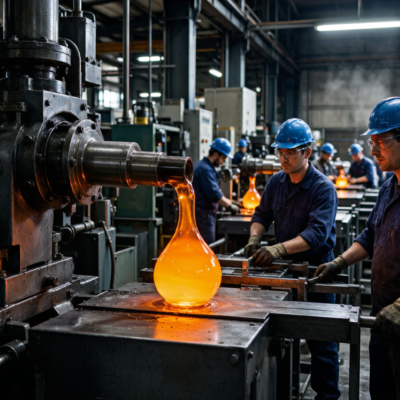
Molten glass leaves the furnace through a throat into the forehearth, a channel that cools and conditions the glass to the exact forming temperature — usually between 1,080 °C and 1,180 °C for small bottles.
At the end of the forehearth, the glass is cut into gobs: a weighted cylindrical slug of glass that will become one bottle. Gob weight and temperature are the two variables that determine every downstream dimension.
- Too hot a gob spreads and folds in the blank mold, causing seams, wrinkles, and thin shoulders.
- Too cold a gob will not distribute, leaving heavy bases, short fills, and chords (glass strings) that weaken the bottle.
- Inconsistent gob temperature across a shift produces the classic buyer complaint: samples approved in pre-production, but mass production with drifting heights and weights.
Good factories control forehearth temperature in independently heated zones — typically three to six zones — each with its own thermocouple and closed-loop control. Ask a prospective supplier how many zones their forehearth has and how often operators log gob weight. A factory that weighs gobs hourly and records them has process discipline; one that does not is relying on luck.
Stage 3: Forming on the IS Machine
Perfume bottles are formed on IS (Individual Section) machines, where each gob drops into a blank mold, is pre-shaped into a parison, then transferred to a blow mold for final shape. The two common processes are press-and-blow (better wall distribution for heavy, decorative bottles) and blow-and-blow (faster, used for simpler shapes).
Temperature enters at every point here:
- Mold temperature. Molds are held around 450–550 °C and internally cooled. If the mold runs hot, glass sticks and seams distort; if too cold, the surface texture roughens and check marks (tiny surface cracks) appear.
- Neck ring temperature. The neck ring forms the bottle’s finish — the threaded or crimp neck that receives the pump. This is the most dimension-critical feature on the entire bottle. Neck ring temperature deviations of even 10–15 °C change the finished neck diameter enough to cause pump fitment failures. If you have ever experienced pumps that will not crimp or leak after filling, trace it back here.
- Reheat in the parison. The outside of the parison cools in the blank mold, then is reheated by its own interior before final blow, which evens wall thickness. Timing here is machine speed dependent — rushing cycle time to hit quota shortens reheat and produces uneven walls.
This is also why mold design and machine setup are inseparable. The same 50 ml bottle geometry may need different gob weights and timing curves on different machines. If you want a deeper technical walkthrough of the forming process itself, our guide to how perfume glass bottles are made covers the full sequence step by step.
Stage 4: Annealing — The Step Buyers Forget to Ask About
A freshly formed bottle leaves the machine at roughly 500–600 °C with severe internal stress. It goes straight into the annealing lehr, a long tunnel kiln that first reheats the glass to just above its stress-relief point (around 540–560 °C for soda-lime), then cools it along a programmed curve over 30–90 minutes.
The cooling curve is the whole game. Cooling too fast leaves stress; the glass may look perfect but will fail impact and thermal-shock tests. The rate is not uniform either: it must be slow in the critical range (roughly 560–450 °C) and can be faster afterward. Lehr zone temperatures are logged continuously, and a professional run includes polariscope stress checks on sampled bottles at the exit.
If your supplier cannot tell you their annealing curve for your bottle geometry, or cannot produce stress-check records, treat that as a red flag. Stress-related breakage rarely appears at the factory — it appears at your filling line or in your customer’s hands, which is the most expensive place to discover it.
What Goes Wrong When Temperature Drifts
For procurement teams, the value of understanding furnace control is knowing which defects trace back to it and what they cost you. The common failure signatures:
| Defect | Temperature Cause | Business Impact |
|---|---|---|
| Stones / inclusions | Melt too cold or insufficient residence time | Rejections at filling; glass particles risk |
| Seeds (bubbles) | Incomplete fining; melt not held hot long enough | Visual rejection, especially in clear glass |
| Cords / striations | Poor glass homogeneity | Weak points, optical distortion in flint glass |
| Wall thickness variation | Gob temperature drift across the shift | Weight inconsistency, leaning bottles, fragile zones |
| Neck dimensional drift | Neck ring temperature variation | Pump leakage, crimping failures |
| Haze / surface bloom | Mold too cold or devitrification window | Dull appearance, rejected by brand QC |
| Stress cracks | Bad annealing curve | Breakage in transit and after filling |
Every one of these defects is cheaper to prevent in the furnace than to discover in a container. A container of 40,000 bottles rejected at your filling plant means re-production lead time of 25–35 days on top of freight both ways.
How Buyers Can Verify a Supplier’s Temperature Discipline
You do not need to be a glass engineer to audit this. Use these six questions and checks during supplier qualification or when comparing quotes that look suspiciously different in price:
- Furnace type and age. Ask: continuous or daily furnace? How many tons/day? Continuous lines with documented maintenance history are the safer bet for volume orders.
- Control system. Is the furnace PLC-controlled with closed-loop zones, or manually fired? Manual firing means human-dependent consistency.
- Data logging. Ask to see a sample temperature log sheet or screen from a recent run. Factories that log and review data will produce your repeat orders identically.
- Gob weight checks. How often is gob weight measured, and what tolerance do they commit to? A ±1 g commitment on a 100 g gob is a serious factory; “we check visually” is not.
- Stress testing. Does QC run polariscope stress inspection per batch, and will they include stress-test records with your shipment documentation?
- First-article protocol. Insist that pre-production samples and mass production come from the same furnace and same forehearth zone. Samples made on a daily furnace then mass-produced on another line is a common source of “samples were perfect, production was not.”
Third-party verification also helps. Factories certified under ISO 9001 quality management 9001 quality management are required to control and monitor process parameters like temperature with documented procedures — it is a reasonable proxy for process discipline, though you should still ask the questions above directly.
The Cost Angle: Why Cheaper Quotes Sometimes Mean Looser Temperature Control
There is a reason two quotes for the same 50 ml bottle can differ by 15–20%. Fuel, furnace size, scrap rate, and cycle time all feed unit cost, and all of them are temperature-linked. A factory pushing the furnace hotter to melt faster, running molds at maximum machine speed, or skipping stress checks can quote lower — the savings come out of consistency, and the cost lands on you as claims and re-orders.
A practical middle path: for your core selling SKU, pay for a factory with a continuous furnace and documented control. For seasonal or low-risk items, a well-run daily-furnace shop can be perfectly acceptable — just order a larger oversupply percentage (typically 5–8% spares instead of 3%) and tighten incoming inspection.
FAQ
How precise is furnace temperature control in a professional glass plant?
A modern continuous furnace with closed-loop control holds melt temperature within roughly ±5 °C of setpoint, and forehearth zones within ±2–3 °C. Manual or aging daily furnaces can swing 20 °C or more, which directly translates into dimensional and quality variation across your production run.
Which temperature-related defect is most expensive for a buyer?
Stress cracks from poor annealing. The bottles pass factory QC looking perfect, then break during transit, filling, or retail handling — often after you have paid freight and filled them with product. It is the hardest defect to catch early and the most expensive to remediate.
Can I request temperature and QC records with my shipment?
Yes, and you should. Reputable perfume bottle factories can provide batch QC reports including temperature logs, gob weight records, and polariscope stress-check results. Make this a line item in your purchase agreement rather than an informal request.
Does deep-colored glass need different temperature control than clear flint glass?
Yes. Colored glass (amber, cobalt, opaque white) changes melt behavior, fining time, and heat transfer, so forming and annealing curves are adjusted per color. This is why color changes on the same mold are treated as a new process trial, not a trivial switch — expect a fresh sample round.
What tolerance should I specify for neck finish dimensions?
For standard crimp (FEA 13/415, 15/415, 18/415) and screw finishes, work with your pump supplier’s drawing and hold critical diameters to roughly ±0.2 mm. Neck dimensions are formed by the neck ring at very specific temperatures, so hold the factory to first-article measurement and periodic in-run checks rather than relying on end-of-line sampling alone.