Perfume bottle mold cost is usually the first real number that makes a buyer pause. A custom shape sounds exciting until the tooling quote lands. At Huanshi, we send mold quotes almost daily, and the range still surprises people. A simple 50ml round bottle might start around $2,800. A complex sculptural design with multiple facets can climb past $12,000. The gap is real. It comes from cavity count, material choice, machining time, and finish complexity.
In this guide, I’ll walk through what drives perfume bottle mold cost, how factories quote it, and where you can save money without ending up with a bottle that looks cheap. If you’re planning a custom launch, this is the number you need to understand before you sign anything.
What a Perfume Bottle Mold Actually Is
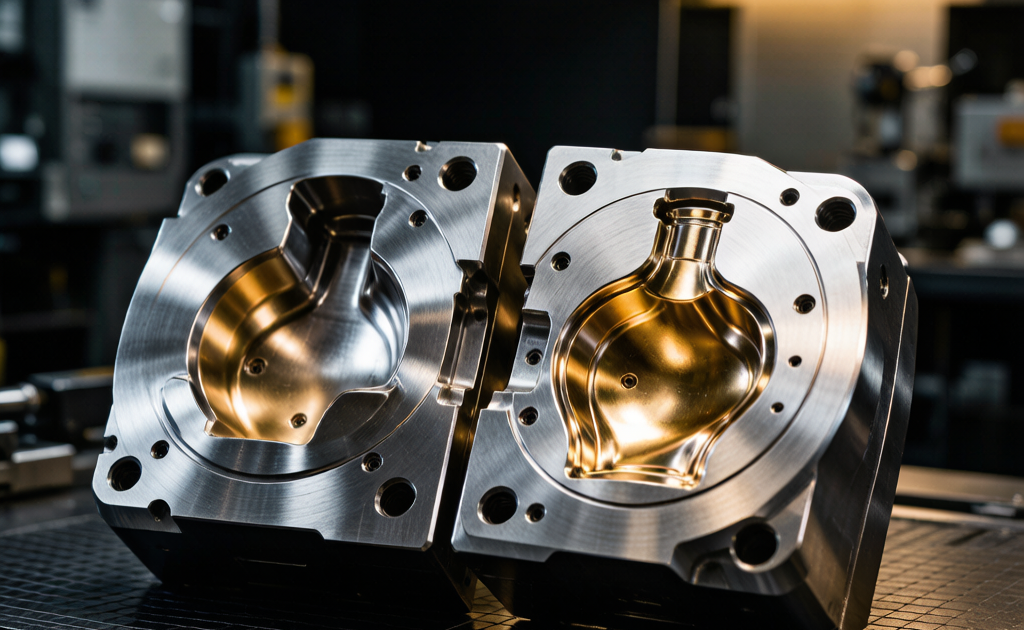
A mold for a glass perfume bottle is a set of metal blocks, usually cast iron or stainless steel, machined to form the external shape of the bottle when molten glass is blown inside. The mold splits into two or more sections so the finished bottle can be released. For complex shapes, the mold can have three or four parts.
The bottle’s shoulder, neck finish, base curve, and wall thickness all come from the mold. If the mold is off by even 0.5mm, the pump won’t fit, the cap threads poorly, or the bottle leans on a shelf. In our factory, we always say the mold is 70% of the quality battle. The rest is glass composition and annealing.
Here’s the thing: a mold isn’t a one-time throwaway tool. A well-made iron mold can produce 200,000 to 400,000 bottles before it needs resurfacing. Steel molds last longer, often 600,000 or more, but cost roughly 40% more upfront. For most perfume brands, cast iron is the sensible starting point.
How Mold Cost Breaks Down
Suppliers don’t always show every line item, but the total usually hides these components:
| Cost Component | Typical Range | Notes |
|---|---|---|
| 3D modeling and CAD | $300–$800 | Often free if you order the mold |
| CNC machining | $1,200–$4,500 | Depends on cavity count and shape |
| Cavity inserts | $600–$1,500 each | More cavities = higher output per cycle |
| Surface finish / texture | $400–$1,200 | Matte, satin, patterned finishes |
| Mold base and assembly | $500–$1,000 | Standard frames cost less |
| Trial runs and adjustments | $300–$900 | Usually 2–3 rounds |
| Total simple mold | $2,800–$5,500 | Round or cylindrical shapes |
| Total complex mold | $7,000–$15,000+ | Sculptural, faceted, multi-part |
The biggest variable is cavity count. A single-cavity mold produces one bottle per cycle. A double-cavity mold produces two. The machine cost per bottle drops, but the mold price rises by 60–80%. For a first order, single cavity is almost always the right call. You can upgrade later once sales prove the shape.
If you want to understand what happens inside the factory before the mold even matters, read our article on how perfume glass bottles are made. It covers blowing, pressing, and annealing in plain terms.
Why Shape Complexity Matters So Much
A plain cylinder is easy to machine. The CNC head moves in clean arcs. The mold splits cleanly down the middle. A faceted bottle, on the other hand, creates undercuts. Undercuts need multi-part molds or collapsible cores. Each extra part adds machining hours and assembly risk.
Deep embossing also costs more. Raised logos, floral patterns, or textured grips require electrode discharge machining (EDM), which is slower than standard CNC. A textured base adds another $400 to $800. Sharp internal corners are particularly tricky because glass doesn’t flow well into tight angles. We often round them slightly to avoid weak spots.
Let’s be real: some of the most beautiful perfume bottle designs on Pinterest would cost $30,000 to mold. The ones that actually ship are usually simplified versions. A good designer knows where to keep drama and where to compromise.
Material Choice: Cast Iron vs. Stainless Steel vs. Aluminum
Most perfume bottle molds use either cast iron or stainless steel. Aluminum molds exist, but they’re rare for glass because the thermal cycling and pressure wear them out too fast.
| Material | Mold Cost | Lifespan | Best For |
|---|---|---|---|
| Cast iron | Lower | 200k–400k bottles | Standard production, first runs |
| Stainless steel | +40% | 600k–1M bottles | High volume, fine detail |
| Beryllium copper inserts | +60% on inserts | Extended cooling zones | Thick-walled bottles |
For a brand planning 50,000 units over two years, cast iron is fine. For a brand moving 500,000 units annually, stainless steel pays back quickly. We typically recommend cast iron for the development mold and steel for the production mold once the shape is locked.
Hidden Costs Buyers Forget
The quoted mold cost isn’t always the final number. Watch out for these extras:
- Artwork revisions: Changing the CAD after machining starts can cost $500–$1,500 per revision.
- Matching cap mold: If your cap is custom too, add $1,800–$4,000.
- Prototype samples: Mold trial samples are usually free, but express shipping can be $150–$400.
- Mold storage: Some factories charge $50–$150 per year to store your mold. We don’t, but it’s worth asking.
- Mold export: If you ever want to move production, shipping a mold overseas can cost $800–$2,000 plus customs.
In our experience, the most expensive mistake is rushing the design phase. A shape that looks good in render but fails in glass means a full remake. We’ve seen brands spend $9,000 twice because they skipped the prototype step.
Can You Avoid Mold Cost Entirely?
Yes, but your shape options shrink. Stock molds are pre-made shapes that any customer can use. At Huanshi, we keep a catalog of roughly 120 stock perfume bottle shapes across 30ml, 50ml, and 100ml sizes. Custom decoration still lets you create a unique brand look without paying for tooling.
Private label brands often start with stock molds. Luxury houses almost always pay for custom molds. The decision point is usually volume and positioning. If you’re testing a market, stock makes sense. If you’re building a signature silhouette, custom is the only way.
Timeline: From Drawing to First Bottle
A typical mold timeline looks like this:
- Artwork and CAD approval: 5–7 days
- CNC machining: 10–15 days for simple molds, 20–30 for complex
- First trial and sample shipment: 5–7 days
- Adjustments: 3–7 days per round
- Production approval: 2–3 days
Total: 3 to 6 weeks. Rush jobs can compress this to 18 days, but the premium is usually 20–30%. I don’t recommend rushing unless you truly have no choice.
How to Reduce Mold Cost Without Sacrificing Quality
Here are five practical ways we’ve seen brands save money:
- Start with a single cavity. You can always add cavities later.
- Use a stock neck finish. Custom neck threads require matching cap tooling.
- Avoid deep undercuts. Keep the shape mold-friendly.
- Limit texture to one panel. Full-body texture adds machining time.
- Order the mold from the factory that will run production. Splitting mold and production between suppliers almost always creates fit issues.
The truth is, the cheapest mold is rarely the best deal. A poorly machined mold produces rejected bottles, inconsistent wall thickness, and cap-fitting problems. Those costs show up later in complaints and returns.
What to Ask Before You Pay
Before sending the deposit, ask your supplier these questions:
- Is the mold cost refundable against future orders?
- What material is the mold made from?
- How many cavities does it have?
- What is the expected mold life?
- Who owns the mold?
- Where will it be stored?
- How many free sample rounds are included?
- What happens if the first samples fail to match the drawing?
At Huanshi, our standard terms include full mold ownership for the client, two free revision rounds, and mold storage at no charge. We also refund 50% of the mold cost against orders totaling 100,000 pieces. Not every supplier offers the same, so compare carefully.
Conclusion
Perfume bottle mold cost ranges widely, but it follows a clear logic. Shape complexity, cavity count, material, and finish drive the price. For most custom launches, expect to spend $3,000 to $8,000 on the first mold. Plan for revisions. Avoid rushing. And treat the mold as a long-term asset, not a one-time fee.
If you’re exploring a custom perfume bottle, send us your sketch or reference photo. We’ll review moldability, quote the tooling, and tell you honestly whether a stock shape can get you 90% of the look at zero mold cost. That’s a conversation worth having before you write the check.
—
Meta Description: Learn what drives perfume bottle mold cost in 2026. Break down tooling prices, materials, cavity count, hidden fees, and smart ways to save on custom glass molds.
Tags: perfume bottle mold cost, custom perfume bottle mold, glass bottle mold price, perfume bottle manufacturer, custom glass bottle tooling