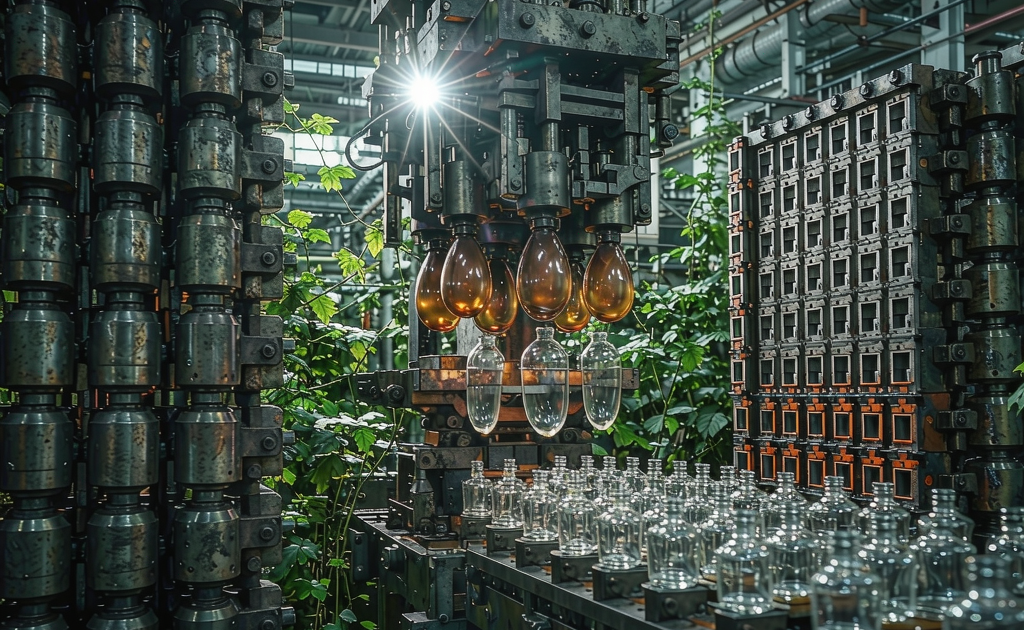
Every mass-produced custom perfume glass bottle on a retail shelf today was shaped by an IS machine — the Individual Section machine that has been the workhorse of glass forming for nearly a century. For a packaging buyer, understanding IS machine perfume bottle forming is not academic curiosity: machine type, mold count, and process choice determine your unit price, lead time, design freedom, and how faithfully your mass production matches the sample you approved. This guide walks through the forming process from a procurement perspective, explains the vocabulary you will hear in factory calls, and shows where forming decisions quietly affect your landed cost.
What an IS Machine Actually Is
IS stands for Individual Section. An IS machine is built from identical, self-contained forming sections arranged in a line — commonly 4, 6, 8, or 10 sections. Molten glass arrives from the forehearth as gobs, and a distribution system (a rotating scoop-and-chute mechanism) routes each gob into one section. Each section cycles independently, which is the machine’s defining advantage: if one section develops a problem, it can be stopped and serviced while the others keep producing.
Key terms worth knowing before your next supplier call:
- Sections / cavities: Each section can hold one or two (sometimes three) molds. A 6-section double-gob machine runs up to 12 bottles per cycle. More cavities means lower unit price but tighter requirements on gob and mold consistency.
- Blank mold and blow mold: The blank mold creates the parison (pre-shape); the blow mold gives the final shape.
- Neck ring and plunger: Form the finish — the critical neck that accepts the pump or cap.
- Take-out tongs: Move the hot bottle to the dead plate and cooling pocket, then into the annealing lehr.
When a factory says “we run your 50 ml bottle on an 8-section double-gob line,” they are telling you their scale and, indirectly, your price tier.
The Two Forming Processes: Press-and-Blow vs Blow-and-Blow
There are two ways to form a narrow-neck bottle from a gob, and the choice matters for cosmetic glass.
Blow-and-blow (BB). Compressed air first blows the gob into the parison in the inverted blank mold, then the parison is flipped and blown again into the final shape. BB is fast and economical, and works well for simpler, thinner bottles. Its weakness is wall distribution: glass follows gravity and air pressure, so heavy decorative bases and thick shoulders are harder to control.
Press-and-blow (PB). A metal plunger presses the gob into a parison in the blank mold, giving precise glass placement; the parison is then blown to final shape in the blow mold. PB delivers far better wall distribution and weight control, which is why nearly all premium perfume bottles — the ones with heavy bases, thick walls, and sculptural shoulders — run on press-and-blow. The trade-off is slower cycle time and higher tooling cost.
Narrow-neck press-and-blow (NNPB) is the modern variant that allows PB-style precision on bottles with long, narrow necks — exactly the geometry of most fragrance bottles. NNPB is what enables today’s lightweight-but-consistent cosmetic glass bottle designs and tight neck tolerances.
As a buyer, the question “will this run press-and-blow or blow-and-blow?” translates directly into: how consistent will my wall thickness and weight be, and how heavy can my design actually be? If your design brief says “heavy base, minimum 380 g,” and the supplier plans BB, expect trouble.
Step by Step: One Cycle of a Perfume Bottle
A full forming cycle runs roughly 6–14 seconds depending on size and process. Here is what happens inside that window:
- Gob delivery. The gob cutter shears a calibrated slug of glass (temperature ~1,080–1,150 °C) and the delivery chute drops it into the blank mold. Gob weight is set to gram-level precision — it plus mold geometry determines the finished bottle weight.
- Parison formation. In PB, the plunger presses the glass against the blank mold walls. The neck ring, sitting on top, forms the finish simultaneously. This is the only moment the finish is ever shaped — everything downstream is inherited from it.
- Invert and reheat. The parison is flipped 180° into the blow mold position. Its outer skin has cooled; the still-liquid interior reheats the skin, evening it out for final blowing.
- Final blow. Compressed air expands the parison against the blow mold walls. Mold venting matters here: trapped air causes dimples and incomplete detail, which matters enormously if your design has embossed logos or faceted surfaces.
- Cooling and take-out. The bottle stiffens against the mold (molds internally cooled around 450–550 °C), tongs take it out, and it passes through a cooling pocket before the lehr. The bottle is still around 500 °C and glowing faintly as it enters annealing.
Step 3 is the subtle one worth remembering: the same design run at different machine speeds produces different wall distributions, because reheat time changes. If your factory raises machine speed mid-order to catch up on schedule, your later cartons may not match the earlier ones. Professional plants lock speeds for the run; it is a fair thing to ask about.
Mold Tooling: What You Are Actually Paying For
When you pay mold fees for a custom bottle — typically USD 800–2,500 per mold set depending on complexity — you are buying precision-machined tooling for several components:
- Blank mold (parison cavity, often cast iron with specific alloys for surface life)
- Blow mold (defines your visible design; can be cast iron, bronze, or steel, with different texture capabilities)
- Neck ring set (forms the finish; the highest-wear item and the most tolerance-critical)
- Plunger (PB/NNPB only; shapes the interior)
- Baffle and funnel (seal the blank mold and guide the gob)
Two practical consequences for buyers. First, mold quality shows up as seam quality: premium perfume bottles have near-invisible parting lines, and achieving that requires tight mold maintenance, not just good design. Second, molds are single-cavity or multi-cavity. A one-cavity mold produces one bottle per cycle — fine for sampling and short runs, slow and costly per unit for volume. If your forecast is real, discuss multi-cavity tooling: it raises mold cost but can cut unit price 10–20% and shorten lead time materially. Our detailed breakdown of perfume bottle mold cost covers the fee structure and when multi-cavity pays for itself.
How Machine Choice Shapes Your Unit Economics
The forming line configuration drives three numbers in your quote:
- Cycle time × cavities = output. A 6-section double-gob PB line producing a 50 ml bottle every ~12 seconds at 12 cavities yields roughly 3,600 bottles/hour. A single-cavity sampling line yields a few hundred. Volume production on serious lines is why Chinese factories can quote aggressive unit prices at 10,000+ piece MOQs.
- Wall distribution → weight. PB/NNPB lets engineers shave glass weight while keeping strength. On a 100,000-piece order, dropping 25 g of glass per bottle saves over 2.5 tons of material — savings that get shared with you in the price.
- Scrap rate. Machine-formed bottles average 92–97% first-pass yield depending on design complexity. Faceted, heavily embossed designs sit at the low end. Quotes that ignore scrap allowances tend to come with quality surprises instead.
When comparing two factories, ask each what machine configuration (sections, gob count, PB or BB) they plan for your SKU. Identical designs on different configurations legitimately produce different prices — and different quality levels.
What Can Go Wrong at the Forming Stage
Forming defects have distinct signatures, useful both for incoming inspection and for holding suppliers accountable:
- Seams / parting lines: Worn molds or misaligned mold halves. Visible on premium clear glass, grounds for rejection.
- Check marks (small surface cracks): Bottle contacted cold metal during take-out — mold temperature or timing fault.
- Thin shoulders / heavy base: Poor parison design or rushed reheat. Weak spot under pump torque.
- Uneven finish: Neck ring wear or temperature drift — the direct cause of leaking pumps.
- Stuck glass / mold marks: Overheated molds; usually fixed with mold cleaning and cooling adjustment.
- Embossing infill: Trapped air in the blow mold; a venting fix, but only if QC catches it on samples.
None of these are exotic. A capable factory prevents them with mold maintenance schedules, gob weight logs, and in-run dimensional checks — ask to see those records when auditing a potential partner. The broader context of a full production QC program is covered in our quality control checklist for perfume bottle production.
Practical Questions to Ask Before Placing Your Order
Condensing this article into a supplier qualification checklist:
- Which process — PB, NNPB, or BB — will run my design, and why?
- How many cavities in the mold, and what is the estimated cycle time?
- What finished bottle weight do you commit to (± how many grams)?
- Will machine speed stay locked for the entire run?
- What first-pass yield do you expect for my geometry, and what oversupply percentage is included free?
- Can pre-production samples and mass production run on the same line configuration?
Factories that answer these crisply have control of their process. Factories that answer vaguely will control yours instead.
FAQ
Why do almost all perfume bottles use IS machine forming instead of mouth-blowing?
IS forming delivers repeatable dimensions, gram-level weight consistency, and outputs of thousands of pieces per hour — requirements no hand process can meet at commercial scale. Mouth-blown bottles remain a niche for ultra-luxury limited editions, typically at 5–20× the unit cost and with visible variation between pieces.
Press-and-blow or blow-and-blow — which should I require for my bottles?
For premium fragrance bottles with heavy bases, thick walls, or sculptural shapes, specify press-and-blow (or NNPB). BB is acceptable for simpler, lighter designs where wall distribution is less critical. The choice should be an explicit line in your technical agreement, not left to the factory’s convenience.
Does the number of mold cavities affect my quality?
Multi-cavity tooling increases throughput and lowers unit cost, but every cavity must produce identical dimensions, which demands tighter mold machining and maintenance. Reputable factories number each cavity and track rejects per cavity. A well-managed 4-cavity mold is no quality risk; an unmaintained one is.
How long does a mold set last before replacement?
Blank molds and neck rings typically last 300,000–600,000 cycles before refurbishment; blow molds longer. For most brand orders this is rarely the binding constraint, but if you plan a SKU running millions of pieces annually, ask about mold refurbishment responsibility and who owns the tooling after your mold fee is paid.
Can the same mold run on different factories’ machines?
Usually not directly. Mold dimensions are designed around the specific machine’s blank mold and neck ring interfaces, gob delivery, and timing. Moving production between factories normally means new tooling adapted to the receiving line — one more reason to lock in a supplier for a SKU’s lifetime where possible.

