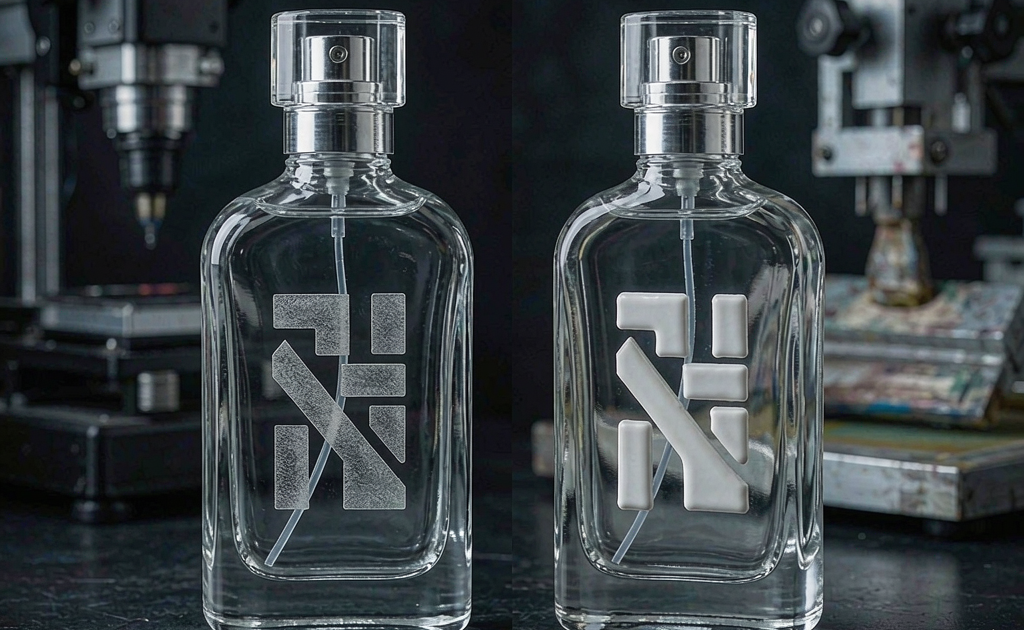
When a fragrance brand puts its name on a bottle, the two workhorse technologies for permanent decoration are laser engraving and screen printing. Both deliver durable, premium branding on custom perfume glass bottles, but they differ sharply in look, cost structure, setup time, and durability behavior. Choosing between them is not a matter of taste alone — it depends on your artwork, order volume, deadline, and how the bottle will be handled in retail. This guide compares the two processes from a purchasing perspective, with the numbers that matter.
How Each Process Works
Screen printing on glass
Screen printing pushes ink through a fine mesh stencil onto the bottle surface. For glass, inks are typically ceramic-frit based and fired at 580–620°C in a lehr, which fuses the pigment into the glass surface permanently. Alternatively, UV-curable organic inks are used for colors that ceramic systems cannot reach or when firing isn’t practical. Fired ceramic print survives alcohol, water, and abrasion essentially forever; UV print offers a wider color gamut and lower heat stress but sits on the surface.
Screen printing is a contact process: each color needs its own screen and, on cylindrical bottles, a rotation fixture. On flat or curved panels, registration between colors is controlled to roughly ±0.2–0.3 mm.
Laser engraving on glass
Laser engraving ablates or micro-fractures the glass surface with a focused beam — usually a CO₂, fiber, or UV laser depending on the effect. The result is a frosted, monochrome mark that is physically part of the glass: it cannot chip, fade, or be scratched off. Advanced systems can create depth control (shallow gray tones), 3D internal engraving inside thick glass, or combination marks where an engraved area is back-filled with color.
There is no ink, no screen, and no firing — the setup is digital, which is where the economics diverge.
Side-by-Side Comparison
| Factor | Screen printing (ceramic fired) | Laser engraving |
|---|---|---|
| Colors | Multi-color possible (1 screen/color) | Monochrome frosted (no ink) |
| Look | Glossy or matte, full-coverage graphics | Subtle, etched, premium-minimalist |
| Setup cost | $30–80 per screen per design/color | $0 (digital files, no tooling) |
| Setup time | 2–5 days per new artwork | Hours |
| Per-piece cost at 10k pcs | $0.05–0.20 (volume-sensitive) | $0.10–0.30 (machine-time-driven) |
| Durability | Excellent when fired; UV print moderate | Permanent — engraved into glass |
| MOQ influence | High (screen costs amortize) | Low (single-piece viable) |
| Best for | Bold multi-color branding at volume | Luxury minimalism, personalization, samples |
When Screen Printing Wins
Screen printing remains the default for mass-market and mid-premium fragrance launches, for four reasons.
Color. A brand identity built on a two-color logo with fine gradients and Pantone-matched hues can only be delivered in ink. Laser marks are inherently monochrome — you cannot laser a red logo onto clear glass without an additional fill process.
Unit economics at volume. Once screens are made, the marginal cost per print is low, and automatic lines print a bottle every 3–6 seconds. At 50,000 units and above, printed decoration is usually 30–50% cheaper than laser time on the same part.
Fired-in permanence. Ceramic inks fired at over 580°C become part of the glass. For bottles that will be washed, refilled, or exposed to alcohol, fired print matches the durability of the container itself — a point our perfume bottle production overview covers in the context of decoration sequencing before annealing.
Fine detail and halftones. Screens at 300+ mesh reproduce small typography and tone gradients that laser rasterization renders differently; for dense artwork, print keeps the design’s original look.
The trade-offs: new artwork means new screens and a firing cycle, so prototype changes cost days and money. Dark glass (deep amber, opaque black) also limits ink visibility — light ceramic inks exist but cost more, and multi-pass printing on dark glass is where registration defects concentrate.
When Laser Engraving Wins
Laser has carved out its own territory, and for some programs it is simply the right tool.
Short runs and sampling. Because artwork is a file, not a screen, laser marks can change between batches with zero tooling cost. A 500-piece limited edition, a trade-show sample set, or an A/B test of two logo placements can all be done on the same tooling. This flexibility also helps during the sampling and prototype phase, when iterating the brand layout before committing to mass production.
The luxury-minimalist look. A frosted, engraved wordmark on heavy clear glass reads as understated and expensive — think of the aesthetic associated with niche fragrance houses. The matte-on-gloss contrast (engraved panel against polished glass) is a texture no ink replicates.
True permanence. Engraving survives everything short of breaking the bottle. For refillable fragrance systems where the bottle is a long-lived object — an increasing trend in EU markets driven by packaging-reduction rules (see EU EU Packaging and Packaging Waste Regulation) — engraving guarantees the branding outlasts dozens of use cycles.
Personalization. Individual names, serial numbers, or batch engraving is trivially digital. Limited runs with unique per-unit marks are only practical with laser.
The trade-offs: monochrome only, slower per piece (a full-body mark can take 10–30 seconds of machine time), and results depend heavily on glass composition — colored and tempered glass may need different laser wavelengths and test marks before production. Laser marks on curved, high-curvature surfaces also need 3D galvo systems; flat-panel-only machines struggle with spherical bottles.
The Hybrid Play: Engrave + Fill or Engrave + Print
Many premium programs now combine both processes: laser-engrave a recessed logo, then screen-print or hand-fill the recess with ceramic ink. The engraved pocket gives the ink a physical key, improving perceived depth and abrasion resistance, while retaining full color. This hybrid costs more than either process alone (both setups plus an alignment operation), but it produces some of the most tactile branding available in fragrance packaging — worth requesting as a sampling option if your design brief emphasizes both color and depth.
Pricing Logic Buyers Should Expect
Understanding how each vendor builds the quote prevents surprises later:
- Screen printing quotes hinge on the number of colors and screens. Two screens, one design, one artwork change = three screen charges. Ask whether screens are one-time or re-setup per order; re-setup fees on repeat orders should be negotiable down or waived.
- Laser quotes hinge on mark area and glass type. Bigger marks, slower speeds, higher cost. Suppliers may quote per-piece or per-hour; at 10,000+ units, request both so you can compare fairly.
- Firing is bundled with print but not with laser. If your program also needs gradient coating or metallization (see our vacuum metallization parameters guide), sequence matters: fired print must precede most coating steps, while laser usually comes after coating — a logistics factor that affects lead time and reject-rate risk.
Lead times in practice: laser-only decoration on stocked glass can ship in 7–12 days; screen printing with new screens and firing adds 5–10 days to the decoration stage. Quality checks for both should follow a written AQL plan; for buyers building supplier audit checklists, ISO 9001 quality management 9001-based process audits (ISO 9001) will surface whether decoration parameters (ink viscosity, firing curve, laser power calibration) are actually controlled rather than improvised.
FAQ
Is laser engraving more durable than screen printing on perfume bottles?
Yes. Laser engraving removes or micro-fractures the glass itself, so the mark is permanent and cannot be scratched or chemically attacked. However, ceramic inks fired at 580–620°C are also extremely durable — for most retail handling scenarios, fired screen print and laser are equally practical; the difference matters most for refillable, washed, or heavily handled bottles.
Can laser engraving reproduce multi-color logos on glass?
Not directly — laser marks are monochrome frosted marks. Multi-color branding requires printing. A hybrid approach (engraved recess filled with ceramic ink) can achieve colored logos with added depth, at higher cost than either process alone.
Which process has lower minimum order quantities?
Laser. Because artwork is digital with no screens or tooling, engraving is viable from a single piece upward. Screen printing typically needs enough volume to amortize $30–80 per screen per color, making it uneconomical below roughly 1,000–2,000 pieces unless you accept higher unit decoration costs.
Does screen printing on dark glass cost more?
Usually yes. Dark or opaque glass needs light ceramic inks with higher pigment loading, often multi-pass printing for opacity, and tighter registration control. Expect a premium of 20–50% over printing the same artwork on clear glass.
Can I combine laser engraving with coating or metallization on the same bottle?
Yes, but sequencing matters. Fired screen printing must be applied before most coatings, while laser engraving typically occurs after coating to cut through and contrast with the coated surface. Discuss the full decoration sequence with your supplier at sampling stage, because it affects lead time, fixturing, and reject rates.


