Buying 10,000 glass perfume bottles is the easy part. Getting them to a warehouse in Rotterdam, Los Angeles, or Dubai without cracks, leaks, or broken sprayers is where real money disappears. For perfume brands shipping internationally, perfume bottle packaging isn’t just a pretty outer box — it’s the engineering system that decides whether your product arrives sellable or shattered.
After shipping fragile bottles through 40+ countries since 2011, our team at Huanshi has learned that 70-80% of in-transit glass damage traces back to one root cause: packaging that was never tested to the standard it needed to meet. That’s where ISTA 3A comes in. This guide walks through what ISTA 3A actually tests, why it matters for perfume bottle wholesalers shipping LCL or FAK, and how to spec packaging that survives a 60-day ocean voyage plus Amazon FBA handling on top of it.
What Is ISTA 3A and Why Perfume Brand Buyers Should Care
ISTA stands for International Safe Transit Association. They publish a series of test procedures (1A, 2A, 3A, 3B, 3E, etc.) that simulate the vibration, drop, and humidity events a packaged product faces during distribution. ISTA 3A specifically targets parcel delivery systems — your standard 70 lb (32 kg) or under box moving through UPS, FedEx, DHL, or local postal networks.
For perfume bottles, ISTA 3A isn’t optional anymore. Most U.S. retailers and Amazon require ISTA 3A or 6A test reports before accepting shipments. EU and UK importers ask for it under EU Packaging and Packaging Waste Regulation traceability. Bypass the test and your brand eats the breakage cost.
The critical distinction most buyers miss: ISTA 3A tests the complete packaged product, not just the bottle. So your ISTA 3A report depends on your outer carton, inner inserts, dividers, and any shrink wrap or tissue. Change one piece and you need a new test.
Key ISTA Test Series at a Glance
| Test Series | Simulates | Typical Use Case |
|---|---|---|
| ISTA 1A | Basic vibration, alternating with package orientation | Non-fragile products, low-value items |
| ISTA 2A | Partial shipment simulation (low humidity) | Vacuum-sealed or cushioned goods |
| ISTA 3A | Full parcel delivery — vibration + drop + impact | Fragrance bottles, glassware, ceramics |
| ISTA 3E | Extended testing for heavy freight | Marine containers, full truckloads |
For a 50ml or 100ml glass perfume bottle in a master carton of 24-48 pieces, ISTA 3A is the right protocol. Anything heavier per unit or larger carton often crosses into 3E territory.
The 7 Hazards ISTA 3A Tests Cover
Every ISTA 3A test sequence runs through seven real-world hazards. Understanding each one shows you where packaging fails — and why a “well-packed” box from your supplier might still arrive damaged.
- Vibration (Transport vibration, 30 minutes minimum) — Simulates hours of road or air transit. Loose bottles rattle, chip against dividers, and micro-fracture at the shoulder.
- Shock (Mechanical handling shock) — Drops from conveyor belts, sorting equipment. For glass perfume bottles, even a 30cm drop can crack a poorly supported base.
- Drop test (Free-fall drop) — Specified drops from 45-90cm depending on package weight. Bottles over 10kg see higher drop heights.
- Impact (Concentrated impact) — Corners and edges strike first during a fall. This is why inner corner protectors matter.
- Stacking (Compression test) — Carton-on-carton pressure during warehouse storage. Glass perfume bottles fail here when master cartons aren’t rated for stacked loads.
- Atmospheric conditioning (Humidity cycling) — Moisture absorption weakens corrugated cardboard. A 30-90% RH swing over 48 hours can reduce carton burst strength by 25%.
- Loose load (Shifting) — When bottles shift inside the carton during a turn, the inner packaging must prevent migration.
If your supplier’s packaging fails any one of these, the ISTA 3A report won’t certify. Our internal test lab runs a modified 3A sequence using ASTM International standards D4169 vibration tables calibrated for 0.5-4Hz frequencies — the range that historically cracks glass.
What Your ISTA 3A Test Report Should Contain
A valid report includes the package mass, dimensions, conditioning profile, drop heights tested, vibration spectrum, and pass/fail per test element. Look for the “ISTA Certified Package” mark and a unique test ID. Reputable labs like SGS, Bureau Veritas, or Intertek issue reports with traceable numbers.
Link: ISO 9001 quality management standards for packaging testing → external source
Link: ASTM D4169 transit simulation standard → external source
Link: ASTM D7386 definition of ISTA test procedures → external source
Link: FDA cosmetic packaging regulations cosmetic container integrity guidance → external source
How to Spec Perfume Bottle Packaging That Passes ISTA 3A
Spec’ing packaging isn’t guesswork. We use five parameters on every quote that ships to a fragile destination.
- Master carton flute rating — Double-wall BC flute or single-wall B+C combo for 30ml-100ml bottles. Below that, single-wall B flute passes for samples only.
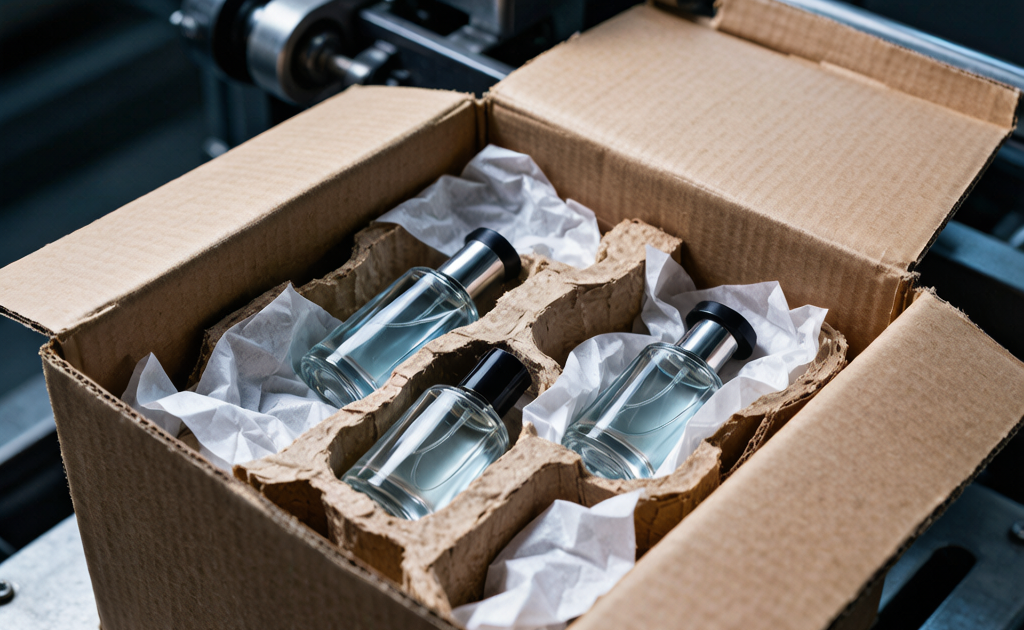
- Internal dividers — Molded pulp, corrugated inserts, or EPS foam. We default to molded pulp since it’s recyclable under PPWR rules.
- Edge protectors — L-profile cardboard on each bottle corner, especially critical for square and rectangular shapes.
- Bottle wrap layer — Glassine or tissue paper for clear bottles; polypropylene film for frosted or coated glass to prevent decoration scratches.
- Void fill and bracing — Air pillows or kraft paper for cushioning. Avoid loose-fill peanuts — they shift during vibration and create gaps.
Our standard 24-piece master carton for 50ml bottles measures 36×28×22cm and weighs 4.5kg. It passes ISTA 3A on the first run in 9 out of 10 cases. The 10th case usually involves a destination with handling harsher than U.S. parcel standards.
Common Packaging Spec Mistakes Buyers Make
Watch for these three mistakes when reviewing a quote:
- Spec’ing the box, ignoring the insert — A $0.40 insert failure costs $14 in returned bottles. Always approve the insert artwork with a sample run.
- Reusing old carton designs — Glass weight shifted by 15g between v1 and v2 of your bottle. If the SKU changed, the packaging likely needs re-testing too.
- Trusting visual inspection — ISTA 3A pass can’t be eyeballed. We’ve shipped bottles that looked perfect and failed impact testing at 75cm drops because the carton flap adhesive had delaminated in humidity.
ISTA 3A Test Cost, Timeline, and Re-test Frequency
Test cost depends on lab and region. For 2026, expect:
- First-time ISTA 3A test: $1,800-$3,500 USD per SKU at SGS, Bureau Veritas, or Intertek
- Re-test on packaging change: $600-$1,200 USD if you only adjust dividers or wrap
- Self-test with calibrated equipment: $0 cash but ~$15,000+ equipment investment (vibration table, drop tester, compression rig)
Lead time runs 2-4 weeks for an external lab. Self-testing slashes that to 48 hours but you sacrifice the certification mark. For brands launching new SKUs, we recommend external lab certification on the first three SKUs, then self-test for line extensions.
Re-test triggers — when you absolutely must re-run:
- Bottle weight changes by ±10%
- Decoration addition or change (silk screen, hot stamping, water transfer printing)
- Outer carton supplier change
- New distribution region with materially different handling
If you skip re-test, document the engineering rationale. PPWR audits in 2026 and beyond increasingly ask for evidence-based testing, not just date-stamped reports.
Comparing ISTA 3A to Amazon Frustration-Free and SIOC
Amazon sellers face an additional requirement: Ships-In-Own-Container (SIOC) or Frustration-Free Packaging (FFP). These build on ISTA 3A but include Amazon-specific elements: bare-package shipping (no secondary overbox), specific scannable labels, and recyclability thresholds.
| Standard | Scope | Required By | Packaging Rule |
|---|---|---|---|
| ISTA 3A | Parcel delivery simulation | Most retailers, EU/UK importers | Single carton tested as a unit |
| ISTA 6A | Amazon.com delivery | Amazon FBA sellers | Tested without overbox |
| SIOC | Amazon FBA standard | Amazon | Tested in retail-ready state |
| FFP | Amazon Tier 1-3 | Amazon | Recyclable + easy-open |
For fragrance brands selling on Amazon, ISTA 6A + SIOC certification eliminates Amazon’s “frustration-free prep fee” of $1.40-$2.00 per shipment. For direct-to-consumer brands shipping via UPS or FedEx, ISTA 3A alone is sufficient and remains the global baseline.
Real Numbers: What Glass Perfume Bottle Packaging Failure Actually Costs
Let’s do the math. A 10,000-piece shipment of 50ml bottles at $0.85 unit value, packed 24 per master carton:
- Master cartons in shipment: 417
- Average breakage rate without ISTA-tested packaging: 4-7% (industry benchmark for seaborne fragile goods)
- Replacement cost: $3,400-$5,950 in lost product + $850-1,400 in logistics rework
- Total exposure: $4,250-$7,350
The same shipment with ISTA 3A-passed packaging typically sees breakage below 0.8%. That’s $680 or less in losses. The packaging investment that saves $3,500+? Usually $0.18-$0.32 per unit, or $1,800-$3,200 across the shipment.
That’s a 2-4x ROI on packaging testing alone, before counting brand reputation, customer complaints, and replacement logistics time.
For brands shipping LCL rather than FCL, breakage rates climb to 9-12% without tested packaging. Repacking at destination adds another $1.20-$1.80 per piece. Test reports pay for themselves on the first international shipment.
How We Test Perfume Bottle Packaging at Huanshi
Every stock mold we ship has a baseline ISTA 3A packaging spec on file. For custom molds, we run a pre-test on the sample run with three packaging options: budget, mid-tier, and premium. The buyer picks based on their destination mix and damage tolerance.
Our standard workflow:
- Bottle sample arrives — Trigger for packaging review.
- Carton spec drafted — Based on bottle dimensions, weight, decoration.
- ISTA 3A pre-test — Run on customer’s behalf at our facility.
- External lab certification — Optional, costs passed through.
- Documentation package — Test report, packaging spec, materials list, recycling data.
- Annual re-test — Triggered by SKU or packaging change.
We provide the full packaging spec sheet with every quote — no hidden data. If you want a copy of our ISTA 3A protocol reference for your own records, just ask.
Link: European Pharmacopoeia glass standards glass container standards → external source
Link: Glass Packaging Institute packaging guidance → external source
Link: FEVE European Container Glass Federation container glass federation packaging research → external source
Frequently Asked Questions
What is ISTA 3A testing for perfume bottles?
ISTA 3A is a parcel delivery simulation protocol that tests the complete packaged product — bottle, dividers, outer carton — under vibration, drop, impact, and humidity conditions typical of UPS, FedEx, and DHL networks. For glass perfume bottles, an ISTA 3A test report confirms the packaging survives typical parcel handling without breakage, leakage, or sprayer damage.
How much does ISTA 3A certification cost?
First-time ISTA 3A testing at an accredited lab runs $1,800-$3,500 per SKU. Re-testing after a packaging change costs $600-$1,200. Self-testing with calibrated equipment eliminates the cash outlay but requires a $15,000+ equipment investment. We bundle the first ISTA 3A report into custom mold projects at our facility.
Is ISTA 3A required for Amazon FBA perfume bottles?
Amazon requires ISTA 6A (a more rigorous variant) for FBA sellers using SIOC or Frustration-Free Packaging. Standard ISTA 3A passes for non-Amazon retailers. If you ship to multiple channels, our recommendation is to certify to ISTA 6A + SIOC so you’re covered across Amazon, retail, and direct-to-consumer under one test program.
How long does ISTA 3A testing take?
External lab testing takes 2-4 weeks including conditioning time. In-house pre-testing (without certification marks) takes 48 hours. We can run pre-tests before you commit to a full lab report, which usually saves one development cycle for time-sensitive launches.
Do I need to retest if I change bottle decoration?
Yes. Adding silk screen printing, hot stamping, water transfer printing, or coating changes the bottle surface friction and weight distribution. We’ve seen decoration additions shift breakage patterns by 30% even when the bottle silhouette is identical. Re-test or document the engineering rationale carefully.
Closing CTA
Ready to spec perfume bottle packaging that survives your destination market? Send us your bottle dimensions, target SKU, and shipping route. We’ll send back a packaging spec sheet, sample ISTA 3A test report (or recommend a lab near you), and a quotation for both bottles and tested cartons. MOQ starts at 1,000 pieces for stock bottles and 5,000 for fully custom molds. Reply today and we’ll have your packaging evaluation in your inbox within 48 hours.