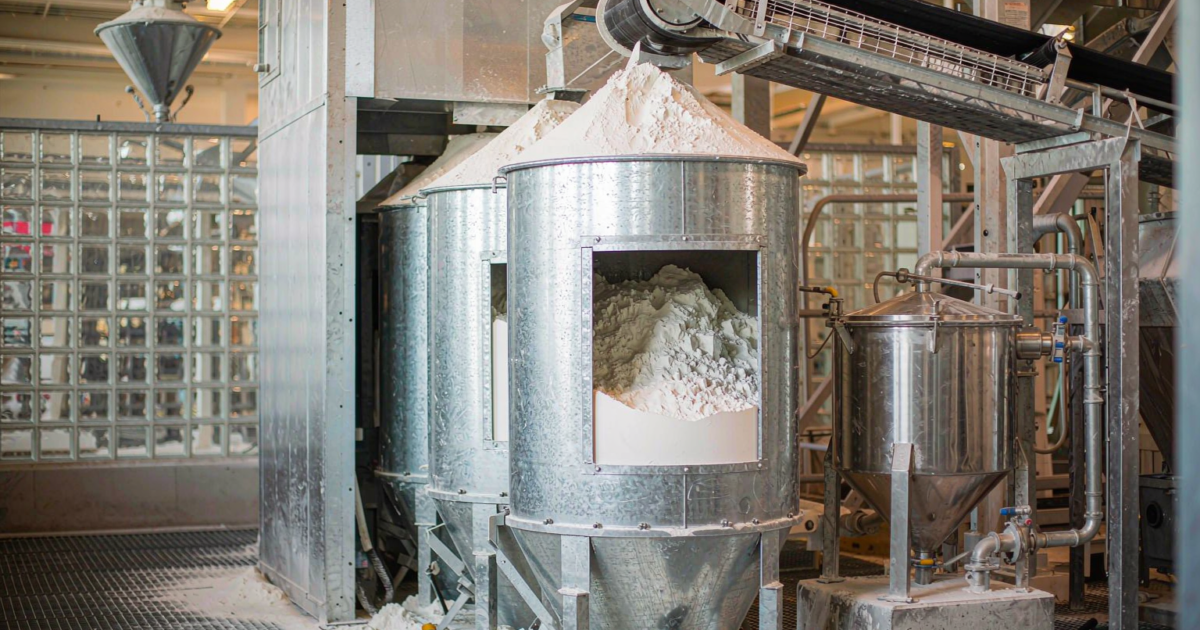
Ask a perfume bottle supplier about quality control and you will hear about leak tests, vision inspection and AQL sampling. Very few buyers ask about what happens one step further upstream: the batch house, where sand, soda ash, carbonates and cullet are weighed, screened and mixed into the charge that the furnace melts. Yet a surprising share of the defects you will later pay for — stones, cords, seeds, colour drift, refractory corrosion — begin here, in a dusty building beside the furnace, before any glass is ever melted.
For a sourcing manager qualifying a custom perfume glass bottle factory, the batch house is where you learn whether a supplier is running a controlled process or a reactive one. This article walks through what a batch house does, which raw material checks actually matter, what specifications to demand, and how to write the batch-related clauses into your purchase order.
What a Batch House Actually Does
A batch house is the raw material handling and mixing area of a glass plant. Its job sounds simple: take the recipe for the glass, weigh each ingredient accurately, mix them into a homogeneous batch, and deliver that batch to the furnace charging point at a steady rate.
The complication is that glass recipes are unforgiving. A soda-lime or crystal-type glass composition specifies each oxide within a window that is often ±0.1–0.3%. Those percentages refer to the final glass, not the raw material, so a variation in sand purity, moisture content or weighing accuracy propagates directly into the melt. If the soda ash (sodium carbonate) feed drifts high, the glass becomes more chemically aggressive toward the furnace refractories. If the alumina source drifts low, the glass becomes less workable and more prone to devitrification at the forming machine. If sand has a coarser grain distribution than specified, some grains survive melting as undissolved silica — which show up in your bottles as stones.
In a modern plant the batch house runs continuously and automatically: silos, conveyors, weigh hoppers, mixers and a batch computer that logs every charge. In smaller plants, much of this is semi-manual, and that is precisely where buyer-relevant risk concentrates. The full picture of what happens after the batch enters the furnace is covered in our guide to how perfume glass bottles are made; this article stays upstream of that, in the building where the glass is still powder.
The Core Materials and What Can Go Wrong
A typical soda-lime glass batch for clear flint perfume bottles contains roughly 70% silica sand, 13–15% soda ash, 8–10% limestone and dolomite, 2–4% feldspar or other alumina source, and 15–30% cullet (recycled glass, calculated on total batch). On top of that come smaller additions: fining agents such as sodium sulphate, colourants or decolourisers (selenium, cobalt, iron oxides, cerium), and sometimes fluorine-free clarifiers.
Every one of these has a failure mode that ends up as a visible or measurable defect in the finished bottle.
| Material | Typical share of batch | What it contributes | What goes wrong if the material is off-spec | Defect you see in the bottle |
|---|---|---|---|---|
| Silica sand | ~70% | Glass former (SiO2) | Iron content too high (green tint), coarse grains (undissolved stones), organic contamination (fining problems) | Stones, colour drift, seeds |
| Soda ash (Na2CO3) | 13–15% | Flux, lowers melting point | Purity below 99%, lumping from moisture, chloride contamination | Furnace corrosion, seeds, chemical durability problems |
| Limestone / dolomite | 8–10% | Stability, durability (CaO, MgO) | Variable calcination, moisture, contamination with clay | Cords, workability drift |
| Feldspar / alumina | 2–4% | Workability, chemical durability | Inconsistent Al2O3 content, heavy mineral inclusions | Devitrification, hard-to-form glass |
| Cullet | 15–30% | Cheaper melt, sustainability | Wrong colour, metal or ceramic contamination, dirty cullet | Stones, colour contamination, metal inclusions |
| Fining agent (Na2SO4) | 0.2–0.5% | Removes bubbles from melt | Under-dosing leaves seeds; over-dosing causes sulphate haze | Seeds, blisters, haze |
| Colourants / decolourisers | ppm to % | Colour or clarity | Wrong iron spec in sand, dosing drift | Visible colour variation between batches |
The two most consequential raw materials for a perfume bottle buyer are sand and cullet. Sand defines the achievable colour and clarity of flint glass — the difference between a premium water-white flacon and one with a faint green-grey cast is largely sand chemistry, primarily total iron expressed as Fe2O3. Cullet, discussed below, is the most common vector for contamination because it is the one ingredient the factory makes or buys second-hand rather than from a certified mineral supplier.
Incoming Raw Material Checks: What Should Be Tested and How Often
A serious batch house runs an incoming inspection protocol on every delivery of every material. The exact suite varies by plant, but the checks below are the ones that map directly to buyer-visible quality, and they are the ones you should be able to see evidence of in a factory audit.
| Check | Method | Typical acceptance spec (flint glass) | Frequency |
|---|---|---|---|
| Sand Fe2O3 content | Wet chemistry or XRF | ≤ 0.015% (premium flint), ≤ 0.03% (standard) | Every delivery |
| Sand grain size distribution | Sieve analysis | > 95% between 100–600 µm, no fraction > 1 mm | Every delivery |
| Sand moisture | Loss on drying or moisture analyser | 0.05–0.1% target; recorded, compensation applied at weighing | Every delivery |
| Soda ash purity | Titration / supplier COA verification | Na2CO3 ≥ 99.2%, NaCl ≤ 0.3% | Every delivery + periodic lab verification |
| Carbonate purity (CaO/MgO) | Titration | Within supplier COA ±0.3% | Each lot |
| Cullet contamination | Visual sort + magnet + metal detector | Zero metal, zero ceramics, colour match to tank | Every load |
| Water quality (batch water) | Conductivity / hardness | Softened, low chloride | Weekly |
| Colourant lot verification | Weigh check against recipe | ±1 g per dosing accuracy class | Every dosing run |
Three of these deserve unpacking, because they carry most of the risk.
Sand iron content. Total iron as Fe2O3 is the single most important number for a clear flint perfume bottle. At 0.015% or below you get the water-white clarity premium brands expect; push toward 0.03–0.05% and the glass reads faintly green, which is visible in a thick heavy-base flacon even if the same glass looks fine in a thin-walled jar. A supplier who cannot state their sand’s Fe2O3 spec from memory is a supplier you should audit carefully.
Sand grain size. Melting kinetics depend strongly on particle size. A grain distribution that is too coarse leaves residual silica particles that survive the melt — classic stones, which appear as opaque white or glassy inclusions and are a critical defect under the acceptance criteria discussed in our glass defects guide. A distribution that is too fine can cause dusting losses, caking and inconsistent weighing. The practical spec is narrow: most flint plants want sand predominantly in the 100–600 µm range.
Soda ash chloride. Chloride in soda ash accelerates refractory attack in the melter and can contribute to fining problems. The distinction between 99.2% and 98.5% purity soda ash is a real cost difference at the supplier, and a factory buying the cheaper grade is making a furnace-life trade-off that will not show up until you are three or four production runs in.
Cullet: The Ingredient Buyers Never Ask About
Cullet — crushed, clean, colour-sorted recycled glass — is both an economic and an environmental tool. Internally generated cullet (rejected bottles, go-devil glass, cut edge waste) is chemically identical to the tank’s glass and nearly free. External purchased cullet is cheaper in cash terms but riskier, because its origin and composition are only as good as the sorting operation behind it.
The balance a plant strikes is a deliberate decision, covered in detail in our article on cullet ratio and perfume glass quality. What matters at the batch house stage is contamination control: every load of purchased cullet should pass over a magnet for ferrous metal, through a metal detector for non-ferrous, and across picking belts or optical sorters for ceramics and wrong-colour glass. A single piece of ceramic will not melt at soda-lime temperatures — it sits in the glass as a hard opaque inclusion that ends up in a formed bottle.
If your program targets a sustainability claim — PCR content, carbon footprint, or a closed-loop statement — the batch house records are the evidence trail, and the input to the closed-loop approach described in glass recycling in the perfume industry. Ask to see cullet records, not just the marketing slide.
Moisture and Weighing: The Silent Variables
Two process variables in the batch house cause slow, invisible drift rather than sudden defects, and both are frequently under-controlled in smaller plants.
Moisture. Sand, soda ash and carbonates all absorb atmospheric water, and hygroscopic materials like soda ash can lump badly in humid weather. Because batch recipes are expressed as dry-basis percentages, a plant that does not measure moisture per delivery will over- or under-dose oxide by the moisture delta. The fix is mundane but essential: measure moisture per lot and let the batch computer compensate the weighed amounts. A plant that only measures moisture weekly, or not at all, is running a glass composition that wanders with the weather.
Weighing accuracy. Recipe accuracy is set by the weighing class of the equipment. Modern batch houses use load-cell weigh hoppers with dosing accuracies of ±0.1–0.5 kg on major ingredients and gram-level accuracy on colourants and fining agents. Trickle-feed dosing and verified calibration schedules are the marks of a controlled house; the audit tell is simply asking how often the scales are calibrated, against what reference, and by whom. A plant operating under ISO 9001 quality management.org/standard/62085.html”>ISO 9001 will have this documented without hesitation.
Traceability and Documentation
The batch house is where traceability becomes possible or impossible. Every furnace charge should carry a batch number that links forward to the production run and back to the delivery lots of each raw material. In practice this means:
- Batch records for every charge: date, recipe ID, weighed amounts per ingredient, moisture compensation applied, mixer ID and time.
- Raw material lot files: supplier, delivery date, COA, incoming test results, quarantine and release decisions.
- Retention samples of each raw material lot, so a defect investigation can re-test the original material months later.
- Batch-to-furnace-to-machine traceability, so a bottle with a stone traces to a charge and a sand lot — not to “the March production week.”
For a buyer, the cheapest possible insurance is to request batch traceability documentation as part of the first-article package. A supplier who can produce a clean batch record chain without preparation is a supplier whose process is genuinely under control. A supplier who needs three days to assemble it is telling you the records are reconstructed, not recorded.
What to Ask a Supplier About the Batch House
If you are qualifying a factory for a custom perfume glass bottle program, the batch house questions below separate controlled plants from reactive ones. You do not need to be a glass technologist to ask them — the quality of the answers is diagnostic on its own.
- What is your sand specification — Fe2O3 content and grain size — and how often do you test incoming sand?
- What cullet ratio do you run for my glass type, internal or purchased cullet, and what contamination controls apply?
- How is moisture measured and compensated at weighing?
- What is the dosing accuracy of your weigh hoppers for major and minor ingredients?
- Can I see a batch record for a recent production run, traced to raw material lots?
- How are colourant lots controlled and verified?
- What happens when an incoming material fails inspection — walk me through your quarantine and release process.
None of these questions is adversarial, and a plant that answers them fluently is a plant you can write tighter specifications with, because you know those specifications will actually be executed.
How Batch Quality Shows Up in Your Bottles
The chain from raw material to finished product is more direct than most buyers assume.
- Stones — undissolved silica from coarse sand, or ceramic contamination in cullet. Zero-tolerance defect.
- Cords and striae — composition inhomogeneity from poor mixing, moisture compensation errors or weighing drift.
- Seeds and blisters — under-fining from wrong sulphate dosing, organic contamination in sand, or excess moisture in carbonates releasing gas during melt.
- Colour drift — iron variation in sand, colourant dosing drift, or cullet colour contamination. Usually a subtle cast difference between lots, obvious once bottles sit side by side on a retail shelf.
- Reduced chemical durability — composition drift toward lower CaO/Al2O3, showing up months later as surface dulling with aggressive fragrance formulations.
Each has a downstream inspection counterpart — the stages described in our quality control checkpoints for perfume bottle production — but inspection is detection, not prevention. Prevention happens in the batch house, and the furnace parameters that turn a good batch into good glass are covered in glass furnace temperature control for perfume bottles.
Writing Batch-Related Clauses Into Your Purchase Order
You do not need to specify the batch recipe — that is the supplier’s engineering territory. What you specify is the outcome and the evidence. Practical clauses:
- Colour and clarity: state the acceptable Fe2O3 equivalent range for flint glass, or reference a control sample with agreed transmission/haze limits on a defined instrument.
- Stones and inclusions: zero tolerance for any opaque or glassy inclusion above a stated size (commonly 0.5 mm) in the critical zone, per your QA agreement’s defect classification.
- Cullet content: if you make a sustainability claim, state the required cullet or PCR percentage, define the calculation method, and require batch records as evidence.
- Traceability: require batch traceability per production lot, retained 24–36 months, with the right to request records during a dispute.
- Colour consistency between lots: require ΔE tolerance against the approved standard for the program duration, including after any raw material supplier change — which should itself trigger re-approval.
FAQ
Why does raw material quality matter more for perfume bottles than for food jars?
Perfume bottles are sold on visual and tactile quality, not just function. A faint green cast, a single stone in a heavy-base flacon, or a colour difference between two production lots is immediately visible in a premium retail context where bottles sit side by side under store lighting. Food jars tolerate composition variation that perfume glass cannot, because the brand penalty of a visible defect is far higher.
What Fe2O3 content should I specify for clear flint perfume bottles?
For premium water-white flint, ask for sand at 0.015% Fe2O3 or below; standard flint commonly runs up to 0.03%. Above that, the glass starts to read green in thick sections. Always confirm the spec against an approved physical sample, because perceived colour also depends on wall thickness and coating.
What is the risk with purchased cullet?
Purchased cullet carries contamination risk from metals, ceramics and wrong-colour glass, and composition risk if the source glass differs from your tank’s recipe. A well-run plant manages this with magnet and metal detector lines, optical sorting, and a fixed cullet ratio per glass type. Internal cullet from the plant’s own production is chemically identical to the tank glass and carries almost none of this risk.
How can I verify a supplier’s batch house controls during a factory audit?
Ask to see the batch house itself, the scale calibration records, moisture measurement equipment, and a batch record for a recent run traced back to raw material delivery lots. Then ask them to explain their quarantine process for a failed incoming material. Suppliers with genuine controls answer quickly and can show documents; suppliers with paper-only systems hesitate.
Can bad raw materials cause defects that only appear weeks after production?
Yes, in two ways. Composition drift toward lower stabiliser content (CaO, Al2O3) can reduce chemical durability, showing up months later as surface dulling or etching with aggressive fragrance formulations. And colour drift between lots often only becomes visible when two production lots are displayed together, which happens at the retailer, not at the factory gate.