The neck of a perfume bottle is the most mechanically stressed part of the package. It carries the cap, the spray pump, and the seal that keeps volatile fragrance from escaping. Inside that neck sits a small component most buyers never think about until it fails: the reducer or neck insert. Choose the wrong one, and you get leakage, inconsistent dosage, or customer complaints about “cheap feel.” Choose the right one, and the bottle performs silently for years.
This guide covers the four main types of reducers and neck inserts used in custom perfume glass bottles, when to specify each, and what to test before signing off on production.
What a Reducer Actually Does
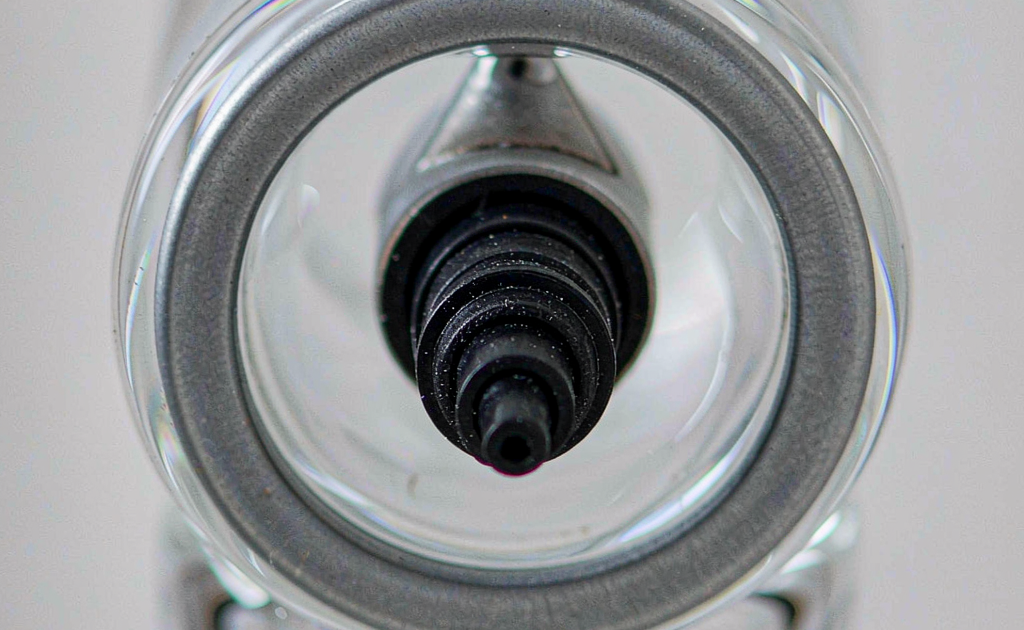
A reducer is a plastic or metal insert that sits inside the bottle neck, between the glass and the closure. Its jobs are:
- Orifice control. It narrows the opening to a precise diameter—typically 1.0mm to 4.0mm—so the user can pour or dab without spilling.
- Seal interface. It provides a flat, consistent surface for the cap or pump to seal against glass that may have minor surface irregularities.
- Flow regulation. Some reducers include a wick, ball bearing, or membrane to control how much liquid reaches the applicator.
Without a reducer, the user is pouring directly from a 13mm or 15mm neck. That works for splash colognes in the 1970s, but not for modern retail.
Type 1: Standard Orifice Reducer (Pour/Dab)
The simplest and cheapest option. A small plastic plug—usually LDPE or PP—with a central hole pressed into the neck.
Specifications
- Orifice diameter: 1.0–3.0mm (1.5mm is standard for parfum)
- Material: LDPE for flexibility, PP for chemical resistance
- Fit: Friction-fit or snap-ring into the neck finish
- Cost: $0.01–$0.02 per unit at scale
Best For
- Parfum and extrait concentrations where the user dabs, not sprays
- Vintage or apothecary-style fragrance bottle lines
- Oil-based attars and roll-on conversions
- Budget lines where pump hardware cost is prohibitive
What Can Go Wrong
The main failure mode is poor retention. If the neck finish has a slight taper or the reducer diameter is at the low end of tolerance, the insert can pop out during shipping—especially in hot containers where air pressure builds. At Huanshi, we specify a minimum retention force of 15N for orifice reducers and test every batch with a pull gauge.
Type 2: Crimp Pump Assembly (Spray)
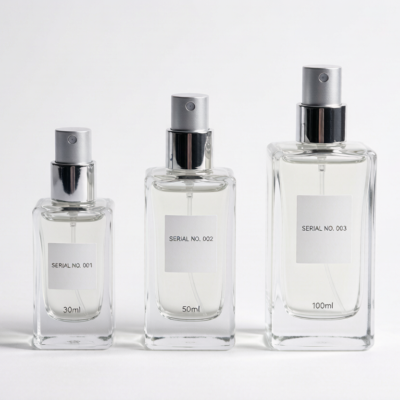
The industry standard for eau de parfum and eau de toilette. A metal or plastic pump with a dip tube is crimped directly onto the neck finish, usually with an aluminum collar.
Specifications
- Neck finish: 13/415, 15/415, or 18/415 (most common for 30–100ml)
- Output per stroke: 0.10–0.15ml (adjustable by pump specification)
- Actuator style: Standard, slim, or custom-molded
- Cost: $0.18–$0.45 per unit depending on metal content and customization
Best For
- Any spray product: EDT, EDP, body mist, hair mist
- Premium lines where the pump feel is part of the experience
- Products requiring fine mist (skincare crossover fragrances)
What to Specify
Not all crimp pumps are equal. Here are the parameters we ask clients to confirm:
- Output per stroke: 0.10ml gives 500+ sprays from 50ml. 0.15ml gives ~330. The difference affects perceived value.
- Locking mechanism: Twist-lock or push-down lock? Twist-lock is more secure for travel.
- Dip tube length: Must reach 2–3mm above the bottle base. Too long and it curls; too short and the last 5ml is unreachable.
- Compatibility: The pump must pass compatibility testing with the specific fragrance formulation. Alcohol-heavy scents are generally safe; oil-based scents can swell certain plastics.
At Huanshi, we source pumps from verified suppliers with ISO 9001 quality management.org/iso-9001-quality-management.html”>ISO 9001 certification and require a 30-day compatibility test before mass production.
Type 3: Screw Pump with Threaded Collar
An alternative to crimp pumps, especially popular for refillable and travel-size bottles. The pump screws onto the neck finish with a threaded plastic or metal collar.
Specifications
- Neck finish: 18/415 or 20/410 (larger than standard crimp sizes)
- Removal: Hand-twist, no tools needed
- Reusability: 50+ cycles typical
- Cost: $0.25–$0.55 per unit
Best For
- Refillable perfume bottle systems
- Travel atomizers where the user transfers fragrance from a larger bottle
- Subscription or refill-program brands
- Tester bottles in retail that need frequent refilling
Tradeoffs
Screw pumps are convenient but bulkier. The threaded collar adds 3–5mm to overall height, which can affect carton dimensions. They are also slightly more prone to leakage if the user does not tighten fully. We recommend including a torque specification in the filling SOP—typically 0.8–1.2 Nm for standard PP collars.
Type 4: Rollerball Insert
A plastic or metal housing with a stainless steel or glass ball that rolls against the skin, dispensing a thin film of fragrance.
Specifications
- Ball diameter: 10mm or 12mm (standard)
- Housing material: PP or POM for chemical resistance
- Ball material: 304 stainless steel (most common) or glass (premium)
- Cost: $0.08–$0.20 per unit
Best For
- Oil-based perfumes and attars
- Touch-up and travel formats (7–15ml)
- Brands targeting markets where spray pumps are unfamiliar or restricted
- Natural and clean-beauty positioning (glass ball reads as more premium)
What to Test
Rollerballs have two common defects:
- Ball seizure. If the housing tolerance is too tight or the fragrance oil is viscous, the ball stops rolling. We test every batch with a standardized viscosity fluid.
- Leakage around the ball seat. This is usually a molding defect in the plastic housing. We specify a maximum gap of 0.05mm between ball and seat.
How to Match the Reducer to Your Bottle Neck
The neck finish—13/415, 15/415, 18/415, 20/410—determines which reducers and pumps are compatible. The first number is the neck diameter in millimeters. The second is the thread pitch or fit type (415 means a specific European standard).
Here is a compatibility matrix we use at Huanshi:
| Neck Finish | Orifice Reducer | Crimp Pump | Screw Pump | Rollerball |
|---|---|---|---|---|
| 13/415 | Yes | Yes (mini) | No | No |
| 15/415 | Yes | Yes | No | No |
| 18/415 | Yes | Yes | Yes | Yes (10mm) |
| 20/410 | Yes | Limited | Yes | Yes (12mm) |
If you are designing a new bottle and have not chosen a neck finish yet, we recommend 15/415 for standard 30–100ml spray bottles. It offers the widest pump availability and the most competitive pricing.
Material Compatibility: The Hidden Risk
Fragrance is not a single chemical. It is a cocktail of alcohols, essential oils, synthetics, and fixatives. Some of these attack plastic over time.
Common issues:
- D-limonene (citrus top notes): Swells LDPE and some PP grades. Use HDPE or POM instead.
- Benzyl alcohol (floral mid-notes): Can stress-crack polycarbonate. Avoid PC housings.
- High alcohol content (>80%): Generally safe for PP and HDPE, but can extract plasticizers from flexible PVC.
At Huanshi, we require clients to provide a 50ml sample of the final fragrance formulation for a 30-day immersion test. We weigh the insert before and after exposure. A mass change >2% is a fail. This test costs nothing and prevents returns.
Quality Checks for Reducers and Inserts
Every batch of reducers that enters our warehouse is checked for:
- Dimensional tolerance. Orifice diameter ±0.1mm. Outer diameter ±0.05mm.
- Retention force. Minimum 15N for friction-fit inserts.
- Visual defects. No flash, no sink marks, no discoloration.
- Functional test. 100 pumps or 50 rollerball rotations with water, then with the actual fragrance.
We keep retained samples for 24 months. If a client reports a field failure, we can trace the batch and run root-cause analysis within 48 hours.
Cost Summary
| Component | Unit Cost (5K MOQ) | Lead Time | Key Variable |
|---|---|---|---|
| Orifice reducer (LDPE) | $0.01–$0.02 | 7 days | Orifice diameter |
| Crimp pump (aluminum) | $0.18–$0.28 | 14–21 days | Output per stroke |
| Crimp pump (Zamac) | $0.35–$0.45 | 21–28 days | Metal weight, plating |
| Screw pump (PP) | $0.25–$0.40 | 14–21 days | Thread spec |
| Rollerball (steel) | $0.08–$0.15 | 10–14 days | Ball diameter |
| Rollerball (glass) | $0.15–$0.20 | 14–21 days | Ball material |
These costs are for the hardware only. Assembly, crimping, and testing add $0.02–$0.05 per unit depending on volume and automation level.
FAQ
Can I use the same reducer for oil-based and alcohol-based fragrances?
Not recommended. Oil-based formulations require materials with higher chemical resistance—POM or HDPE instead of LDPE. Rollerballs are generally better for oils; crimp pumps work best for alcohol-based sprays. If you plan to launch both formats, specify different inserts from the start.
What is the difference between 13/415 and 15/415 neck finishes?
13/415 has a 13mm neck diameter and is common for 5–15ml miniature bottles. 15/415 has a 15mm neck and is the standard for 30–100ml retail sizes. Pump availability is much wider for 15/415. If you are designing a new bottle above 30ml, 15/415 is the safer choice.
How do I prevent leakage during air freight?
Three controls: (1) specify a pump with a locking actuator, (2) use a heat-shrink band around the cap-neck junction, and (3) keep fragrance fill level at 95% of nominal volume to allow for thermal expansion. At Huanshi, we also nitrogen-flush the headspace to reduce pressure buildup.
Can I get a custom-colored pump to match my bottle?
Yes, but MOQs are higher. Custom anodized aluminum starts at 10,000 units. Custom-molded plastic actuators start at 5,000 units but require a $800–$1,200 mold fee. If your volume is lower, we recommend choosing from our standard color library—matte black, glossy white, gold, silver, and rose gold are stocked.
What is the typical failure rate for crimp pumps in the field?
With proper specification and testing, under 0.3%. The most common field failures are dip tubes that are too short (user cannot access last 5ml) and pumps that lose prime after shipping (air bubble in the chamber). Both are preventable with pre-shipment functional testing, which we include as standard.