A perfume gift set is the highest-margin SKU on most fragrance brand sheets — and the easiest one to get wrong. Unlike a single hero bottle, a set multiplies every sourcing variable: multiple bottle sizes, multiple pumps, an insert engineered to hold them all, and a transit test that now applies to a system, not a component. Brands that treat the set as “a box with bottles in it” routinely discover the problems at the filling line or, worse, in customer unboxing reviews.
This guide lays out how procurement and brand teams should configure a gift set from the bottle side: which size combinations sell, how to design the insert around glass reality, and where the hidden costs hide.
Start With the Size Architecture, Not the Box
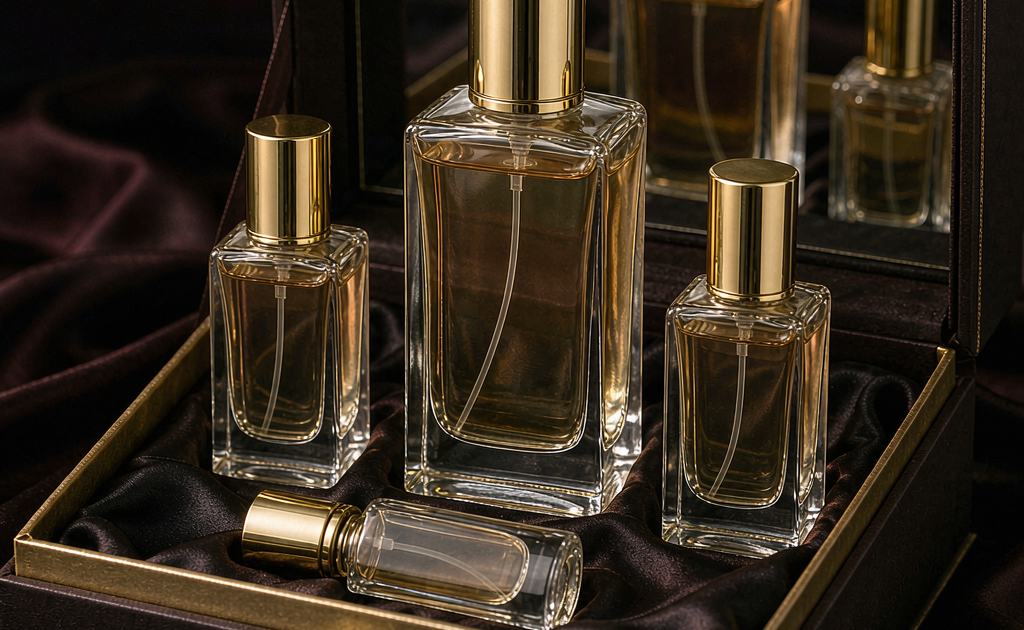
The most durable gift set structures follow a simple principle: one hero, one or two supporting roles, optional travel size. The proven configurations include:
The classic trio — 100 ml + 30 ml + 10 ml. The hero bottle anchors perceived value; the 30 ml is the “for the handbag” unit; the 10 ml covers travel. This is the global best-seller structure for eau de parfum gift sets and maps cleanly onto a rectangular rigid box with three cavities.
The duo — 50 ml + 10 ml. A tighter, more affordable set popular in mid-market positioning and holiday promotional runs. Fits a compact box, keeps freight weight down (important: a fully loaded trio in heavy glass can push 900 g–1.2 kg per set before the carton).
The body-line extension — 50 ml bottle + 150–200 ml body lotion or shower gel. Technically a mixed-material set: the second item is usually plastic or a wider-neck cosmetic glass bottle. This configuration trades glass complexity for supply-chain complexity — you are now coordinating two different product types into one box.
The discovery collection — 5 × 5–7.5 ml miniatures. A sampling-led set that drives full-size conversion. Glass-heavy for its size (five molds or one shared mold family), and merchandised heavily around Q4.
Choose the architecture before any packaging design work. The insert, the box dimensions, the freight class, and even the retail price point all cascade from the bottle lineup. If you are still deciding between single sizes for the hero SKU itself, our comparison of 100 ml versus 125 ml bottles covers the shelf-impact and unit-cost trade-offs that shape that decision.
Glass Choices Within the Set
Once the lineup is set, decide how the bottles relate to each other visually and technically:
Shared mold family vs. dedicated molds. The cost-efficient route is a hero mold plus a scaled-down companion using the same shoulder language — buyers read it as one design family, and your supplier can sometimes cut the companion from an existing mold with minor modifications. Fully bespoke molds for each size look best but can add $12,000–30,000 in tooling across a trio.
Finish consistency. A gift set fails visually when the three bottles carry three different cap finishes. Lock one finish decision (say, brushed gold zamac on all three) and let the size create hierarchy, not the material. Our guide to cap materials explains how zamac, Surlyn, and ABS behave across different bottle scales.
Weight balancing. A 100 ml bottle at 380 g next to a 10 ml at 45 g creates a lopsided unboxing. Designers mitigate this with the layout — travel size placed in the lid cavity, hero centered — but the weight ratio should be checked at the 3D render stage, not after molding.
The Insert Is the Real Engineering Task
Ask any contract packer: the insert is where gift sets go wrong. Glass bottles inside a rigid box face three failure modes in transit — shock (drops), vibration (road/sea freight), and compression (stacking in master cartons). Your insert must handle all three, which means:
Cavity tolerances. Glass bottles have manufacturing tolerances of ±0.5 mm or more on outer dimensions — more if the design has a heavy base or pronounced shoulders. A vacuum-formed or molded pulp insert cut to nominal dimensions will gripe bottles at the top of tolerance and rattle the ones at the bottom. Spec cavity tolerances at +1.0 to +1.5 mm on each side, with a soft overcap or ribbon to stop vertical movement.
Material selection. The common options, in ascending cost:
- Molded pulp / paperboard: eco-friendly story, good compression, moderate shock absorption; best for sets under ~800 g total.
- EVA foam with flocked or velvet lamination: excellent shock control, premium hand feel, but petroleum-based and increasingly flagged under EU packaging rules. If your market includes the EU, review the EU Packaging and Packaging Waste Regulation direction on recyclability before committing to laminated foam structures.
- Molded silk-board or rigid card inserts: the luxury standard; requires precise engineering because the material has minimal compliance — it holds bottles rather than cushioning them, so the outer box must carry the shock performance.
- Recycled PET thermoforms: transparent, precise, recyclable stream; works well when the set design wants the bottles visible on open.
Drop testing. The assembled set should pass ISTA 3A-style testing — that means drops on faces, edges, and corners from the height appropriate to your distribution channel, plus vibration and compression. A set that passes with bottles individually boxed can still fail assembled, because the insert transmits energy between cavities. Test the system.
Weight, Freight, and the Hidden Cost Line
Gift sets punish naive cost models. Run the numbers on all three freight layers:
- Component weight: bottles + closures + insert + rigid box. A 100/30/10 trio in heavy flint glass with zamac caps typically lands at 1.0–1.4 kg per finished set.
- Master carton density: sets are rigid boxes — they don’t nest. A pallet of single bottles packs denser than the same glass volume in gift sets, so your per-unit freight can rise 15–30%.
- E-commerce last mile: if the set sells DTC, it must survive parcel networks, not just palletized wholesale. That usually means an additional corrugated shipper around the gift box.
Practical mitigation: keep total set weight under ~1.2 kg where possible (courier dimensional breakpoints), design the rigid box to nest two-high in the master carton, and agree on who supplies the shipper — brand or filler — before PO stage.
Timeline and MOQ Reality
A gift set is a program, not an order. Realistic planning for a custom trio:
- Weeks 0–3: bottle lineup freeze, 3D renders, insert engineering drawings
- Weeks 3–10: mold cutting for any bespoke companion bottles; box and insert sampling in parallel
- Weeks 10–13: fit trials — real bottles into real inserts into real boxes — plus transit testing
- Weeks 13–18: mass production, decoration, assembly or co-packing
Total: 4–5 months from freeze to fill-ready. MOQs typically start at 3,000–5,000 sets for assembly programs; lower for sets built entirely from stock bottles and stock boxes. If your timeline is shorter, the fallback is the duo configuration built from existing molds, which can compress to 8–10 weeks.
Our walkthrough of how perfume glass bottles are made explains what happens inside those mold and production weeks, and this guide to sampling from 3D render to prototype maps the approval checkpoints you should build into the schedule.
A Pre-PO Checklist
Before signing the gift set PO, confirm:
- Every bottle in the set has a signed-off dimensional drawing and a physical golden sample
- Insert cavity tolerances account for glass tolerance stack-up (+1.0–1.5 mm per side)
- Transit test report exists for the assembled set, not just components
- Cap finish and decoration are consistent across all sizes
- Total set weight is within your freight and courier breakpoints
- Assembly responsibility (factory vs. filler vs. co-packer) and its cost are written into the quotation
Gift sets reward brands that engineer the system early. The ones that scramble in September for a November launch pay for it in air freight and compromised inserts.
FAQ
What is the most popular perfume gift set configuration?
The 100 ml + 30 ml + 10 ml trio is the global best-seller for eau de parfum gifting, followed by the 50 ml + 10 ml duo for mid-market price points. Discovery sets of 5 × 5–7.5 ml miniatures dominate sampling-led strategies, especially in Q4 holiday programs.
How much does a custom perfume gift set cost to develop?
Budget components: mold tooling for any bespoke bottles ($6,000–15,000 per mold), box and insert tooling ($2,000–8,000 depending on structure), sampling and transit testing, then per-unit assembly costs. A fully custom trio program typically needs $15,000–35,000 in upfront development before mass production MOQs of 3,000–5,000 sets.
What insert material is best for glass bottles in a gift set?
It depends on weight and market. Molded pulp suits sets under ~800 g and carries a strong eco story for EU markets. Flocked EVA foam gives the best shock protection for heavy trios but faces recyclability scrutiny under EU packaging regulation. Rigid silk-board inserts are the luxury standard but transfer shock duty to the outer box design.
How do I prevent bottles from breaking in transit?
Engineer all three layers: insert cavities with +1.0–1.5 mm tolerance and vertical retention, a rigid outer box with adequate stacking strength, and a corrugated shipper for parcel channels. Most importantly, transit-test the fully assembled set — passing component tests does not guarantee the assembled system survives drops, vibration, and compression.
What is the lead time for a custom perfume gift set?
Plan 4–5 months from lineup freeze to fill-ready for a custom trio including mold cutting, insert engineering, fit trials, and transit testing. A duo built from existing bottle molds and a semi-custom box can compress to 8–10 weeks. Start holiday gift set programs no later than June–July for a November shelf date.