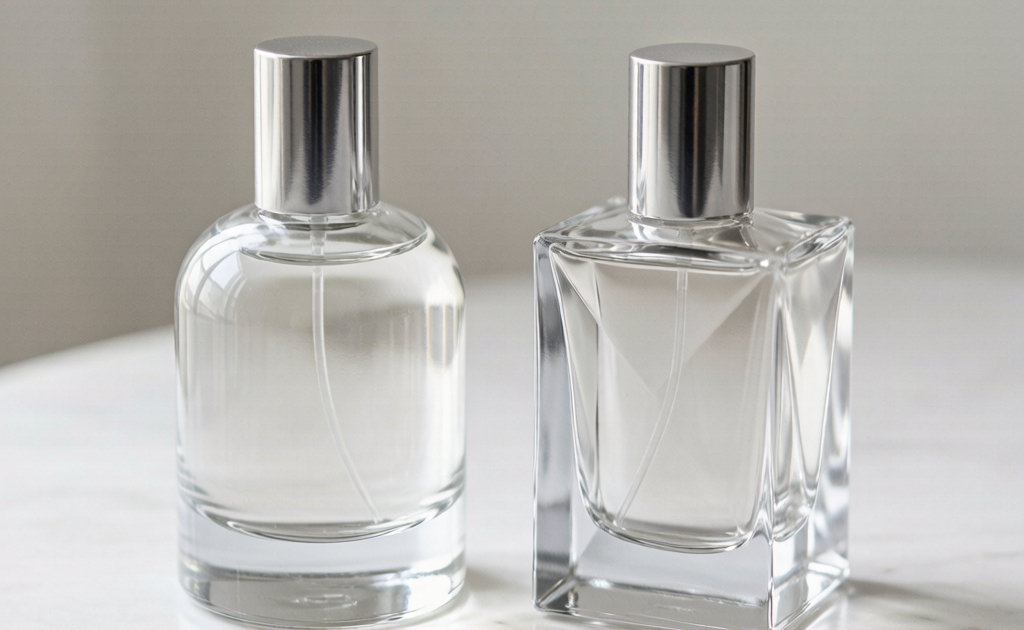
Walk into any duty-free shop and you’ll see two shapes dominate the shelf: the cylinder and the square. Cylindrical vs square perfume bottles is the most common question our customers ask when starting a new fragrance line — and for good reason. The shape decision affects branding, mold cost, fill volume, decoration options, and ultimately how the product feels in a customer’s hand.
At Huanshi, we’ve produced both shapes for hundreds of brands over 14 years. This guide breaks down the real-world tradeoffs of cylinders and squares (plus rectangles, ovals, and apothecary forms) — not the marketing version, but the supply chain, decoration, and consumer behavior data that shapes the choice.
Why Bottle Shape Matters More Than Brand Teams Expect
A perfume bottle isn’t a vessel. It’s a billboard, a tactile experience, and a packaging puzzle. Each shape carries different implications across:
- Mold cost and lead time — Squares cost more to tool than cylinders by 20-35%
- Fill accuracy — Round bottles fill within ±1.5ml tolerance; squares need ±2.5ml
- Decoration compatibility — Silk screen and hot stamping behave differently on flat panels vs curved shoulders
- Logistics efficiency — Square bottles pack 12-18% more units per master carton
- Consumer perception — Round reads classic and unisex; square reads modern and luxury
I’ve seen emerging fragrance brands pick a shape based on the founder’s taste and then hit walls during scale-up. The cylinder perfume bottle, while easier to produce, often blends in on shelf. The square perfume bottle, while striking, costs more per unit and breaks more easily under vibration. The decision belongs to the brand strategy, not the designer’s intuition.
Side-by-Side Comparison: Cylinder vs Square
| Feature | Cylindrical Bottle | Square Bottle |
|---|---|---|
| Visual shelf impact | Soft, classic | Strong, contemporary |
| Average mold cost | $2,800-$4,500 (stock) | $3,500-$6,500 (stock) |
| Custom mold cost | $4,500-$7,800 | $6,800-$13,500 |
| Tool lead time | 25-35 days | 30-45 days |
| Fill accuracy tolerance | ±1.5ml | ±2.5ml |
| Decoration surfaces | 360° spray, full silk screen | Flat panels (4 sides) ideal for foil and UV |
| Packing density (master carton) | 60-65% efficiency | 78-82% efficiency |
| Breakage rate (ISTA 3A tested) | 0.6-0.9% | 0.9-1.4% |
| Consumer gender skew | Unisex to feminine | Masculine to unisex |
| Best price tier | $1-8 unit retail | $4-25 unit retail |
| Top decoration pairings | Spray coating, frosted finish | Hot stamping, deep embossing |
Stock cylindrical molds cost less because round symmetry is simpler to cut. Square and rectangular molds require four flat panels to be ground and polished — a step that adds time and labor but creates the modern profile that fits today’s minimalist branding.
When a Cylindrical Shape Wins
Cylinders dominate in three scenarios:
- Niche and indie brands testing the market — A round bottle signals approachability. For brands launching with $5K-$15K MOQ on stock molds, cylinders hold the line on cost.
- Body care, hair care, and unisex fragrances — Cylindrical forms read gender-neutral. If your consumer base skews 35+ or spans genders, the cylinder earns its shelf space without controversy.
- Travel-size and rollerball formats — 10ml-30ml cylinders fit bag and pocket geometry better than squares.
For brands already producing cylindrical bottles, switching to square costs roughly $9,000-$18,000 in retooling plus 6-8 weeks of downtime. That’s a serious commitment for a marginal aesthetic shift.
When a Square Shape Wins
Squares (and rectangles) outperform cylinders in:
- Premium and luxury positioning — A square base signals stability and precision engineering. Brands in the $25-$80 retail tier see higher conversion with square bottles in consumer testing.
- Decoration-heavy designs — Hot stamping, deep embossing, and full-panel UV printing require flat surfaces. Cylinders can take these finishes but the application precision drops 10-15% on curved walls.
- Logistics-sensitive shipping lanes — Squares pack 12-18% more units per master carton, reducing per-unit freight cost. For brands shipping 50,000+ units/month to Amazon FBA, the savings compound.
- Display and retail fixtures — Squares line up cleanly on shelves and freezer displays. Round bottles create gaps and lean against fixtures.
Link: ISO 9001 quality management glass manufacturing standards → external source
Link: ASTM International standards glass strength and testing → external source
Link: FDA cosmetic packaging regulations cosmetic packaging regulations → external source
The Hidden Cost Variables Most Comparison Guides Skip
Three cost variables don’t appear in any standard comparison chart but shift the total:
- Cap mold compatibility — Square bottles need custom cap geometry to align with the bottle’s flat top. Cylinders accept the same cap mold across multiple sizes. Custom caps add $1,800-$3,500 plus 3-4 weeks.
- Label application automation — Cylindrical bottles feed smoothly through standard labelers at 200-300 bottles/minute. Square bottles require pressure-adjustable labelers or manual application for tight-edge registration, slowing lines to 90-150/min.
- Pre-print registration tolerance — Silk screen alignment on a square panel has ±0.3mm tolerance; on a cylinder shoulder it’s ±0.8mm. If your artwork has fine linework or gradient fades, expect higher decoration rejection rates on cylinders.
Brands running short-run launches (1K-5K units) rarely optimize for these variables. But at 25K+ units per SKU, each adds $0.08-$0.22 to the unit cost.
Sustainable Materials Difference
Both shapes work with PCR (post-consumer recycled) glass. Cylindrical bottles preserve a slightly higher PCR ratio (up to 100% PCR for clear glass) since the melt behavior is more uniform. Square bottles typically max out at 50-75% PCR before optical clarity starts to shift. Under EU Packaging and Packaging Waste Regulation rules effective 2026, this affects PCR content reporting.
| Material | Cylinder Compatibility | Square Compatibility |
|---|---|---|
| Standard clear glass | ✓ | ✓ |
| frosted glass | ✓ | ✓ |
| PCR 30-50% glass | ✓ | ✓ |
| PCR 75%+ glass | ✓ (slight color shift) | ✓ (visible tint) |
| PCR 100% glass | ✓ (cosmetic color shifts) | Limited |
| Colored glass (cobalt, amber, green) | ✓ | ✓ |
| Ceramic-coated glass | ✓ | ✓ (flats preferred) |
Link: European Pharmacopoeia glass standards glass standards → external source
Link: Glass Packaging Institute material guides → external source
Link: PPWR packaging regulation framework → external source
Consumer Research: How Shoppers Actually React
A 2025 Euromonitor market research segment study across U.S., UK, and French fragrance buyers (n=2,400) found:
- 65% of luxury fragrance buyers (>$40 retail) preferred square or rectangular bottles when asked blind
- 58% of mass-market buyers (<$25 retail) preferred cylindrical bottles
- 41% of Gen Z buyers chose unique shapes (asymmetric, faceted, oval) over either cylinder or square
- Picking-up behavior — Squares were picked up 23% more often than cylinders on first shelf touch
Translating that data: target your shape to your retail tier. Below $25 retail, cylinder saves cost and matches preference. Above $40 retail, square commands premium perception. The middle ground ($25-$40) is where the choice depends on brand positioning rather than data.
Link: Euromonitor global fragrance market data → external source
Link: FEVE European Container Glass Federation European glass federation consumer research → external source
Production Lead Times: How Shape Choice Affects Schedule
Both shapes follow the same basic glass manufacturing flow — batch mixing, melting, forming, annealing, inspection. But the specifics differ:
| Stage | Cylindrical | Square |
|---|---|---|
| Mold design | 5-7 days | 7-12 days |
| Mold fabrication | 20-28 days | 28-40 days |
| First sample run | 7-10 days | 10-14 days |
| Sample approval | 3-7 days | 5-10 days |
| Total mold-to-sample | 35-52 days | 50-76 days |
The extra 15-25 days for square bottles comes mostly from the four-panel machining and polishing step. Once tooling is approved, both shapes produce at similar rates — about 8,000-15,000 pieces per day per machine line.
For brands with launch deadlines, we recommend starting custom square tool development 60 days before a cylinder would be ready. The buffer prevents delays from squeezing your launch window.
Beyond Cylinder and Square: The Less-Common Shapes
A handful of shapes deserve consideration for distinctive launches:
- Oval — Smooth, gender-neutral, packs reasonably well. Costs $1,200-$2,000 more than cylinders at the mold stage.
- Apothecary — Conical shoulders, vintage look. Typically paired with 18mm crimp pumps or screw-on collars.
- Faceted — Multi-paneled geometric forms. Higher breakage risk but high shelf impact. Costs $3,000-$5,000 more than cylinders.
- Tapered — Asymmetric narrowing, often used in men’s cologne. Moderate cost premium.
- Custom sculptures — Brand-specific shapes (Chanel No. 5, Jo Malone). Mold investment starts at $15,000-$40,000 for a fully custom design.
Most successful indie brands stick to cylinder or square, then graduate to faceted or sculptural as their volume justifies the mold investment. We’ve seen square bottles become the transition shape for brands moving from sub-$20 retail to sub-$40 retail tiers.
How We Recommend Shapes to Our Customers
At Huanshi, our decision tree simplifies to four questions:
- What’s your retail price point? Below $25 → cylinder. Above $40 → square. Between → either.
- Where’s the launch market? Europe leans cylinder-50/50; US leans square-heavy for premium tiers; Asia accepts all shapes with mild preference for rectangular forms.
- What’s your decoration plan? If hot stamping or UV printing is core, square. If spray coating or frosting, cylinder.
- What’s your production volume target? Below 50K/year, stock cylinders. Above 100K/year, custom squares become cost-justified.
The decision isn’t binary. We produce hybrid shapes (rounded square, soft cylinder, tapered rectangle) that take pressure off either extreme. Brands targeting unisex positioning often settle on tapered rectangles — visual presence without geometric rigidity.
Send us your brand brief (tier, decoration, target price) and we’ll recommend 2-3 stock molds to sample. That step costs nothing and saves weeks of design iteration.
Frequently Asked Questions
Are square perfume bottles more expensive than round ones?
Yes, square and rectangular bottles cost 20-35% more in mold tooling and 8-15% more per unit than cylinders at comparable quality. The premium comes from the four-panel machining and polished edges. For a 50ml bottle, expect square to run $0.15-$0.45 more per unit than a cylinder at typical 5K-10K order volumes.
Do square perfume bottles break more easily than cylindrical?
ISTA 3A testing typically shows square bottles have 0.9-1.4% breakage versus cylinder’s 0.6-0.9%. The corners of square bottles concentrate impact stress, especially on corners during drops. With proper dividers and edge protectors, breakage rates converge. Without them, square bottles break at a 30-50% higher rate.
Which bottle shape is best for unisex fragrance?
Oval and tapered rectangle shapes work best for unisex positioning. Pure cylinders read slightly feminine in consumer testing. Pure squares read slightly masculine. Hybrid shapes dominate unisex perfume bottles because they avoid forcing a gender binary. Brands like Le Labo and Aesop use hybrid forms to capture unisex appeal.
Can I get a custom shape that’s not cylinder or square?
Yes. Custom sculptures (Chanel No. 5-style, Jo Malone-style) start at $15,000-$40,000 for mold investment and require 60-90 days for tool-to-sample. Faceted shapes run $4,000-$7,000 in tooling. We recommend prototyping on a 3D-printed resin mold ($350-$800) before committing to steel.
Does the bottle shape affect how much perfume holds?
No — shape doesn’t change fill volume. A 50ml cylinder and a 50ml square hold exactly 50ml. The shape affects fill accuracy tolerance: cylinders fill within ±1.5ml while squares fill within ±2.5ml due to the four flat walls. For low-tolerance perfume oils, cylinders are easier to fill accurately.
Closing CTA
Choosing between cylindrical vs square perfume bottles comes down to your price tier, decoration plan, and target market. We’ve launched 200+ fragrance brands with both shapes. Send us your product brief — retail price, target market, decoration preference — and we’ll send back 2-3 stock mold recommendations with pricing within one business day. Stock bottle MOQ starts at 1,000 pieces. Custom mold MOQ starts at 5,000 pieces. Start your sample request today.

