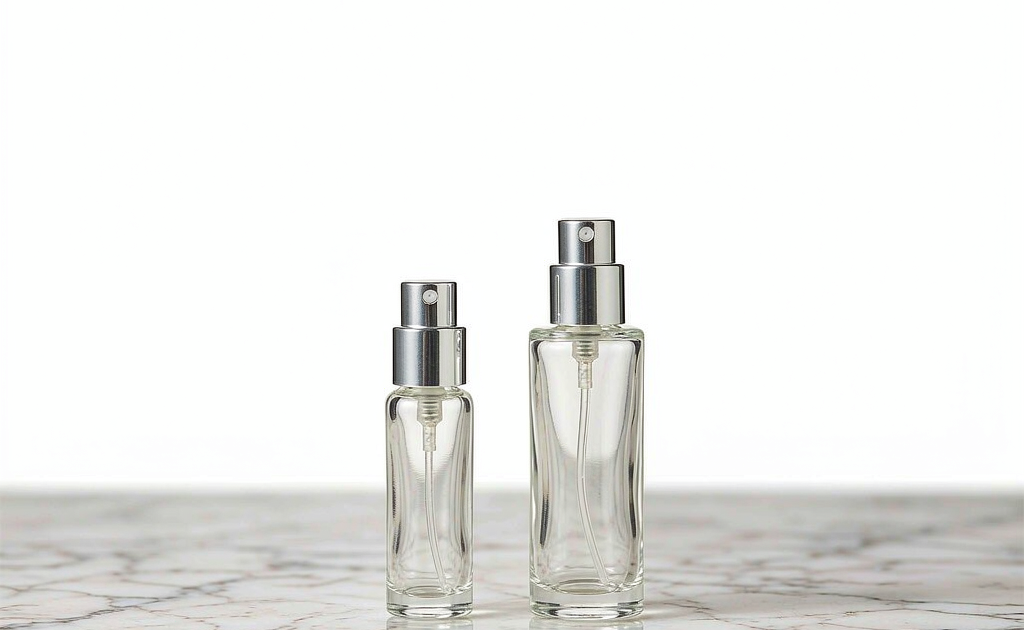
If you sell fragrance at retail, online, or through department-store counters, the smallest bottle in your lineup often does the biggest commercial work. The 5ml perfume sample bottles versus the 10ml decant-and-discovery-format debate is not an aesthetic question — it is a margin, logistics, and conversion question that packaging buyers need to answer before placing a custom order. Get the format wrong and you either give away too much juice per unit or you lose discovery-set shoppers who wanted something small enough to try and cheap enough to impulse-buy.
This guide compares the two sizes from a B2B sourcing perspective: unit economics, filling and crimping compatibility, shipping weight thresholds, and — most importantly — which size converts better in which channel. The short answer: 5ml wins for mass discovery sampling and influencer seeding; 10ml wins for paid travel-retail sets, subscription boxes, and any program where the sample itself must feel like a purchasable product rather than a freebie.
Why Sample Sizes Matter More Than Ever
Discovery sets have become the fastest-growing segment in fragrance e-commerce. Industry observers consistently report that sample-first programs reduce return rates and lift full-bottle conversion, because the customer’s first physical interaction with the brand is a low-cost, low-risk purchase. For an emerging brand, a well-priced discovery set is often the cheapest customer-acquisition tool available — cheaper than paid ads on a per-converted-customer basis once repeat purchase behavior kicks in.
For the packaging buyer, that means sample bottles are no longer an afterthought ordered at the last minute. They are a strategic SKU with their own MOQ, mold, decoration, and lead-time considerations. And because a 5ml and a 10ml bottle look similar in a catalog photo, the differences only become obvious once you start filling, capping, and shipping them at volume.
The Physical Differences That Drive Cost
Volume and Juice Cost per Unit
The math on fragrance concentrate is unforgiving. At a typical oil concentration of 18–20% for eau de parfum, a 10ml bottle contains twice the juice of a 5ml — and juice, not glass, is usually the most expensive component of a sample unit once you account for rare naturals like oud, rose absolute, or orris. A brand giving away 50,000 units per year at 10ml instead of 5ml effectively doubles its sampling budget with no change in perceived generosity for many consumers, because both sizes read as “tiny bottle” on a counter or in an unboxing video.
For paid discovery sets — where the customer buys the sample — 10ml often works in your favor: consumers judge value by fill volume, and a 10ml priced at $12–15 feels substantially more generous than 5ml at $8–10, even though your incremental cost is mostly juice.
Glass Weight and Shipping Thresholds
A 5ml sample bottle in flint glass typically weighs 25–40g empty; a 10ml equivalent runs 45–70g. That difference compounds fast. If your fulfillment operation ships internationally and you sit near a 100g or 250g shipping tier, the cap-and-bottle weight can push a parcel into the next price band. For subscription-box operators shipping thousands of parcels monthly, that 20–30g per unit difference is a line item worth negotiating with your glass supplier — sometimes it is cheaper to move to a thinner-wall 10ml design than to absorb the freight.
Wall thickness also matters for transit survival. At 5ml, most standard molds produce glass thick enough to survive drop testing; at 10ml with thin walls, you should require ISTA-style drop and vibration testing before committing. We covered our approach to this in detail in our article on perfume bottle packaging and ISTA 3A testing.
Filling Line Compatibility
Both sizes usually share the same neck finish — commonly 13/415 or 15/415 crimp — which means one set of change parts can often serve both sizes on the same filling and capping line. This is a genuine sourcing advantage: ask your bottle supplier to confirm neck finish consistency across sizes before you order, because it lets you switch production between 5ml and 10ml without engineering downtime. For brands without in-house filling, co-packers typically charge a minimum batch fee, so running both sizes in one campaign amortizes that fee across two SKUs.
Conversion Performance: What the Channel Data Says
E-commerce Discovery Sets
In online discovery programs, 5ml has a structural advantage: it allows you to offer 4–6 scents in one set at a price point under $30. Consumers comparing a $28 six-piece 5ml set against a $45 three-piece 10ml set overwhelmingly choose breadth. More scents per set means more chances for the customer to find a favorite — and the full-bottle purchase follows the discovery, not the sample size itself. If your business model treats samples as a funnel, 5ml converts better per dollar spent.
Travel Retail and Subscription Boxes
Where the sample must stand alone as a product — travel retail counters, monthly subscription boxes, gift-with-purchase tiers — 10ml wins. Airport security rules permit containers up to 100ml, so the constraint is not regulatory but psychological: a 10ml atomizer in a clear zipper bag reads as a legitimate travel product, while 5ml reads as an airline freebie. Subscription-box operators report that 10ml formats support higher monthly price points without churn complaints, because subscribers perceive “a real bottle” rather than “a sample.”
Influencer and PR Seeding
For seeding campaigns, 5ml is usually sufficient. The goal is sensory exposure, not product utility, and a smaller unit lowers your cost per touched influencer by roughly 40% once juice, glass, decoration, and shipping are counted. Reserve 10ml for top-tier partnerships where the unboxing needs to feel premium — a heavier glass bottle with a metal cap photographs better and survives the mail better.
Sourcing Considerations for Each Size
MOQ and Mold Economics
Both 5ml and 10ml bottles are generally available as stock molds from established suppliers, which keeps MOQ in the 3,000–5,000 unit range and avoids tooling fees entirely. Custom-mold sample bottles are rarely justified: tooling for a small-format bottle costs nearly as much as for a full-size one because mold complexity doesn’t scale down with volume. If you need brand differentiation, spend your budget on decoration — silk-screen printing, hot-stamped caps, or a colored coating — rather than a proprietary silhouette. Our perfume bottle mold cost guide breaks down when custom tooling actually pays for itself.
Decoration Constraints on Small Formats
Screen printing on a 5ml cylindrical body gives you roughly 25–35mm of printable height — enough for a logo and one line of text, but not a full back label. At 10ml you gain 10–15mm of canvas. Plan artwork accordingly: single-color print on 5ml, two-color on 10ml, and always request a printed sample before mass production because ink behavior on small radii differs from full-size bottles.
Cap and Atomizer Choices
The sprayer is the hidden cost driver in small formats. A standard crimp sprayer adds $0.08–0.15 per unit; a metal-overcap sprayer adds another $0.05–0.12. On a 5ml bottle whose total unit cost might be $0.60–1.10, the closure can represent 30% of the bill of materials. This is why many brands specify a simple overcap for discovery sets and a premium metal cap only for the 10ml travel SKU — a two-tier closure strategy that protects margin where volume is highest.
A Practical Decision Framework
Ask three questions in order:
- Is the sample free or paid? Free → 5ml. Paid → 10ml, or both sizes tiered.
- How many scents per set? Four or more → 5ml. One to three → 10ml.
- Does the unit ship internationally at volume? If yes, model the freight weight of both sizes before deciding; the 20–30g gap can flip the answer for parcel-tier-sensitive operations.
Run a controlled test if you can afford it: seed 2,000 units of each size to comparable audiences and track full-bottle conversion over 90 days. The glass is cheap; the data is not.
Working With a Manufacturer
When you brief a supplier on a sample-bottle program, specify: neck finish (so sprayers cross-fit), wall thickness minimums, drop-test requirements, decoration method and print area, and packaging configuration (tray-packed, shrink-wrapped, or pre-assembled). A manufacturer that pre-assembles atomizers at the factory saves you a step — and a common source of leaks — versus bottles that arrive empty with closures shipped separately. Ask for 5ml and 10ml references from their existing clients to sanity-check their small-format quality history, because small bottles amplify every defect: a 0.3mm neck ovality that a 100ml bottle tolerates will leak visibly on a 5ml crimp.
Regulatory note for US-bound programs: cosmetic containers and their labeling fall under FDA cosmetic packaging regulations oversight, and sample sizes are not exempt from ingredient labeling requirements. Review the FDA’s cosmetic labeling guidance when finalizing artwork, because exemption thresholds for small cosmetic packages are size-specific and easier to meet on 5ml than on 10ml — another subtle reason the 5ml format is operationally friendlier for mass sampling.
Conclusion
The 5ml versus 10ml decision is a funnel-design decision, not a packaging detail. Use 5ml to maximize the number of noses you reach per dollar; use 10ml where the sample must earn its own price tag. Both share sprayer hardware, which lets you build a two-tier sampling program on one set of filling-line change parts — the single most overlooked sourcing lever in small-format fragrance packaging.
FAQ
How many sprays does a 5ml perfume sample bottle provide?
A standard atomizer delivers roughly 0.08–0.1ml per spray, so a 5ml bottle yields about 50–60 sprays — enough for a customer to test a scent daily for two weeks, which is the exposure window most brands target in discovery programs.
What is the typical MOQ for 5ml and 10ml perfume sample bottles?
Stock-mold 5ml and 10ml bottles typically carry MOQs of 3,000–5,000 units per size. Custom molds usually start at 10,000–20,000 units and are rarely cost-effective for sample formats; decoration is the better differentiation lever.
Can 5ml and 10ml bottles share the same sprayer and crimping tooling?
Usually yes. Most 5ml and 10ml sample bottles share common neck finishes such as 13/415 or 15/415, meaning one set of crimping change parts serves both sizes. Always confirm the neck finish in writing with your supplier before ordering sprayers separately.
Which size is more cost-effective for influencer seeding campaigns?
5ml is generally 30–40% cheaper per unit once juice, glass, decoration, and shipping are counted, and it provides adequate sensory exposure for seeding. Reserve 10ml for top-tier influencer kits where a premium unboxing justifies the cost.
Are perfume sample bottles exempt from ingredient labeling in the US?
Not fully exempt, but small cosmetic packages benefit from size-specific labeling exemptions under FDA rules, which are easier to satisfy on a 5ml bottle than a 10ml. Check the FDA cosmetic labeling regulations during artwork approval and confirm compliance with your label printer.