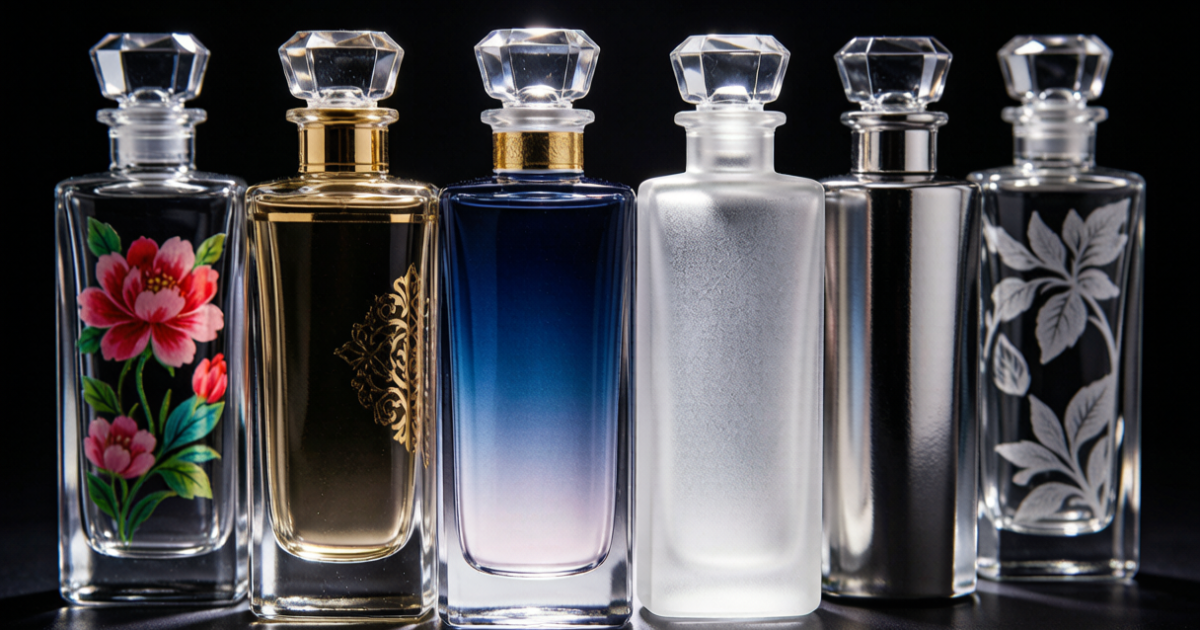
Walk into any department store fragrance section and you’ll see hundreds of perfume bottles. Most contain similar glass. What separates the $40 bottle from the $400 one isn’t the glass — it’s the decoration.
A clear glass perfume bottle costs about $0.30-0.50 off the production line. The same bottle with the right combination of decoration techniques can retail for ten times that, driven entirely by perceived value. The frosting, the gold accent line, the weighted base with a subtle gradient — that’s what makes a customer reach for one bottle over another sitting right next to it.
Here’s the thing though: most buyers don’t know what decoration options exist. They know what they want the final bottle to look like, but they don’t know the process names, the cost implications, or the technical limitations. That knowledge gap costs money.
Let’s fix that. These are the eight decoration techniques that matter for perfume glass bottles in 2026.
1. Silk Screen Printing
The workhorse of perfume bottle decoration. If you see a logo or text printed directly on glass, it’s almost certainly silk screen.
How it works: A mesh screen carries a stencil of your design. Ink is forced through the open mesh areas onto the glass surface. The bottle then goes through a curing oven at 180-220°C, which bonds the ink to the glass permanently.
What it’s good for: Logos, brand names, simple line graphics, decorative bands. Works on flat and gently curved surfaces.
Technical specs:
- Line thickness: minimum 0.3mm
- Color count: up to 4-5 colors per pass (each color needs a separate screen)
- Durability: cured ink resists scratching, alcohol, and normal wear
- Cost per bottle: $0.05-0.15 (depends on color count)
Watch out for: Sharp corners in your design. Screen printing produces slightly rounded corners because of how ink flows through mesh. If your logo has razor-sharp angles, consider pad printing instead.
One more thing: each color needs its own screen and its own pass through the printing station. A 4-color logo takes 4 times longer than a 1-color logo. That affects both cost and production speed.
2. Hot Stamping (Gold Foil)
That gold or silver accent you see on luxury perfume bottles? Hot stamping. Also called foil stamping.
How it works: A heated brass die presses metallic foil against the glass surface. The foil transfers only where the die makes contact, leaving a thin metallic layer bonded to the glass.
What it’s good for: Premium logos, decorative lines, accent borders, serial numbering. The metallic finish signals luxury instantly.
Technical specs:
- Foil colors: gold, silver, copper, rose gold, holographic, matte black
- Line thickness: minimum 0.5mm (thicker than silk screen)
- Durability: excellent when properly applied — resists scratching and chemical exposure
- Tooling: brass die required ($50-200 per design)
- Cost per bottle: $0.10-0.30
Watch out for: Small text. Hot stamping doesn’t handle fine detail well. If your brand name is in a delicate serif font at 6pt, the foil will blob and the letters will merge. Stick to bold, simple designs.
The brass die is a one-time cost. Once you have it, you can reuse it for reorders at no additional tooling charge. Just keep it clean — a scratched die produces scratched foil.
3. Spray Coating
If you want a colored bottle but can’t justify the cost of colored glass (which requires a full batch melt with colorants), spray coating is your answer.
How it works: The bottle rotates on a spindle while an electrostatic spray gun applies a thin layer of colored lacquer. The coating cures in an oven, creating a durable colored finish on the exterior surface.
What it’s good for: Opaque colors, translucent tints, gradient effects, pearl finishes, metallic-look coatings. Essentially any color you can imagine.
Technical specs:
- Color matching: Pantone Matching System (PMS) available
- Coverage: full bottle, partial bottle, or gradient (faded effect)
- Coating types: glossy, matte, satin, metallic, pearlescent
- Durability: good — resists scratching but can chip on edges
- Cost per bottle: $0.15-0.40 (depends on complexity and color)
Watch out for: Gradient coating. It looks stunning but requires precise control of spray timing and bottle rotation. Not every factory can do it well. Ask for samples before committing.
Spray coating also changes the tactile feel of the bottle. A matte coating feels warmer and softer in the hand than bare glass. That sensory difference matters at the retail shelf — customers pick up bottles before they smell the fragrance.
4. Frosting (Acid Etching)
frosted glass bottles diffuse light beautifully. The surface has a soft, matte quality that feels premium and understated.
How it works: Two methods exist. Acid etching uses hydrofluoric acid to create micro-pits on the glass surface, scattering light. Sandblasting uses fine abrasive particles blasted at the glass under pressure.
What it’s good for: Full-bottle frosting, selective frosting (frosted bands or patterns), creating contrast between clear and frosted areas.
Technical specs:
| Method | Cost/bottle | Finish Quality | Environmental Concern |
|---|---|---|---|
| Acid etching | $0.08-0.15 | Smooth, uniform | Acid waste management |
| Sandblasting | $0.10-0.20 | Slightly rougher texture | Dust containment |
Watch out for: Acid etching requires proper waste treatment. EU regulations on hydrofluoric acid disposal are strict. If your supplier can’t document their waste process, your bottles might face compliance issues in European markets.
Frosted bottles pair exceptionally well with spray coating accents. A frosted body with a glossy colored base creates depth and contrast that photographs beautifully for e-commerce.
5. Laser Engraving
No tooling. No setup dies. No minimum order penalty. Laser engraving is the most flexible decoration method available.
How it works: A computer-controlled laser vaporizes microscopic amounts of glass from the surface, creating engraved patterns, text, or images. The depth and pattern are entirely programmable.
What it’s good for: Serial numbers, QR codes, fine-line logos, decorative patterns, personalized text. Perfect for small batches and limited editions.
Technical specs:
- Minimum line width: 0.1mm (much finer than any other method)
- Engraving depth: 0.05-0.5mm (adjustable)
- Pattern complexity: virtually unlimited — driven by digital file
- Durability: permanent — it’s physically etched into the glass
- Cost per bottle: $0.20-0.50 (depends on engraving area and complexity)
Watch out for: Speed. Laser engraving is slower than other decoration methods. On a high-volume order (10,000+), it becomes a bottleneck. Use it for small batches, personalization, or selective decoration — not full-bottle coverage.
6. Vacuum Metallization
Want a bottle that looks like polished chrome, silver, or gold? That’s vacuum metallization.
How it works: The bottle goes into a vacuum chamber. A metal (usually aluminum) is vaporized and condenses on the bottle’s interior surface, creating a thin reflective layer. From outside, the bottle looks metallic. Inside, it’s still glass.
What it’s good for: Mirror finishes, metallic silver/gold/chrome effects, creating a premium look without the weight of solid metal.
Technical specs:
- Metal types: aluminum (standard), chromium (higher durability)
- Finish: high-gloss mirror, satin metallic, tinted metallic
- Coating location: interior (most common) or exterior
- Durability: interior coating is permanent; exterior coating needs protective lacquer
- Cost per bottle: $0.25-0.60
Watch out for: Vacuum metallization happens in a chamber, so bottle size is limited by chamber dimensions. Oversized or unusually shaped bottles might not fit. Check with your supplier early.
Also, metallized bottles aren’t transparent — you can’t see the liquid level inside. For some brands that’s fine (luxury positioning). For others it’s a deal-breaker (consumers want to see how much product remains).
7. Pad Printing
When silk screen can’t handle your design — too much detail, too many colors, irregular surface — pad printing steps in.
How it works: A silicone pad picks up ink from an etched plate (cliché) and transfers it to the bottle surface. The flexible pad conforms to curved and irregular surfaces that rigid screens can’t reach.
What it’s good for: Logos on curved bottle shoulders, multi-color designs in a single pass, fine detail work.
Technical specs:
- Minimum line width: 0.15mm
- Color count: up to 6 colors (registered in single pass on multi-color machines)
- Surface compatibility: flat, convex, concave — the pad adapts
- Durability: similar to silk screen when properly cured
- Cost per bottle: $0.08-0.20
Watch out for: Ink opacity. Pad printing deposits less ink per pass than silk screen, so colors on dark or colored glass might need a white underbase. That doubles the printing passes.
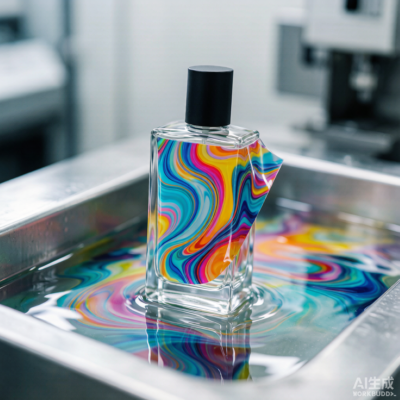
8. Water Transfer Printing
For complex, full-coverage patterns — think camouflage, marble, carbon fiber, or custom artwork — water transfer printing is the answer.
How it works: A thin film printed with your pattern floats on water. The bottle is dipped through the film, which wraps around the entire surface. The pattern transfers to the glass, covering even complex geometries.
What it’s good for: Full-bottle patterns, designs that wrap completely around irregular shapes, limited edition decorative effects.
Technical specs:
- Pattern options: nearly unlimited (custom films can be printed)
- Coverage: 360° wrap including complex curves
- Durability: good with clear topcoat applied
- Minimum order: typically 1,000+ bottles (film setup cost)
- Cost per bottle: $0.30-0.70
Watch out for: Consistency. Each bottle is dipped individually, so there’s natural variation in pattern placement. For some designs this is fine (organic patterns). For designs requiring precise registration, it’s a problem.
Combining Techniques: Where the Magic Happens
No premium perfume bottle uses just one decoration method. The magic happens in combination.
Here are proven combinations that work:
| Combination | Effect | Example Use Case |
|---|---|---|
| Frosting + silk screen | Frosted body with crisp logo | Minimalist luxury brands |
| Spray coating + hot stamping | Colored body with gold accent | Classic luxury positioning |
| Frosting + laser engraving | Frosted body with engraved pattern | Limited edition / artistic |
| Clear glass + vacuum metallization + silk screen | Mirror finish with printed logo | Bold, modern fragrance |
| Spray gradient + pad printing | Fade effect with detailed logo | Trendy / Instagram-friendly |
The cost of combining techniques adds up. A bottle with three decoration methods might cost $0.50-1.00 more per unit than plain glass. At 5,000 units, that’s $2,500-5,000 in additional decoration cost.
Is it worth it? Look at it this way: decoration is the single most cost-effective way to differentiate your bottle from every other 50ml flint glass bottle on the market. The glass is a commodity. The decoration is your brand.
Choosing the Right Decoration for Your Project
Three questions narrow it down fast:
1. What’s your order quantity?
- Under 1,000: laser engraving, pad printing (low/no tooling)
- 1,000-5,000: add silk screen, frosting, spray coating
- 5,000+: all options available, including water transfer and vacuum metallization
2. What’s your budget per bottle for decoration?
- $0.05-0.15: single-color silk screen or frosting
- $0.15-0.35: multi-color silk screen, hot stamping, spray coating
- $0.35-0.70: vacuum metallization, water transfer, combinations
3. What’s your brand positioning?
- Minimalist/clean: frosting + single-color silk screen
- Classic luxury: spray coating + hot stamping
- Bold/modern: vacuum metallization + laser engraving
- Artistic/boutique: water transfer + selective frosting
Match the technique to your brand, not the other way around. A minimalist brand with water transfer marble pattern sends mixed signals. A luxury brand with a single-color silk screen logo on clear glass looks unfinished.
Ready to discuss decoration options for your perfume bottles? Contact Huanshi — we offer all 8 decoration techniques in-house, with samples available for every method.