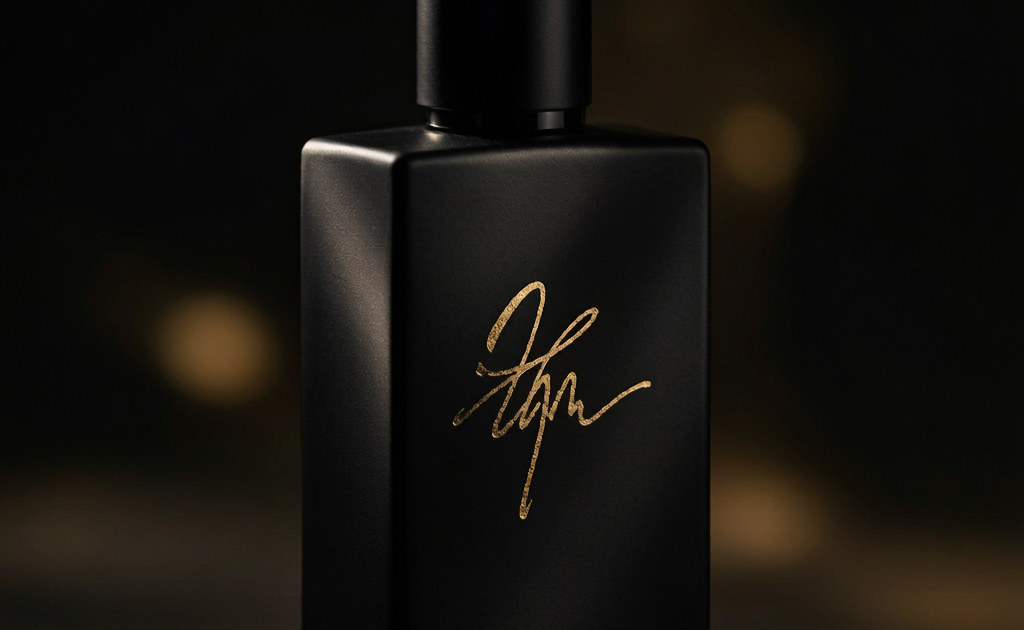
I remember the first time a client asked for matte black perfume bottles. It was 2024, and the request was unusual enough that I had to check if our factory could even produce them. Today, matte black is one of our most requested finishes — it’s become the go-to choice for brands that want to signal luxury, mystery, and modern minimalism in one stroke.
But matte black is tricky. Get it wrong and you get streaky, uneven coating that looks cheap. Get it right and you have a bottle that commands $120+ on a department store shelf. Here’s everything you need to know about specifying, ordering, and quality-checking matte black perfume bottles.
Why Matte Black Works
The psychology is straightforward. Black communicates authority, exclusivity, and timelessness. The matte finish softens the harshness of pure black, adding sophistication that glossy black can’t match. In a market flooded with clear and frosted bottles, matte black stands out without being loud.
Brands like Tom Ford, Byredo, and Maison Margiela have used matte black to anchor their identity. The finish works equally well for masculine, feminine, and unisex fragrances — it’s gender-neutral by design.
How Matte Black Is Achieved on Glass
There are four primary methods. Each has different cost, durability, and visual characteristics:
Method 1: Spray Coating (Most Common)
The bottle is coated with a matte black paint layer after forming. This is the industry standard because it’s cost-effective and versatile.
- Cost: $0.15-0.35 per bottle
- Durability: Medium — can scratch with hard contact
- Uniformity: Good, but streaks possible on curved surfaces
- Color depth: Solid, opaque black
The process involves electrostatic spray guns applying a lacquer-based matte black coating, followed by a curing oven at 180-200°C for 20-30 minutes. The matte effect comes from micro-texture additives in the coating.
Method 2: Electroplating (PVD)
Physical Vapor Deposition applies a thin metal layer (typically chromium or titanium) that’s then treated to a matte finish.
- Cost: $0.30-0.60 per bottle
- Durability: High — scratch-resistant
- Uniformity: Excellent — conforms to all surfaces
- Color depth: Deep, metallic-tinged black
PVD is more expensive but delivers a premium feel that spray coating can’t match. The bottle feels heavier in the hand because the plating adds a subtle density to the surface.
Method 3: Colored Glass (Melt-Stage)
Black pigment (typically iron oxide + manganese) is added to the glass melt itself. The bottle comes out of the mold already black.
- Cost: $0.08-0.15 per bottle (just the colorant)
- Durability: Permanent — color is in the glass, not on it
- Uniformity: Excellent — no coating to wear off
- Color depth: Very dark, but not truly matte (glass surface is glossy)
To achieve a matte look with colored glass, you need secondary sandblasting or acid frosting. This adds $0.08-0.20. Total: $0.16-0.35.
Method 4: Sandblast + Black Infusion
The glass is first sandblasted to create a matte surface, then a black pigment is infused into the micro-abrasions.
- Cost: $0.20-0.40 per bottle
- Durability: Very high — pigment is embedded in the glass
- Uniformity: Good — depends on sandblast consistency
- Color depth: Rich, deep matte black with tactile texture
This is the method I recommend for premium brands. The texture is tangible — customers can feel the matte finish, not just see it. It adds a tactile dimension that spray coating lacks.
Comparison: Which Method Should You Choose?
| Method | Best For | Cost/Bottle | Durability | Visual Rating |
|---|---|---|---|---|
| Spray coating | Mid-range brands, fast turnaround | $0.15-0.35 | Medium | 7/10 |
| PVD electroplating | Premium brands, metallic feel | $0.30-0.60 | High | 9/10 |
| Colored glass + frosting | Durability priority | $0.16-0.35 | Permanent | 8/10 |
| Sandblast + infusion | Tactile premium | $0.20-0.40 | Very high | 9/10 |
For orders above 5,000 bottles, sandblast + infusion gives the best value. The per-bottle cost is moderate, but the perceived value is significantly higher than spray coating.
Design Considerations for Matte Black Bottles
Decoration on Matte Black
Not all decorations work on matte black. Here’s what does:
| Decoration | On Matte Black | Notes |
|---|---|---|
| gold foil stamping | ✅ Stunning | High contrast, premium |
| Silver foil | ✅ Elegant | Cooler tone vs gold |
| Silk screen (white) | ✅ Clean | Crisp contrast |
| Silk screen (metallic) | ✅ Premium | Rose gold trending |
| Embossing (no color) | ✅ Subtle | Tactile, shadows define |
| Decal | ⚠️ Risky | Can peel at edges on matte surface |
| Engraving | ⚠️ Shows silver/glass underneath | Contrast may be unwanted |
My recommendation: gold foil + embossed logo. The gold catches light against the matte black, and the emboss adds a tactile element. This combination is what makes $150 bottles look like $150 bottles.
Shape Matters More on Black
With clear glass, intricate shapes are visible through the liquid. On matte black, the shape is the only visual element. Choose bottles with:
- Strong geometric forms (squares, hexagons, cylinders with heavy bases)
- Flat surfaces that catch light (matte black creates beautiful light gradients)
- Minimal decoration — let the form speak
Avoid overly complex curves on matte black — they create uneven coating and look messy.
Cap and Closure Pairing
The cap makes or breaks a matte black bottle. Here are proven combinations:
- Matte black cap + matte black bottle: Monolithic, powerful. Best for masculine/unisex
- Gold cap + matte black bottle: Classic luxury. Best for premium positioning
- Brushed silver cap + matte black bottle: Modern, cool. Best for minimalist brands
- Wood cap + matte black bottle: Organic luxury. Best for natural/organic fragrances
Avoid glossy black caps on matte black bottles — the gloss/matte mismatch looks unintentional.
Quality Issues to Watch For
1. Coating Uniformity
The most common defect. Hold the bottle under direct light and rotate slowly. Streaks, thin spots, or color variation indicate poor spray technique or insufficient curing.
Acceptable: No visible streaks at arm’s length under office lighting.
Rejectable: Streaks visible at 30cm under any lighting.
2. Scratch Resistance
Run a fingernail across the surface with moderate pressure. A quality matte black finish should show no mark. If your nail leaves a visible line, the coating is too soft and will degrade on store shelves.
3. Cap Alignment
The cap must align perfectly with the bottle. On matte black, misalignment is more visible than on any other finish because the matte surface doesn’t distract from imperfections.
4. Consistency Across the Batch
Matte black must be consistent across every bottle in the order. Place 10 bottles in a row — they should be indistinguishable in color. If some are lighter or have different sheen levels, the batch has quality control issues.
Cost Expectations
Here’s what you should budget for a 50ml matte black perfume bottle:
| Component | Budget Option | Premium Option |
|---|---|---|
| Base bottle (glass) | $0.55 | $0.88 |
| Matte black finish | $0.15 (spray) | $0.35 (sandblast+infusion) |
| Gold foil logo | $0.20 | $0.30 |
| Cap (plastic matte) | $0.10 | $0.25 (metal) |
| QC (visual) | $0.03 | $0.08 (full) |
| Packaging | $0.05 | $0.15 |
| Total (5,000 pcs) | $1.08 | $2.01 |
The jump from budget to premium is about $0.93/bottle — but the perceived retail value increase is $30-50/bottle. That’s the highest ROI upgrade in perfume packaging.
Minimum Order Quantities
Matte black finishes have higher MOQs than clear or frosted because the setup is more involved:
- Spray coating: 1,000 pcs minimum
- PVD electroplating: 3,000 pcs minimum
- Colored glass + frosting: 5,000 pcs minimum
- Sandblast + infusion: 2,000 pcs minimum
If you need under 1,000 matte black bottles, expect to pay 40-60% more per unit due to setup cost amortization.
Frequently Asked Questions
How is matte black applied to perfume bottles?
Matte black is achieved through four methods: spray coating ($0.15-0.35/bottle), PVD electroplating ($0.30-0.60), colored glass with secondary frosting ($0.16-0.35), or sandblast with black pigment infusion ($0.20-0.40). Spray coating is most common; sandblast infusion offers the best premium feel.
Are matte black perfume bottles more expensive?
Yes, matte black finishes add $0.15-0.60 per bottle compared to plain clear glass. However, the perceived retail value increase far exceeds the cost — matte black bottles typically command $20-50 higher retail prices than equivalent clear bottles.
What decorations work on matte black perfume bottles?
Gold foil stamping, silver foil, white silk screen, metallic silk screen, and embossing all work well on matte black. Avoid decals (which can peel) and engraving (which reveals the underlying glass color). Gold foil on matte black is the most popular premium combination.
What is the minimum order quantity for matte black perfume bottles?
MOQs range from 1,000 pieces (spray coating) to 5,000 pieces (colored glass + frosting). For orders under 1,000, expect 40-60% higher per-unit costs. Sandblast infusion starts at 2,000 pieces and offers the best premium-to-cost ratio.
How do I quality-check matte black perfume bottles?
Check for coating uniformity (no streaks under direct light), scratch resistance (fingernail test should leave no mark), cap alignment, and batch consistency. Place 10 bottles in a row — they should be indistinguishable in color and sheen.
—
Ready to create a matte black bottle that stands out on any shelf? Contact Huanshi for samples and a detailed quote. We offer all four matte black methods and can recommend the best one for your brand positioning.


