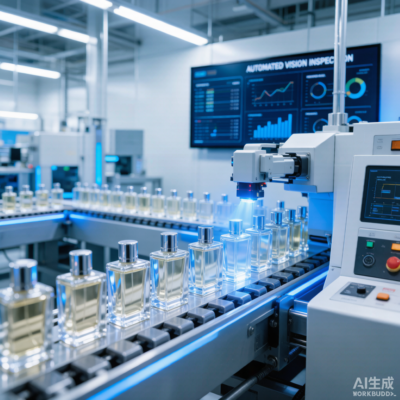
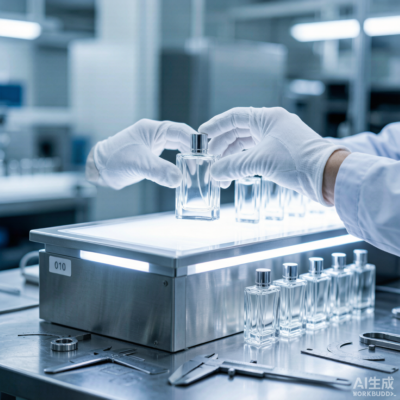
Most perfume brands never see the place where their bottles are made. That’s a problem. Decisions about mold complexity, decoration layering, QC criteria, and shipping windows all flow from how a factory actually works — and the gap between a glossy brochure and the line floor is bigger than most buyers realize.
This piece is our open invitation. We’re walking you through the Huanshi perfume bottle factory, end to end, in the same order a real bottle travels: raw materials in one door, finished pallet out the other. Along the way, we’ll flag the decisions that affect your order and the places where production reality diverges from sales-deck promises.
If you’re vetting a custom perfume glass bottle manufacturer in China, this read should give you a baseline for what to ask. If you’re an existing client, it’s a refresh on the specifics behind your shipments. Let’s get into it.
Where We Are and What We Run
Huanshi’s perfume bottle production sits inside our 20,000 m² integrated glass complex in Xuzhou, Jiangsu. Both the bottle manufacturing and decoration lines run on-site. That’s important — most “factories” in this space are actually assembly operations that buy bottles from elsewhere and decorate them. We’ve had buyers show us competitor quotes where the “factory” had three decoration tables and a warehouse. We have eight full production lines and four decoration lines.
Here’s the production footprint at a glance:
- 20,000 m² covered production area
- 300+ direct production employees
- 8 IS (individual section) bottle forming lines
- 4 decoration lines (silk screen, hot stamping, spray coating, sandblasting)
- 24-hour batch furnaces (continuous flow)
- 2 in-house QC labs (dimensional + visual)
- 50 million+ bottle annual capacity across standard SKUs
The 24-hour furnace operation matters more than people realize. It means our batch is always flowing, which keeps cullet ratios stable and color drift minimal. Factories that shut down furnaces overnight to save energy spend the next day’s first two hours ramping back up — and the bottles produced in that window tend to be off-spec.
Stage 1: Glass Batch House (Where Every Bottle Starts)
Everything starts here, in the batch house, where raw materials are weighed and mixed.
The recipe
Standard soda-lime glass (the kind that makes up roughly 90% of all perfume bottles) is built from:
- Silica sand (SiO₂): ~70%
- Soda ash (Na₂CO₃): ~13%
- Limestone (CaCO₃): ~11%
- Dolomite: ~3%
- Other minor ingredients (feldspar, colorants): ~3%
For a 30% PCR batch, we substitute crushed post-consumer recycled cullet for about a third of the virgin raw mix. The recipe stays chemically equivalent after melting, but the furnace energy drops by roughly 8-12% per batch.
Why our recipe matters to your order
If you’ve been told that all “Type III” soda-lime glass is the same, that’s half true. The chemistry is standardized, but the cullet sourcing, colorant purity, and minor-ingredient choices vary. Two factories can both produce “clear Type III glass” and one will have noticeably greener tint or more seed defects than the other. We test every new cullet supplier for three months before we put their material into a perfume bottle batch.
For colored glass — amber, cobalt blue, emerald green — the colorant purity matters even more. We’re running a 2026 trial of iron-oxidized amber cullet sourced from European window glass recycling streams. Early color readings are holding at DE<1.0 across batches, which is excellent consistency.
Stage 2: Furnace and Forehearth
The mixed batch enters the furnace at roughly 1450-1500°C. That’s the part of the process nobody photographs, because it’s loud, hot, and visually monotonous. Important things happen here anyway.
What happens in the furnace
Silica sand melts. Carbonates decompose off-gas (CO₂, SO₂). The molten glass homogenizes. Refining agents (typically sodium sulfate or cerium oxide) help bubbles rise out. After roughly 18-24 hours of transit through the furnace, the glass reaches the forehearth at working temperature — about 1050-1100°C for IS forming.
The two numbers you should ask about
Pull rate (tons of glass pulled from the furnace per day) — affects how many bottles per shift your line can produce. We run roughly 60-80 tons per day across our combined lines.
Color drift window (acceptable DE variance batch-to-batch) — for premium fragrance work, we hold DE<0.5 between batches. Most trade-grade glass runs DE<1.5. Below DE<0.5 means a retailer setting up a 12-SKU shelf with bottles from multiple batches won't see color variation under D65 lamps. Above DE<1.5 and the difference starts showing up in photography.
Stage 3: IS Forming Line (Where Bottles Take Shape)
This is the part most buyers picture when they imagine a glass factory. It’s also where the precision lives.
How IS machines work
Each of our 8 lines uses an Individual Section (IS) machine — a rotary forming system with 6-12 sections, each with its own blank mold and blow mold. A gob of molten glass is cut, dropped into the blank mold, pressed into a parison (preform), then blown into the finished bottle shape in the blow mold.
Cycle times range from 4 to 12 seconds per bottle depending on size and complexity. For a 50ml cylindrical perfume bottle, our typical cycle is around 6 seconds. For an 8ml sample bottle, we push down to 3.5 seconds. For a heavy 100ml luxury bottle with thick walls, we’re at 10-12 seconds.
What affects your bottle quality
Three things matter most at this stage:
- Mold temperature control — variation of more than 5°C between cycles produces “cold shut” lines on the bottle shoulder. We run closed-loop thermal monitoring on every section.
- Blow pressure precision — too high and the bottle gets thin walls (impact weakness); too low and you get incomplete forming (rounded shoulders, low fill line).
- Lubricant and swabbing cycle — automated graphite swabbing every 200-400 cycles keeps the mold surface consistent. Manual swabbing introduces human variability.
Stage 4: Annealing Lehr (Where Stress Gets Removed)
Bottles coming off the IS line are thermally stressed. If you packed them into cartons at this point, roughly 30-50% would crack within 24 hours from internal stress.
We send them through an annealing lehr — a long temperature-controlled tunnel that reheats bottles to about 580°C, holds them at that temperature through the critical strain point, then cools them back down in a controlled gradient.
The temperature curve
A typical perfume-bottle annealing curve for soda-lime glass:
| Zone | Temperature | Time | Purpose |
|---|---|---|---|
| Entry | 580°C | 5 min | Reheat above strain point |
| Hold | 580°C | 15-25 min | Stress relief |
| Fast cool | 580°C → 480°C | 30 min | Rapid cooling through low-annealing range |
| Slow cool | 480°C → 380°C | 60 min | Controlled cooling |
| Final cool | 380°C → 50°C | 90 min | Ambient-ready |
Total lehr transit: roughly 3-4 hours per bottle.
If you’ve ever received a shipment where bottles cracked in the carton weeks after delivery, the lehr was probably the culprit. Skipping or shortening the slow cool zone is one of the cost cuts we never make.
Stage 5: Quality Control at First Article
Bottles come off the lehr into an automated inspection station. We sample dimensions on a defined percentage based on line running rate.
First article QC checklist (each batch)
- Bottle height (target tolerance ±0.3mm)
- Body diameter (target tolerance ±0.2mm)
- Neck finish diameter (target tolerance ±0.15mm)
- Neck height (target tolerance ±0.2mm)
- Wall thickness (minimum 1.2mm body, 1.5mm base)
- Visual: seeds, bubbles, cracks, mold seams, cold shuts
Heads-up if you’re a buyer: the tolerance numbers above are tighter than what we publish in our sales documentation. We hold ourselves to those because perfume bottle fitting is unforgiving — a 0.2mm pump shoulder mismatch means your crimper rejects 5-15% of bottles during filling. We’re trying to make your production line happy, not just our own QC.
Stage 6: Decoration
Bottles that pass first-article QC move to decoration staging. We have four dedicated lines:
Silk screen printing
For logos, ingredient lists, batch codes, and single/multi-color prints. Cured with UV or thermal drying depending on ink chemistry. Up to 6 colors per pass on our Heidelberg-derived press.
Hot foil stamping
For metallic logos, accents, and luxury callouts. Roll-on or platen presses. We stock gold, silver, rose gold, copper, holographic, and matte black foils in inventory. Custom foil colors take about 10 days to source.
Spray coating
For color over-sprays, matte coatings, gradient effects, soft-touch finishes. Includes both UV-cured and air-dry systems. Used heavily for our matte and gradient effect SKUs.
Sandblasting
For textured frost and decorative surface patterns. Operates at a different facility zone because of the dust extraction requirements.
After decoration, bottles go to a secondary QC pass with tightened visual criteria. The decorated SKU holds to roughly 0.5-0.8% defect rejection; plain bottles run about 0.3%.
Stage 7: Packaging and Shipping Prep
The final stage is packaging. We pack bottles in:
- Corrugated cartons with polybag dividers (default)
- Reinforced cartons with foam cradles (for luxury formats)
- Custom-printed retail cartons (for D2C and brand-direct fulfillment)
- Bulk pallet configurations for ocean freight optimization
For 40HQ container loading, our standard 50ml cylinder SKUs fit roughly 28,000-32,000 pieces per container depending on decoration and packaging. We’ve worked out volumetric loading plans for every format in our catalog.
Common Questions Buyers Ask During Factory Visits
We’ve hosted about 60 client visits over the last two years. Here are the questions that surface every time:
“What’s your actual annual capacity?” Roughly 50 million standard bottles across our catalog. For a single custom SKU, we typically commit up to 4-5 million pieces annually before needing additional capacity.
“Can you do small batch?” Yes, with caveats. Minimum 500 pieces per SKU for stock designs, 2,000 pieces for custom mold, 1,000 pieces for decoration-only changes. Lower MOQs are sometimes possible for repeat customers, but the unit cost moves accordingly.
“How do you handle IP protection?” Custom molds are stored in restricted-access areas with separate tooling rooms per client. Customer-owned molds can be returned at project completion or held in dedicated storage. We don’t display or sell customer-specific molds to other buyers — that’s contractually barred in every project agreement.
“What’s your defect rate?” Currently under 0.3% across the catalog. We publish a quarterly QC report for repeat clients.
“Can you handle direct-to-Amazon shipping?” Yes. We work with several US and EU 3PL partners. Mixed-SKU palletization and FNSKU labeling available.
Why We’re Sharing All This
Buyers don’t need to visit our floor to know what we’re doing. But the more you understand the process chain, the better your RFQs and the fewer surprises in production.
We’ve seen too many brands order perfume bottles that looked great in renders and arrived as off-spec cartons because the spec sheet lacked the precision the line needed. The way to avoid that is to talk production language with your supplier — batch ratios, lehr curves, pull rates, neck tolerances. If your rep can’t answer those in their sleep, you’re working with a middleman.
Ready to bring us a project? Send us your design references and target volumes and we’ll come back with a feasibility read, mold cost estimate, and a clear production timeline. If you want to visit the line in person, we host client visits quarterly — just ask.
Related reading on what happens after the bottle leaves our floor: our refillable perfume bottle design guide and our breakdown of ISTA 3A packaging testing for glass exports.