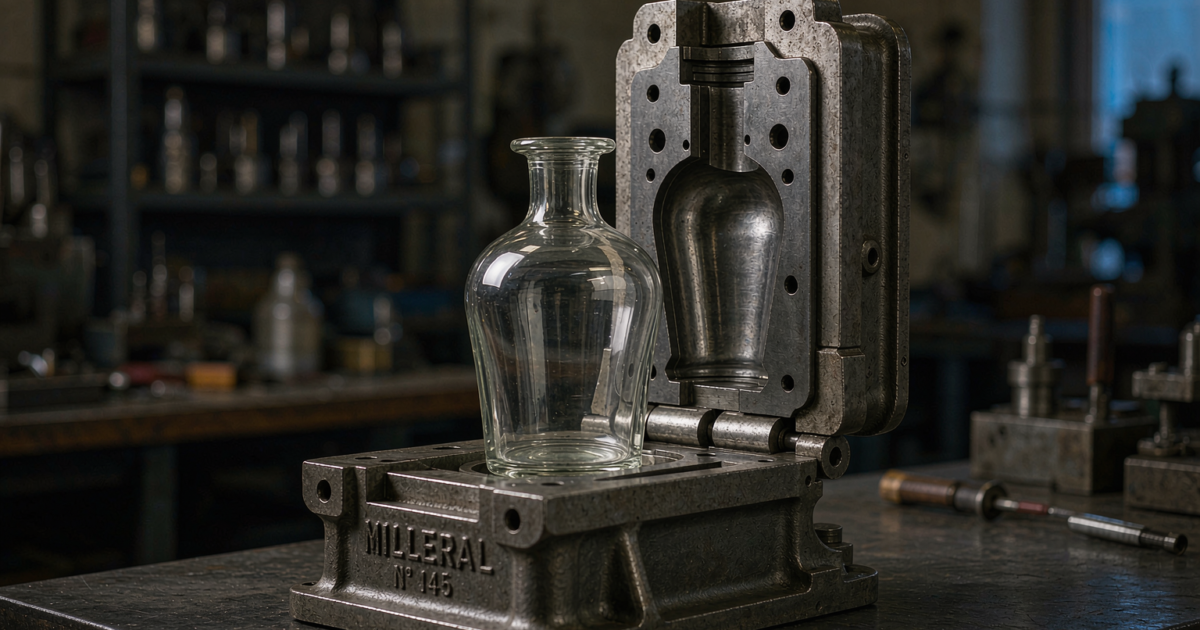
A perfume bottle mould is the single most expensive invisible asset in your supply chain. You never ship it, you never see it in a container, and yet everything about your bottle — its wall thickness, its parting line, the way the shoulder catches light — lives inside that steel. When a buyer and a factory part ways, the mould becomes the battleground: the factory holds the physical asset, the buyer holds the design investment, and the contract decides who wins. Most contracts, in our experience, decide nothing, because nobody wrote the mould ownership question down.
The default position in Chinese glass manufacturing is simple and unfavourable to buyers: the factory that pays for the mould owns it. If you never negotiated ownership, you are renting access to your own design, and the rental can be revoked, repriced, or quietly extended to your competitors.
This article explains how mould ownership actually works in perfume bottle production, what the standard clause structures look like, what ownership does and does not entitle you to, and the contract language that prevents the four most common disputes. It assumes you are buying custom or semi-custom flacons from an Asian or European supplier; the principles transfer, but the default legal positions differ.
What a Perfume Bottle Mould Actually Is
Perfume glass bottles are formed in two mould families, and your contract should name both.
Blank moulds shape the parison — the initial thick-walled glass form. Blow moulds shape the final exterior geometry. Depending on the forming process (press-and-blow for wide-shoulder flacons, blow-and-blow for narrow-neck bodies), the set may include neck mould inserts, bottom plates, and baffle plates. A single bottle design typically requires one full mould set per forming section slot, and a production run of any scale runs the design on multiple sets in parallel.
That parallel-set detail matters commercially. A factory quoting “one mould fee” may be quoting one set for one section, then charging for additional sets as your volumes grow — or, more often, building the additional sets themselves and treating them as their property even though your design fee paid for the first. Clarify whether your ownership extends to all sets of the design, including replacements made as originals wear out.
The physical life of the tooling is finite. Cast iron and bronze-alloy mould halves survive roughly 200,000 to 500,000 cycles before surface degradation shows on the bottle, and the range depends on glass temperature, mould coating, and cooling discipline. Our article on mould lifespan breaks down the wear mechanics. For ownership purposes, the key number is replacement frequency: over a five-year programme, expect every set you own to be replaced at least once, and write the replacement funding rule in advance.
The Three Ownership Models
Mould arrangements in perfume bottle sourcing fall into three structures, each with a distinct risk profile.
| Model | Who pays | Who owns | Buyer’s risk | Typical use |
|---|---|---|---|---|
| Factory-funded | Factory | Factory | Design can be sold to competitors; switching means re-tooling | Stock and semi-stock bottles, catalogue decoration programmes |
| Buyer-funded, supplier-held | Buyer | Buyer | Factory holds the asset; access depends on the relationship | Custom flacons, private label with exclusivity expectations |
| Buyer-owned, third-party-held | Buyer | Buyer | Storage and logistics of moving heavy tooling | Large brands, multi-factory sourcing strategies |
Factory-funded is the default and it is not inherently bad. The factory amortises the tool across all buyers of the design, your upfront cost drops, and for a genuinely generic shape you lose little. The loss begins when the shape is distinctive. A factory that owns a mould has no obligation to withhold it from the next brand that asks for “something like yours” — usually with a 5% geometry change that is legally just different enough. If design exclusivity is part of your brand value, factory ownership quietly deletes it. The middle path is a factory-funded mould with a contractual exclusivity clause: the factory retains ownership but contractually agrees not to run the design for other customers for a defined term or volume. This is common and enforceable, and it costs less than buying the tool.
Buyer-funded, supplier-held is the standard custom programme structure. You pay the tooling, the factory stores and maintains it, and — if the contract is written correctly — the mould is your property held in bailment. The contract must state three things explicitly: the mould is buyer property upon final payment, it is identifiable and tagged as such, and it is released or shipped at the buyer’s instruction within a defined number of days of request. Without the tagging clause, “your” mould is a theoretical asset indistinguishable from the forty others in the tool room.
Third-party holding — the mould lives at a tooling shop or a warehouse you control — gives maximum portability but adds friction at every production run. Glass factories accept outside moulds reluctantly and some will not accept the liability at all, because mould fit on their specific IS machines affects forming quality, and a mould they did not build becomes their excuse for every defect. This model suits buyers running the same design across multiple factories, which is a strategy few programmes actually need.
What Ownership Does — and Does Not — Give You
Buyers frequently overestimate what owning a mould entitles them to. Ownership gives you four things:
- Portability. You can instruct the factory to ship the mould to an alternative glass plant. In practice this requires the mould to fit the alternative plant’s forming equipment — mould dimensions, neck holder sizes, and takeaway machinery are surprisingly standardised in the perfume bottle segment, which makes portability real rather than theoretical.
- Exclusivity control. As owner, you decide who runs the design. Combined with a non-compete clause, this is the only structure that guarantees no other brand uses your geometry.
- Continuity. The factory cannot “lose” your design in a commercial dispute, raise a reopening fee, or decline your reorders because volumes disappointed them.
- Asset value. The mould appears on your balance sheet as tooling, which matters for financed brands and group reporting.
Ownership does not give you:
- Design rights. A mould is a copy of a design; the design itself is protected only by registered industrial design or copyright, depending on jurisdiction and how original the shape is. Ownership of tooling and ownership of intellectual property are separate questions, and the contract should address both.
- Free maintenance. Mould cleaning, re-coating, and part replacement cost money every production run. Specify who pays: the usual position is the buyer pays maintenance on a buyer-owned mould, at quoted rates, with a cap per run.
- Quality immunity. A mould you own that produces dimensional defects is still the factory’s process problem on the line, but root-cause fixes that involve re-machining your mould will be quoted back to you.
The Four Disputes and the Clauses That Prevent Them
Dispute one: the switching hostage. The buyer wants to move factories; the factory refuses to release the mould or demands a “release fee” equal to the unpaid balance of a tooling subsidy. Prevention: a clause stating that upon written notice and settlement of outstanding invoices, the mould ships within 15 business days at the buyer’s expense, and that no fee other than outstanding invoice balances applies. If the factory subsidised part of the tooling, a declining-balance release schedule works: the release cost falls to zero after a defined cumulative volume, which aligns both parties’ incentives instead of holding the design hostage.
Dispute two: the silent competitor. The buyer discovers a near-identical bottle in a competitor’s range. Prevention: an exclusivity clause with teeth — a defined term (two to three years is normal), a defined scope (the exact geometry plus “variants differing by less than an agreed dimensional tolerance”), and a liquidated damages amount. Vague promises of exclusivity are unenforceable; the damages number is what makes the clause real.
Dispute three: the worn-out mould. After two years, bottle quality degrades — parting lines thicken, seams show. The factory says the mould needs replacement and quotes a full new tooling fee. The buyer assumed mould fee was a one-time cost. Prevention: a clause stating expected mould life in cycles or production runs, a maintenance schedule with inspection records provided on request, and a replacement funding rule. A fair position: the first replacement set is factory-funded if the mould wore out within the agreed life under normal maintenance; subsequent replacements are buyer-funded at cost.
Dispute four: the vanished asset. The factory reorganises, the tool room gets shuffled, and the mould tagged to your design cannot be produced for inspection or shipment. Prevention: mandatory tagging (mould number, buyer name, date), an annual physical verification right — a photo of the mould with a dated sign is enough — and a liability clause making the factory responsible for replacement at full cost if a buyer-owned mould is lost, destroyed, or untraceable.
Tooling Fee vs Mould Ownership: A Clause Checklist
When you review a perfume bottle supply contract, run this list against the tooling section. Every “no” is a future negotiation you will have from a position of weakness.
| # | Contract item | What “good” looks like |
|---|---|---|
| 1 | Ownership transfer | Buyer property upon full payment of tooling invoice, stated in one sentence |
| 2 | Scope of sets | Ownership covers all sets of the design, including future replacement sets, or replacement sets follow the clause-3 funding rule |
| 3 | Tagging and identification | Moulds engraved or tagged with buyer name and mould number; photo provided after tagging |
| 4 | Release mechanism | Shipment within 15 business days of written request; only outstanding invoices may be offset |
| 5 | Subsidy release schedule | If factory subsidised tooling, a declining-balance release cost with a volume trigger to zero |
| 6 | Exclusivity | Term, scope with dimensional tolerance, liquidated damages — or an explicit statement that none exists |
| 7 | Maintenance | Schedule, responsibility, per-run cost cap, inspection records on request |
| 8 | Life and replacement | Expected cycles stated; replacement funding rule agreed before it is needed |
| 9 | Loss liability | Factory liable at full replacement cost for lost or untraceable buyer-owned moulds |
| 10 | IP separation | Mould ownership and design IP addressed as separate clauses |
Item 6 deserves one more sentence. If the factory resists liquidated damages on exclusivity — and many will — an alternative is a price mechanism: a contractual discount that applies only while the design remains exclusive, which converts exclusivity from a promise into an ongoing commercial choice the factory renews with every shipment.
The Negotiation Reality
Mould clauses are negotiated in exactly one window: before the tooling invoice is paid. After payment, your leverage drops to the relationship, and the factory knows it. If you are currently negotiating a custom programme, fold the mould section into the overall cost structure conversation rather than treating it as legal housekeeping — a factory that quotes tooling transparently will usually accept mould clauses transparently, and one that resists both is telling you something.
A note on where mould fees actually sit in the negotiation: our mould cost guide explains how tooling quotes are built — cavity count, steel grade, surface finish, section slots — and why a low tooling quote on a complex flacon usually means shortcuts that surface as defects later. Buyers who understand the tooling quote negotiate ownership more credibly, because they can tell the difference between a mould worth owning and a commodity tool.
If you are early in the process, the practical sequence is: design freeze, prototype approval, mould contract with the clauses above, then production tooling. Jumping from artwork directly to mould payment is how buyers end up owning (or not owning) a tool for a bottle that was never properly approved. The staged approach is set out in our prototype versus production article.
OEM and ODM: Different Defaults, Same Clause
One final distinction, because it changes the default ownership position. In a pure OEM programme — your design, factory manufacture — buyer-funded ownership is the natural structure and factories accept it without drama. In an ODM programme — factory’s existing design, adapted to your brand — the factory almost always retains ownership, because the design belongs to their catalogue. The difference and the grey zone between them is covered in our OEM versus ODM article.
The practical advice is identical either way: get the arrangement in writing. In ODM, the clause to fight for is not ownership but exclusivity — a written commitment that the adapted design will not be offered to other customers in your markets, at any price, for the contract term. In OEM, fight for the full ownership package, because you are paying for the tool and the alternative is renting your own idea.
Buyers assembling a full custom programme should run the mould section alongside the wider manufacturer checklist — ownership, exclusivity, maintenance, and release are four of the twenty questions that determine whether a factory relationship scales or stalls.
FAQ
Who owns the mould if the factory pays for it?
The factory does, unless the contract says otherwise. The practical protection for a buyer is not ownership but an exclusivity clause: a defined term during which the factory agrees not to run your design for other customers, ideally with a liquidated damages amount attached.
Can I move my mould to a different factory?
Yes, if you own it and the contract has a release clause. Physically, perfume bottle moulds are standardised enough to fit most alternative glass plants, but confirm mould dimensions and neck holder sizes with the receiving factory before committing to a switch. Give the current factory a written instruction and settle outstanding invoices first.
How long does a perfume bottle mould last?
Between roughly 200,000 and 500,000 forming cycles per set, depending on glass temperature, mould coating quality, and cooling discipline. At typical perfume bottle volumes, that means every mould set is replaced at least once during a five-year programme, which is why the contract needs a replacement funding rule agreed in advance.
Is a mould ownership clause worth it for a small brand?
Usually not on a first order. For a first custom bottle under modest volumes, a factory-funded mould with a written exclusivity clause gives you the protection that matters — nobody else runs your design — without the upfront tooling cost. Buy ownership when the design becomes commercially significant or when your volumes make you dependent on continuity.
What happens to my mould if the factory closes or loses it?
Whatever your contract says — and if it says nothing, you have an unsecured claim against a company that may no longer exist. A well-drafted clause makes the factory liable at full replacement cost for lost or untraceable buyer-owned moulds, and an annual photo verification gives you evidence the asset still exists.