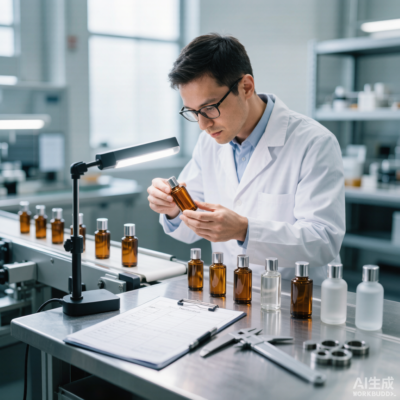
A single leaky perfume bottle can ruin a customer’s first impression. Worse, it damages your brand reputation and triggers costly returns. At Huanshi, we have tested over 2 million bottles in the past five years. We have learned that perfume bottle quality control is not a checkbox exercise. It is a layered process that starts long before the first drop of fragrance touches the glass.
Leak testing sits at the heart of this process. Whether you are sourcing 1,000 units for a boutique launch or 100,000 for a major retail rollout, understanding how leak testing works gives you leverage in supplier negotiations. It also helps you set realistic acceptance criteria that protect your margins without adding unnecessary cost.
In this guide, we break down the methods, standards, and real-world considerations that define leak testing for perfume glass bottle production. We draw on ISO 9001 quality management quality protocols, ASTM International standards material standards, and the daily practices running on our factory floor.
Why Leak Testing Matters More Than You Think
Perfume is not water. It contains alcohol, essential oils, and volatile compounds that degrade packaging over time. A micro-leak that would go unnoticed in a water bottle becomes a serious problem when expensive fragrance seeps out or evaporates.
The financial impact extends beyond the product itself. Leaking bottles stain retail displays, damage neighboring inventory, and create liability issues. In 2023, a European luxury brand recalled 12,000 units due to cap seal failures. The direct cost exceeded €180,000. The reputational damage was harder to measure.
From a manufacturing standpoint, leak defects fall into three categories:
- Cap-related leaks: Poor crimping, mismatched neck finishes, or defective gaskets
- Glass-related leaks: Micro-cracks, pinholes, or uneven wall thickness at stress points
- Assembly-related leaks: Misaligned pumps, over-torqued caps, or contamination on sealing surfaces
Each category requires a different detection method. No single test catches everything. That is why we run multiple protocols in sequence rather than relying on one catch-all check.
Vacuum Decay Testing: The Industry Standard
Vacuum decay testing is the most widely adopted method for sealed perfume bottle inspection. The principle is straightforward. Place a sealed bottle inside a vacuum chamber. Draw a vacuum. Monitor pressure over time. If the pressure rises, gas is escaping from the bottle.
The sensitivity of this method is impressive. Modern systems detect leaks as small as 0.01 mbar·L/s. For context, a human hair has a diameter of roughly 0.08 mm. Vacuum decay can reliably catch defects far smaller than that.
At Huanshi, we run vacuum decay on 100% of bottles destined for clients with fragrance filling. The test cycle takes 8-12 seconds per unit. Our chamber accommodates 24 bottles simultaneously. This keeps throughput high without sacrificing coverage.
| Parameter | Typical Setting | Acceptable Range |
|---|---|---|
| Vacuum level | -0.85 bar | -0.80 to -0.90 bar |
| Hold time | 10 seconds | 8-15 seconds |
| Pressure rise limit | 0.05 mbar | 0.03-0.10 mbar |
| Test temperature | 23°C | 20-25°C |
| Calibration frequency | Daily | Before each batch |
The key variable is the pressure rise threshold. Set it too tight and you reject good bottles. Set it too loose and defects slip through. We calibrate this threshold against a master sample set that includes known good units and controlled defect samples.
ASTM D3078 provides the foundational methodology for vacuum decay testing of flexible and rigid packages. While the standard targets food and pharmaceutical packaging, the principles transfer directly to perfume bottle quality control. We adapted the protocol to account for the smaller headspace and higher vapor pressure typical of fragrance products.
Pressure Decay and Bubble Testing: When to Use Each
Vacuum decay works well for sealed, intact bottles. But what about bottles that have not been filled yet? Or bottles with pumps that need functional testing under positive pressure?
Pressure decay testing reverses the logic. Instead of pulling vacuum, we pressurize the bottle interior and monitor for pressure drop. This method is ideal for testing pump assemblies and spray mechanisms before the bottle ever sees fragrance.
We pressurize to 1.5 bar using clean, dry air. The hold time is 15 seconds. Any drop exceeding 0.02 bar triggers rejection. This test catches faulty pump crimps, cracked dip tubes, and defective actuator seals that vacuum decay might miss.
Bubble testing is the simplest method and still one of the most reliable for visual confirmation. Submerge a pressurized bottle in water. Watch for bubbles. It sounds old-school, but it works. We use bubble testing as a secondary confirmation for any unit that fails pressure decay. It also serves as a spot-check method during line changeovers.
| Test Method | Best For | Sensitivity | Speed | Cost |
|---|---|---|---|---|
| Vacuum decay | Sealed filled bottles | Very high | Fast | Medium |
| Pressure decay | Pump assemblies, empty bottles | High | Fast | Medium |
| Bubble test | Visual confirmation, spot checks | Medium | Slow | Low |
| Helium leak test | Ultra-high sensitivity needs | Extremely high | Slow | High |
Helium leak testing sits at the top of the sensitivity pyramid. We reserve it for pharmaceutical-grade or luxury clients who specify zero-tolerance protocols. The equipment cost is significant. The test cycle is slower. But for applications where even 0.001 mbar·L/s matters, helium is the only choice.
The Role of Glass Quality in Leak Prevention
No amount of downstream testing compensates for poor glass. The best seal in the world cannot fix a bottle with a micro-crack near the neck finish or a wall thickness variation that creates a stress concentration.
We inspect incoming glass using automated vision systems before any assembly begins. The cameras check for:
- Wall thickness uniformity (target variance under 5%)
- Neck finish concentricity (within 0.15 mm tolerance)
- Surface defects including seeds, stones, and checks
- Dimensional compliance against approved samples
ISO 9001 quality management principles guide our incoming inspection procedures. We maintain inspection records for every batch. If a glass lot shows elevated defect rates, we quarantine it and notify the glass supplier immediately. This upstream control reduces downstream leak failures by roughly 60% compared to skipping the step.
glass annealing quality also matters. Poorly annealed glass retains internal stress. Over time, that stress releases through micro-cracks. We verify annealing quality using polarized light inspection. Bottles showing stress patterns outside acceptable limits go straight to recycling.
Cap and Closure Testing: The Overlooked Variable
Bottles do not leak in isolation. The closure system is equally critical. A perfect bottle paired with a defective cap still fails.
We test cap torque consistency using digital torque testers. The target range depends on the cap type:
- Crimp pumps: 15-25 N·cm
- Screw caps: 20-35 N·cm
- Magnetic caps: 12-18 N·cm
Over-torquing deforms the gasket. Under-torquing leaves gaps. Both cause leaks. We set torque limits on our capping equipment and verify settings every two hours during production runs.
Gasket material selection also affects long-term seal integrity. Natural rubber offers excellent elasticity but degrades when exposed to high alcohol concentrations. Silicone gaskets resist fragrance chemicals better but cost roughly 30% more. We recommend silicone for any product with alcohol content above 70%.
The European Pharmacopoeia glass standards sets standards for container closure integrity in pharmaceutical applications. While perfume is not a drug, the testing methodologies apply. We reference these standards when clients ask for documentation supporting their own quality claims.
Acceptance Criteria: What AQL Level Makes Sense?
Acceptable Quality Limit (AQL) defines how many defects are tolerable in a given batch. For leak testing, the right AQL depends on your market position and risk tolerance.
| Application | Recommended AQL | Rationale |
|---|---|---|
| Mass market retail | 1.0 | Balance cost and coverage |
| Premium brands | 0.65 | Lower tolerance for visible defects |
| Luxury/limited edition | 0.25 | Near-zero defect expectation |
| Pharmaceutical crossover | 0.10 | Regulatory compliance required |
At AQL 1.0, a batch of 5,000 bottles requires inspection of 200 units. If 5 or fewer fail, the batch passes. At AQL 0.25, the same batch requires 315 inspected units with a maximum of 2 failures allowed.
We default to AQL 0.65 for most clients. This strikes a practical balance. It catches systematic issues without driving inspection costs to unsustainable levels. Clients can specify stricter levels. We adjust pricing accordingly.
Real-World Testing Protocol at Huanshi
Our standard leak testing sequence runs as follows:
- Incoming glass inspection: Vision system check for dimensional and surface defects
- Annealing verification: Polarized light stress inspection on sample basis
- Pre-assembly pressure test: 1.5 bar hold on empty bottles with pumps attached
- Vacuum decay test: 100% inspection at -0.85 bar for 10 seconds
- Bubble confirmation: Secondary check on any unit flagged in step 4
- Torque verification: Digital torque check on capped assemblies every 2 hours
- Final spot check: Random sample vacuum decay before palletization
This seven-step protocol adds roughly 4-6% to unit cost compared to no testing. It reduces field failure rates from industry averages of 0.8-1.2% to under 0.15%.
For clients who want even tighter control, we offer 100% helium leak testing as an add-on service. The cost increase is approximately 12-15% per unit. The defect detection rate approaches statistical zero.
Frequently Asked Questions
What is the minimum order quantity for custom perfume bottles with leak testing?
Our standard MOQ is 1,000 pieces for stock shapes with decoration. Fully custom molds start at 5,000 units. All orders include our baseline seven-step testing protocol at no extra charge.
How long does leak testing add to production lead time?
The testing sequence itself adds 1-2 days to a typical 25-day production schedule. This is already built into our quoted lead times. Helium testing adds an extra day due to slower cycle times.
Can I specify my own AQL level?
Yes. We default to AQL 0.65, but clients can request any level from 0.10 to 4.0. Stricter AQL levels increase inspection time and may affect unit pricing slightly.
What happens to bottles that fail leak testing?
Failed units are segregated and destroyed. We do not re-test or re-work rejected bottles. This prevents defective product from ever reaching your supply chain.
Do you provide leak testing documentation for regulatory submissions?
We provide batch test reports, calibration certificates, and inspection logs on request. For pharmaceutical or cosmetic regulatory filings, we can format documentation to match your submission requirements.
Ready to Source Bottles That Pass Every Test?
Leak testing is not optional for serious perfume brands. It is the difference between a product that arrives intact and one that creates customer complaints, returns, and reputation damage.
At Huanshi, we have built our quality system around real-world failure modes. We test every batch. We document every result. And we stand behind the bottles that leave our factory.
If you are evaluating perfume bottle suppliers, ask about their testing protocols. Ask for data. A supplier who cannot show you test records is a supplier who is not testing.
Contact us today for a sample evaluation or a detailed quote. We will walk you through our quality process and show you exactly how we ensure every bottle meets your standards.