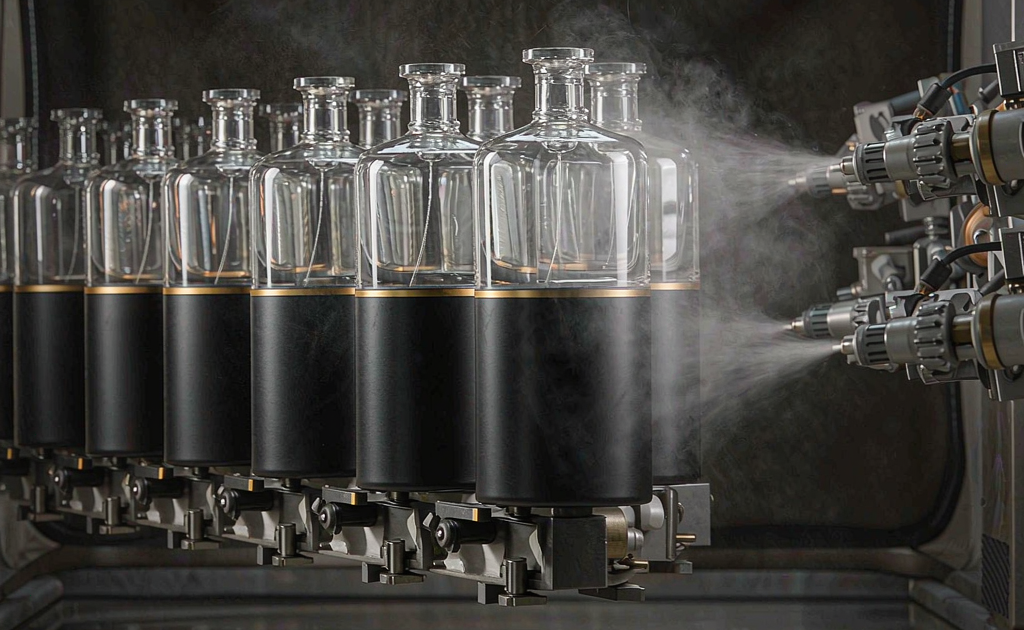
When a brand wants a perfume bottle that reads as premium at retail, two-tone spray coating is one of the most effective ways to get there. A classic example is a clear bottle with a gold or pearl upper third and a matte black body — the contrast is visible from three meters away on a crowded shelf. But two-tone spray perfume bottle production is also one of the more technically demanding decoration processes a cosmetic glass bottle factory runs, because everything depends on masking and registration. Get either wrong and the color boundary wanders, overspray ruins the finish, and your rejection rate climbs fast.
This guide explains how masking and registration actually work in two-tone bottle coating, what tolerances you should expect, and which questions to ask a supplier before you commit to a tooling deposit.
Why Two-Tone Coating Is Harder Than It Looks
Spray coating a single color on glass is a mature, forgiving process. The bottle is masked at the neck finish, coated, cured, done. Two-tone work doubles the number of operations and introduces a new failure mode: the boundary between color A and color B.
Three problems dominate:
- Boundary wander. The line where the two colors meet drifts up or down the bottle body, or tilts because the bottle was not seated identically in the fixture.
- Overspray. Fine mist from color B lands on the freshly cured surface of color A, creating a hazy, contaminated band at the boundary.
- Adhesive residue. Masking tape or liquid maskant leaves marks, dulls the base coat, or pulls off the first color when removed.
Each of these is solved by the same two disciplines: controlled masking and controlled registration.
Masking Methods: Tape, Caps, and Liquid Maskants
Precut masking tape
The most common method for mid-volume runs. Die-cut adhesive tape rings or wraps are applied by hand or semi-automatically to protect the area that must stay color A. Tapes made for glass spray work use silicone or polyester film with temperature-resistant adhesive, because most spray systems cure with either infrared or UV heat that can bake a cheap tape into the coating.
The limits are real: hand-applied tape is only as consistent as the operator. A well-trained line worker applying tape to 2,000 bottles a day will vary by ±0.5 mm in tape position. That is usually acceptable for a boundary hidden under a collar or within a deliberate gradient, but unacceptable for a razor-sharp horizon line at a fixed height.
Custom spray caps (masking fixtures)
For high-volume programs, factories machine a custom masking cap that drops over the bottle neck and upper shoulder, exposing only the zone to be sprayed. The cap is keyed to the bottle shape, so position is fixed by the glass geometry rather than by the operator. Positional repeatability improves to around ±0.2 mm, and line speed can double.
The trade-off is tooling cost. A machined aluminum masking cap for a custom bottle shape typically runs USD 150–400 per size, with a 7–12 day lead time, and only works for that exact bottle profile. If you change the bottle, you buy new caps. This is why masking caps make sense above roughly 30,000–50,000 units per colorway; below that, tape is usually cheaper overall.
Liquid maskants
Peelable liquid maskants are sprayed or dipped, dried, and then peeled away after the second color cures. They follow complex contours — curved shoulders, fluted bodies — that tape cannot cover cleanly. They cost more per bottle in material and labor, and the peel step can mar soft coatings, so they tend to appear on specialty runs: heavy flacon shapes, sculptural limited editions, and sampling quantities.
Registration: Holding the Boundary Where the Design Says It Should Be
Registration in bottle coating means two things: rotational registration and vertical (height) registration.
Vertical registration
Vertical registration controls how high or low the color boundary sits. It is governed by:
- Fixture seating. The bottle must sit at a fixed datum — usually the neck finish, which is the most dimensionally controlled part of the glass. A finish-to-fixture design means body-length variation (typically ±1.0–1.5 mm on a standard bottle) moves the boundary relative to the bottom of the bottle but not relative to the collar, which is usually what the eye judges against.
- Spray height setting. Machine-mounted spray guns are set against the same datum and verified with a first-article check.
- Glass variance. If the boundary is specified from the bottle bottom, a ±1.0 mm body-length variation becomes a visible ±1.0 mm boundary wander. Smart designers specify the boundary from the top (collar side) to hide glass variance.
A practical tolerance for a hard, visible two-tone boundary is ±0.5 mm on capped-volume programs and ±1.0 mm on tape-masked runs. Anything tighter is achievable but priced accordingly.
Rotational registration
If one of the “colors” is a partial wrap — say a 180-degree color panel or a stripe — the second operation must land in the right rotational position. This is done by keying the bottle against a mold seam, a molded logo pad, or a fixture notch. Rotational misalignment of more than a few degrees is instantly visible on a striped design, so this kind of work is almost always done on indexed rotary machines rather than simple turntable booths.
The Boundary Zone: Hard Lines, Soft Lines, and Overlap Tricks
Design teams usually want a razor-sharp boundary. Manufacturing teams know that the crispness of the line is a cost dial.
- Hard line: masked second color with clean tape edge. Sharpest result, highest rejection sensitivity. Any tape lift during spraying produces a hairline defect.
- Soft line (gradient): the second color is sprayed with a feathered edge or a slight overlap that is then cured and lightly sanded/buffed. Far more forgiving, and it reads as intentional “shadow fade” — a look that is currently fashionable anyway.
- Overlap ring: a deliberate metallic band (gold, silver, or colored ring 2–4 mm wide) placed exactly over the junction. The band covers the boundary entirely, converting a tolerance problem into a design feature. This is the single most cost-effective trick in two-tone work and is used constantly on premium cosmetic glass bottle projects.
For background on how single-color and gradient coating works, see our guide to gradient color perfume bottles, which covers the spray parameters behind feathered transitions.
Coating Stack and Adhesion at the Boundary
Two-tone work layers multiple films: base coat (color A), possibly a clear or pearl intermediate, then color B. Each layer must bond to the previous one, and the boundary region is where intercoat adhesion failures show up first — as flaking chips along the line.
Controls that matter:
- Surface prep. Flame treatment or adhesion promoter on the glass before the first coat; the second color is sprayed over cured color A, which must be scuff-free but not overly glossy.
- Cure discipline. Under-cured base coats soften and pull when masked; over-cured coats reduce intercoat bite. UV-cured systems cure in seconds, which shortens the window for dust contamination between colors (more on UV chemistry in our vacuum metallization process guide, which shares the same line discipline).
- Cross-hatch testing. A standard adhesion check (ISO 9001 quality management 2409 cross-cut, or ASTM International standards D3359) should be run at the boundary zone specifically, not just in the middle of each color field. A line that passes mid-field and fails at the junction is a masking or cure problem.
Quality programs at a certified factory follow documented QMS procedures; ISO 9001 requires that these inspection points, rejection criteria, and rework rules be written, audited, and traceable — which is exactly what you want behind a multi-layer decoration process.
Cost Model: What Two-Tone Adds Per Bottle
Rough adders for a 50 ml cosmetic glass bottle at 10,000–50,000 unit volumes (ex-works, decoration only, glass excluded):
| Cost element | Typical adder (USD/bottle) |
|---|---|
| Second color spray (labor + material) | $0.10 – $0.25 |
| Masking material (tape) | $0.03 – $0.06 |
| Masking fixture amortization (caps) | $0.02 – $0.05 |
| Higher rejection allowance (2–4% vs 1%) | $0.02 – $0.04 |
| Extra QC sampling | $0.01 – $0.02 |
In short, budget a 15–30% decoration premium over single-color spray, plus one-time fixture costs if you go the masking-cap route. Fixture amortization drops fast with volume, which is why the economics flip decisively above the ~30k mark.
Lead time is the other hidden cost: two-tone programs typically add 3–5 days over single-color coating for the extra spray cycle, cure dwell, and boundary QC, and sampling (first articles across the boundary) adds another 5–7 days before mass production.
What to Ask a Supplier Before Committing
A capable two-tone coater should answer these without hesitation:
- What is your boundary tolerance, and how is it measured? Look for a numeric answer (±0.5 mm class) tied to a fixture datum, not “very good.”
- Do you use masking caps or tape for my volume? They should recommend the method based on your quantity, not the other way around.
- What is your rejection rate on two-tone programs? Under 3% at boundary-critical designs is a good sign; “we don’t track it” is a bad one.
- Can you show cross-hatch results at the junction? Ask for a test panel from a previous program.
- What happens on color-match across the boundary? Two colors sprayed in separate operations must each hit the Pantone or physical standard independently; ask how they verify both.
- Is the line ISO 9001 certified, and can I see the inspection records for my order?
If a factory offers a sampling step with painted physical samples across the boundary before tooling, that is a strong signal — our perfume bottle sampling process overview explains why first articles matter at every decoration stage.
FAQ
How sharp can the color boundary be on a two-tone perfume bottle?
With custom masking caps, a boundary tolerance of about ±0.2–0.3 mm is achievable, giving a visually sharp line. Tape-masked runs sit around ±0.5–1.0 mm. For perfectly crisp junctions, many brands add a 2–4 mm metallic ring over the boundary, which hides tolerance entirely and adds a premium detail.
What volume justifies tooling for masking caps?
Custom masking fixtures typically cost USD 150–400 per size with 7–12 day lead time. Above roughly 30,000–50,000 units per colorway, the repeatability and speed gains outweigh the tooling cost; below that, die-cut tape is usually the cheaper route.
Why does my two-tone boundary wander even though the bottles look identical?
Glass body length varies by ±1.0–1.5 mm even on standard bottles. If the color boundary is specified from the bottle bottom, that variance shows up as boundary wander. Specify the boundary from the neck finish side instead — the finish is the most dimensionally controlled feature of the bottle.
Can two-tone coating fail adhesion at the color junction?
Yes. The junction is where intercoat adhesion failures appear first, usually as small flakes along the line. The fixes are disciplined surface prep, correct cure of each layer, and cross-hatch adhesion testing (ISO 2409 / ASTM D3359) performed specifically at the boundary zone.
How much does two-tone spray coating add to decoration cost?
Expect USD 0.15–0.40 per bottle in added cost versus single-color spray (second spray pass, masking material, fixture amortization, higher rejection allowance), or roughly a 15–30% decoration premium, plus one-time masking tooling for high-volume programs.