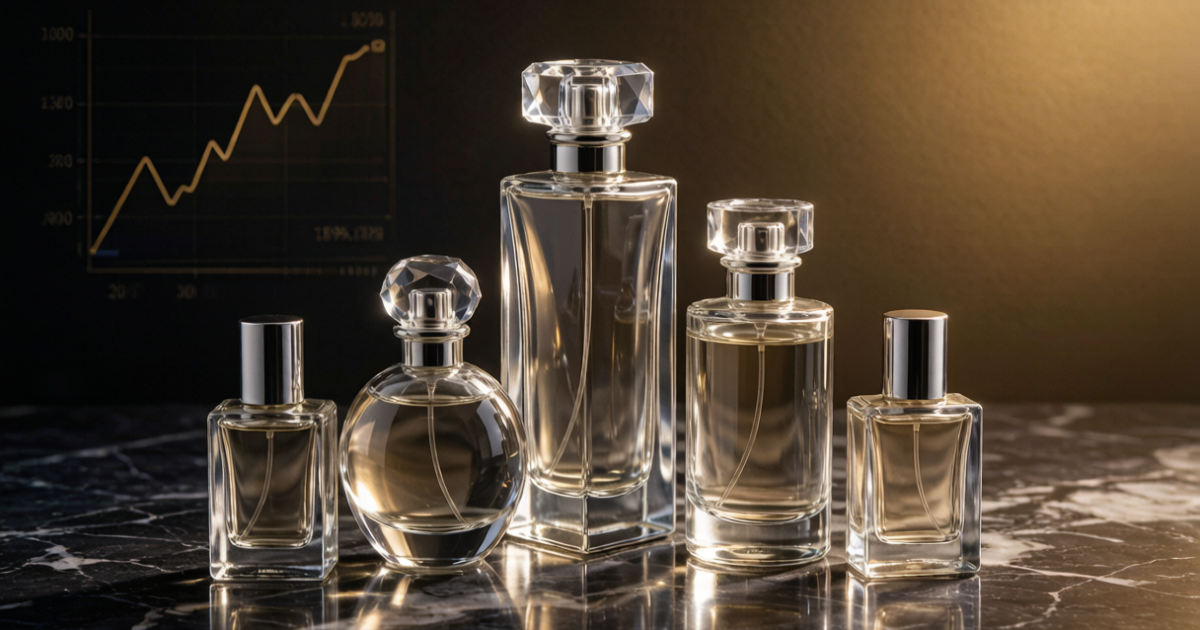
The perfume glass bottle market sits at $1.8 billion right now. By 2030, that number climbs to $2.2 billion. But the real story isn’t the total — it’s who’s buying, what they’re buying, and why the rules of sourcing have quietly shifted underneath the industry.
If you’re a brand owner, a procurement manager, or a packaging designer working with perfume glass bottles in 2026, the landscape looks different than it did even two years ago. Material costs fluctuated. Sustainability moved from marketing buzzword to legal requirement. And the rise of indie fragrance brands completely changed what “minimum order quantity” means in practice.
Here’s what actually matters for buyers right now.
Market Size and Growth: Reading Between the Numbers
The perfume glass bottle market grows at roughly 3.5% annually. That sounds modest. But zoom out and the broader cosmetics and perfume glass packaging segment tells a different story — $9.31 billion in 2024, projected to hit $24.72 billion by 2037. That’s a 7.8% compound annual growth rate.
Why the gap? Because the narrow number counts only perfume bottles. The wider figure includes all glass packaging across cosmetics and fragrance — jars, vials, diffusers, the works. The perfume-specific slice grows slower, but it grows steadily, and it commands the highest per-unit margins in the entire glass packaging category.
Three regions drive this growth at different speeds:
| Region | Market Position | Key Driver |
|---|---|---|
| Europe | Largest share | France, Italy, Germany manufacturing base; sustainability regulations |
| North America | Close second | Gen Z and millennial fragrance consumption; DTC brand boom |
| Asia-Pacific | Fastest growing | Rising disposable income; China’s 5-10ml mini bottle trend |
Asia-Pacific deserves attention. The small-format trend — 5ml, 10ml, 15ml bottles — took off in Chinese markets first and is now spreading globally. Brands that originally dismissed travel-size formats as low-margin afterthoughts are reconsidering.
What’s Actually Changing in 2026
Sustainability Isn’t Optional Anymore
Let’s be blunt. If you’re sourcing perfume glass bottles for the European market, sustainability isn’t a selling point. It’s a legal requirement.
The EU’s packaging regulations now mandate specific recycled content thresholds and recyclability standards. Brands that ignore this face market access issues, not just PR problems. Here’s what that means practically:
- PCR glass (Post-Consumer Recycled) is no longer a premium option. SGD Pharma already offers bottles with 20% PCR content. Buyers should expect this to become the baseline, not the upgrade.
- Lightweighting reduces both material cost and carbon footprint. A 10% weight reduction on a 50ml bottle saves real money at scale — and it shows up in freight calculations too.
- Refillable systems moved from niche luxury to mainstream expectation. Brands like Le Labo and Maison Margiela proved consumers will pay for refill infrastructure. The bottle isn’t disposable anymore — it’s a keeper.
The Indie Brand Shift
Five years ago, a new perfume brand needed 10,000+ bottles to get factory pricing. That barrier collapsed.
Now, manufacturers offer low MOQ options starting at 500-3,000 units for stock molds and 3,000-5,000 for custom designs. This opened the door for hundreds of indie fragrance brands who previously couldn’t access custom packaging.
But low MOQ comes with tradeoffs buyers should understand:
- Stock molds mean your bottle shape isn’t unique. Competitors can buy the same bottle.
- Custom colors and decorations often have minimum quantities separate from the bottle MOQ.
- Lead times for small orders can actually be longer, since they’re slotted between larger production runs.
The smart indie brands treat their first order as a test batch. They pick a stock mold, customize with decoration (silk screening, frosting, colored coating), and save the full custom mold investment for when they’ve proven market demand.
Decoration Technology Got Better and Cheaper
Eight years ago, if you wanted gradient color on a glass perfume bottle, you needed a specialized facility and a big budget. Today, spray coating technology makes gradient finishes accessible at mid-range volumes.
The same goes for:
- Frosting — acid etching and sandblasting both dropped in cost
- Gold foil stamping — faster setup, lower minimums
- Laser engraving — no tooling cost, perfect for small batches and personalization
- Water transfer printing — complex patterns now viable at 1,000-unit quantities
This matters because decoration is where brand differentiation happens. The bottle itself is glass — a commodity. The decoration is what makes it yours.
Pricing Reality Check
Nobody publishes transparent pricing for custom perfume glass bottles. That’s intentional. But after analyzing quotes from multiple Chinese manufacturers, patterns emerge.
Here’s what buyers should expect for a 50ml perfume glass bottle:
| Order Quantity | Unit Price Range (FOB China) | What’s Included |
|---|---|---|
| 500 – 1,000 | $0.80 – $1.50 | Stock mold, basic decoration |
| 1,000 – 5,000 | $0.60 – $1.20 | Stock mold, standard decoration |
| 5,000 – 10,000 | $0.45 – $0.90 | Stock or light custom, full decoration |
| 10,000+ | $0.35 – $0.70 | Custom mold options, all decorations |
| 50,000+ | $0.25 – $0.50 | Full custom, premium decoration |
These are rough ranges. Actual pricing depends on glass color, decoration complexity, cap/pump quality, and packaging requirements. But they give you a frame of reference for evaluating quotes.
A red flag: if a supplier quotes significantly below these ranges, something’s off. Either the glass quality is compromised, the decoration will fade or scratch easily, or the caps and pumps are substandard. In our experience, the cost of replacing a defective batch — including lost production time and expedited shipping — always exceeds whatever you saved on unit price.
How to Evaluate a Supplier in 2026
The old checklist still applies (factory audit, sample approval, MOQ negotiation), but 2026 adds new items:
1. Ask about PCR glass availability. If they can’t provide it, they’re not ready for European markets.
2. Request defect rate data. A reputable manufacturer tracks this. Under 1% is acceptable. Under 0.5% is good. Under 0.3% is excellent.
3. Check their decoration in-house capability. Outsourced decoration means longer lead times and less quality control.
4. Verify ISTA 3A packaging testing. International shipping damage is the #1 source of post-production loss.
5. Ask about refillable system experience. Even if you don’t need it now, you might in two years.
What This Means for Your Sourcing Strategy
The market in 2026 rewards flexibility. Brands that lock into rigid specifications — one bottle, one decoration, one supplier — miss opportunities to adapt as trends shift.
Here’s a practical approach:
- Start with a stock mold and customize through decoration. Save custom mold investment for proven products.
- Order in phases. First batch: 1,000-3,000 units for market testing. Second batch: scale up with confidence.
- Plan for refillability even if your first product isn’t refillable. The design conversation is cheaper now than later.
- Build supplier redundancy. One primary, one backup. Supply chain disruptions happen.
The perfume glass bottle market isn’t complicated. But it rewards buyers who understand the manufacturing reality behind the price quote. Know what you’re buying, know what questions to ask, and know what the market expects — and you’ll source better bottles at better prices.
Looking for a perfume glass bottle manufacturer that understands these challenges? Contact Huanshi for a quote — we offer stock molds from 500 units, full decoration capabilities, and defect rates under 0.3%.