Every year, sometime in late September, a brand founder emails a supplier asking whether 15,000 bottles can be ready for the holiday season. Every year, the honest answer is that they should have been ordered in June. The holiday gift season is the single most predictable deadline in fragrance packaging and still the most commonly missed, because the deadline that matters is not when the product reaches the warehouse — it is when the retailer’s purchase order was already cut, and that happens weeks earlier than most first-time buyers expect.
This article sets out a realistic timeline from drawing to shelf, works backwards from the dates that actually govern the season, identifies the steps that slip most often, and shows where paying for air freight is cheaper than missing the window. The numbers below are planning ranges, not guarantees, and every one of them assumes sampling goes smoothly on the first or second round.
Why the Holiday Deadline Is Not a Delivery Date
A brand selling direct-to-consumer has one deadline: the day the product must be in its own fulfilment centre to ship before the carrier cutoff. A brand selling through retail has three, and they arrive in sequence.
The retailer’s PO cut. Large retailers place holiday orders in spring and require goods at their distribution centre in late summer to early autumn. If you are selling into retail, your deadline is not December at all — it is roughly August or September.
The brand’s own listing date. Product pages, photography and paid campaigns need finished goods earlier than the shipping cutoff, because the content has to be shot with the real bottle. A bottle that arrives on 1 December cannot support a campaign that started on 25 November.
The carrier cutoff. Parcel networks publish ground and air cutoffs that tighten each year. Missing them by two days can mean promising delivery in January.
The practical consequence is that a “holiday order” placed in June is on time, an order placed in August is tight, and an order placed in October is a project to be rescued rather than planned. Our overview of perfume bottle lead times covers the underlying durations; this article puts them on a calendar.
The Real Timeline From Drawing to Shelf
The table below is a planning template for a decorated, custom-moulded bottle with a plated cap, produced in Asia for a US or EU destination. Weeks are counted from the day the brief is confirmed.
| Stage | Duration | Cumulative | Notes |
|---|---|---|---|
| Brief, spec and quotation | 1–2 weeks | Week 2 | Slow if the spec keeps changing; lock weight, neck and decoration early |
| Tooling design and mould making | 3–6 weeks | Week 8 | Custom shapes only; stock moulds skip this entirely |
| First samples (bare glass) | 2–3 weeks | Week 11 | Includes mould trial, hand samples, courier time |
| Sample review, revision, re-sample | 2–5 weeks | Week 16 | The most common slip point; budget two rounds |
| Decoration trials | 1–2 weeks | Week 18 | Coating, print, plating each need a trial on the approved glass |
| Bulk glass production | 3–5 weeks | Week 23 | Depends on furnace schedule and colour changeovers |
| Decoration in bulk | 1–3 weeks | Week 26 | Multiple operations run sequentially, plus reject allowance |
| Assembly, QC and packing | 1 week | Week 27 | Pump crimping or cap torquing, then cartoning |
| Sea freight to US East Coast | 4–6 weeks door to door | Week 33 | Port to door, including customs clearance |
| Sea freight to EU | 4–5 weeks | Week 32 | Northern EU ports; inland adds days |
Read the bottom row against the calendar and the arithmetic becomes uncomfortable. A program that starts in late May lands in the US around mid-January. To be on a shelf in mid-November, a fully custom, decorated, ocean-freighted program needs to start in early April.
That is why stock moulds and standard decoration matter so much for holiday programs. Removing tooling and cutting sampling rounds can compress the front end from 16 weeks to 5–7, which is the difference between a viable season and a missed one.
Working Backwards From Black Friday
Black Friday is now the anchor date for the fragrance gifting season in the US, and it arrives in the last week of November. Working backwards with realistic durations:
- Shelf date: mid-November (week 46).
- Retail DC receipt: late October to early November, allowing two weeks for the retailer’s own inbound processing.
- Departure from origin port: late September for sea freight to the US.
- Goods ready at factory: mid-September.
- Bulk production start: early to mid-August.
- Samples approved: mid-July.
- Order placed: late April to early May.
For EU destinations, shift each milestone roughly one to two weeks later for UK and Northern European ports, and earlier for markets requiring longer inland transit.
For a brand shipping direct-to-consumer only, the timeline is shorter because there is no retail DC step, but it is not short enough to justify an October order. Sea freight departing in early October typically arrives late November, leaving no margin for the fulfilment centre intake and no ability to recover from a customs query.
The Critical Path: What Actually Slips
In practice, four stages cause most holiday misses. Everything else is usually on time.
| Slip point | Typical delay | Root cause | How to prevent it |
|---|---|---|---|
| Sample approval rounds | 2–5 weeks | Subjective feedback, changed artwork, new stakeholder | One decision-maker, written approval criteria, physical reference sample |
| Decoration trial failure | 1–3 weeks | Adhesion fails after washing; colour off-target on coated glass | Send the artwork and washing spec with the first sample request |
| Furnace scheduling | 2–4 weeks | Colour changeover queued behind a larger order | Book capacity with a deposit; confirm the production slot in writing |
| Freight booking | 1–2 weeks | Peak season surcharges and rolled bookings in Q4 | Book space in early September, not when goods are ready |
The pattern is clear: delays cluster before bulk production, not during it. A program that loses three weeks in sampling has lost three weeks that no amount of factory pressure will recover.
Sampling and Approval: The Hidden Month
Sampling is where holiday programs quietly die, and it is almost always a process failure rather than a factory failure.
Too many approvers. A sample that circulates through founder, marketing, and an investor for two weeks each round burns six weeks. Designate one approver and make the decision binding.
Moving targets. Changing the bottle weight or the neck finish after the first sample resets the tooling conversation. Lock the specification before sampling begins, in writing, including tolerances.
No physical master. Approving from photographs is the single most common cause of a re-sample. Colour and finish cannot be judged reliably on a screen. Approve against a physical master sample, then keep that master at the factory as the reference for every reorder.
Decoration judged separately from glass. Coating applied to an unapproved glass sample, or glass approved without the intended coating, produces a mismatch. Approve the assembled pack — bottle, collar, cap, print — as one object. Our guide to the perfume bottle sample approval workflow sets out a formal sequence that removes most of this ambiguity.
Air Freight as Insurance, Not as a Plan
There is a moment in every tight holiday program when the question becomes whether to pay for air freight. The answer is usually yes, but only for a portion of the order, and only if the arithmetic is done properly.
Air freight for glass is expensive because glass is heavy and air is priced on chargeable weight — the greater of actual weight and volumetric weight. A 50 ml flacon at 160 g plus carton and pump lands around 0.22 kg per finished unit; a 5,000-piece air shipment is over a tonne. Air costs multiples of sea per kilogram, so the question is not “is air expensive” — it is “what does arriving late cost.”
For a brand with a committed retail PO, missing the window can mean chargebacks, cancelled orders, or carrying inventory for twelve months. In that case, air freighting the launch quantity and sea freighting the replenishment is straightforwardly correct. For a brand with no committed orders, air freight on speculative inventory is a way to convert a cash-flow problem into a bigger one.
A practical middle path is to split the order: send the hero SKU by air to hit the shelf date, and let the second and third SKUs arrive by sea in January for the post-holiday and Valentine’s window. That preserves the season without air freighting the entire program.
Gift Sets: The Multi-Piece Complication
Gift sets are the highest-value holiday SKU and the most prone to delay, because they multiply the number of components that must arrive together.
A three-piece set requires three bottle sizes, three closures, an insert, and a rigid box — five supply chains that must converge on one assembly date. If the box arrives two weeks late, the bottles sit in the warehouse and the assembly line waits. If one bottle size is short, the whole set is short.
Two rules keep gift sets on schedule. First, design sets around bottles already in production for the core range, so no new tooling is introduced. Second, order the rigid box and the insert with the same lead-time buffer as the longest bottle, not the shortest — the packaging usually has the longest lead of any component in a gift set. Our guide to perfume gift set bottle configuration covers the structural choices that keep sets buildable.
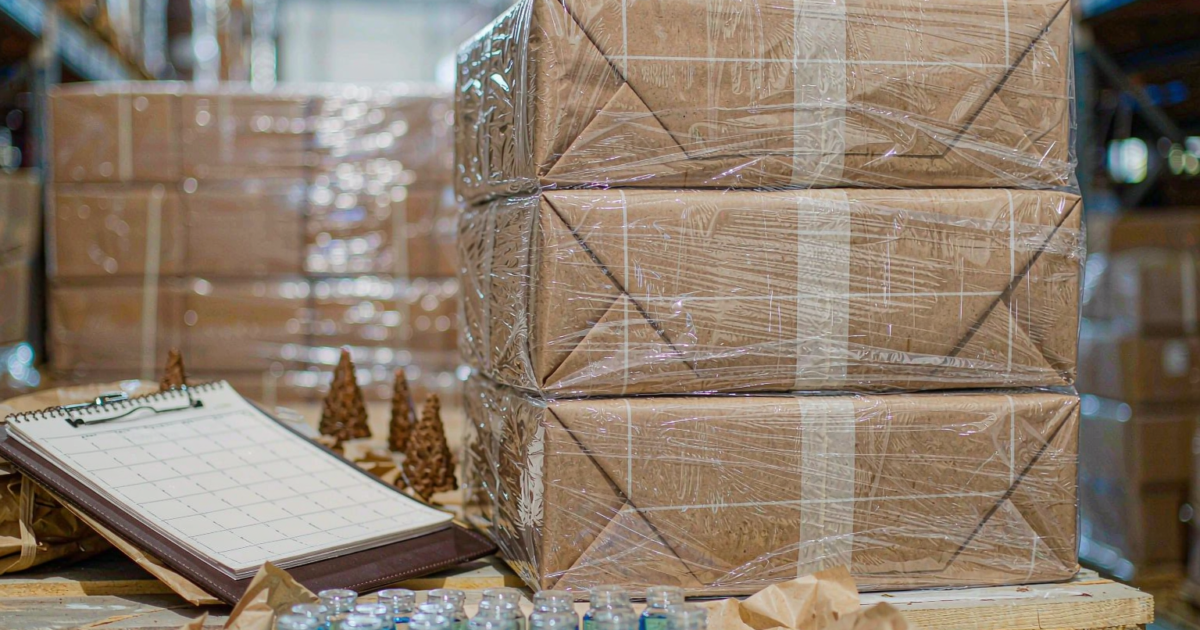
There is also a carton arithmetic issue: sets are bulky and cube out before they weigh out, so freight cost is driven by volume rather than mass. Plan pallet configurations early — our reference on perfume bottle carton and pallet specs covers the layer counts and case-mark requirements that carriers and retailers expect.
Cutoffs by Destination, in Practice
The following are working cutoffs for decorated glass programs shipped by sea, assuming a stock mould and approved artwork. Treat them as the latest sensible order date, not a comfortable one.
| Destination | Latest production-ready date | Latest sea departure | Notes |
|---|---|---|---|
| US West Coast | mid-August | early September | Shortest ocean transit; customs can add a week |
| US East Coast | mid-August | early September | Longer transit; add buffer for East Coast port congestion |
| Northern EU | late August | late September | Inland delivery to 3PL adds 3–7 days |
| UK | late August | late September | Allow extra time for customs documentation post-Brexit |
| Middle East | early September | early October | Strong gifting season; heavy bottles need earlier booking |
Note that these dates assume the factory slot is already reserved. A supplier quoting four weeks of production is quoting production time, not queue time; in September, queue time is the variable that breaks programs.
FAQ
When should I place a perfume bottle order for the holiday season?
For a fully custom, decorated bottle shipped by sea to the US or EU, place the order in April or early May. For a stock mould with standard decoration, late June to early July is workable. Anything after mid-August should be planned as an air-freight or a January delivery, not a holiday program.
How long does a custom perfume bottle take from order to delivery?
A realistic end-to-end range is 26–33 weeks: 3–6 weeks of tooling, 4–8 weeks of sampling and revision, 3–5 weeks of bulk glass, 1–3 weeks of decoration, and 4–6 weeks of ocean freight plus clearance. Removing tooling and one sampling round — by using a stock shape — cuts this to roughly 18–22 weeks.
Is it cheaper to air freight late goods or to miss the season?
It depends on what the season is worth. Air freight for glass is expensive per kilogram because glass is dense and priced on chargeable weight, but a missed retail window can cost a cancelled PO plus a year of carrying costs. For committed orders, air freighting the launch quantity and sea freighting replenishment is usually the correct call; for speculative inventory, it usually is not.
What is the most common reason holiday orders arrive late?
Sampling rounds, not production. Most delays come from multiple approvers, feedback based on photographs rather than a physical sample, and specification changes after the first sample. Factories rarely lose more than a week in production; brands routinely lose four to six weeks in approval cycles.
Can I order gift sets later than single bottles?
No — gift sets need more lead time, not less, because every component must converge. A set adds an insert and a rigid box, and the box usually has the longest lead time of any element. Design sets around bottles already in production, and order the box with the same buffer as the slowest bottle rather than the fastest.