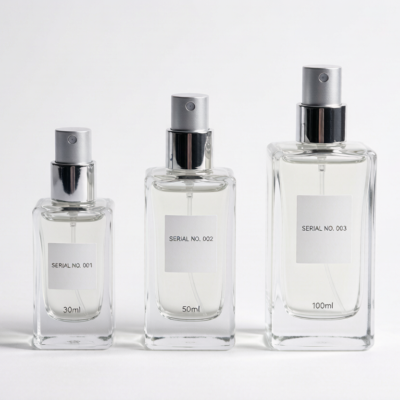
Shoulder geometry is one of the most underrated decisions in fragrance packaging. The shoulder — the transitional zone where the bottle body tapers into the neck — determines how a bottle fills, how it crimps, how it survives transit, and how it reads on a shelf. Buyers comparing a square shoulder perfume bottle against a round shoulder equivalent are really choosing between two manufacturing philosophies: the crisp, architectural look of molded flat planes versus the soft, continuous curve of a rounded profile.
Neither is objectively better. Square shoulders deliver shelf presence and a modern, faceted aesthetic; round shoulders deliver strength, forgiving tolerances, and lower decoration rejection rates. This guide breaks down the trade-offs from a sourcing perspective — mold cost, defect rates, filling behavior, decoration coverage, and drop-test survival — so you can match the geometry to your brand positioning and your production reality.
What the Shoulder Actually Does
Before comparing aesthetics, it helps to understand the shoulder’s mechanical jobs. In a glass perfume bottle, the shoulder:
- Distributes stress from the crimping operation down into the body. Crimp pumps apply significant downward force on the neck finish, and the shoulder geometry determines whether that stress disperses smoothly or concentrates at a transition point.
- Controls glass flow during forming. In blow-mold and press-blow production, the shoulder is one of the last areas to form, and sharp transitions there are where glass distribution thins out.
- Sets the visual “attitude” of the bottle. A hard 90-degree shoulder reads architectural and masculine-leaning; a soft radius reads fluid, feminine, and classical.
Every trade-off in this article traces back to those three functions.
Square Shoulders: The Architectural Look
Shelf Impact and Brand Signaling
A square shoulder perfume bottle creates defined planes that catch light differently at every angle. On a multi-brand counter, those facets create shadow lines that round bottles cannot match — which is why so many niche and masculine fragrance lines default to the format. The geometry also pairs naturally with heavy square bases and magnetic caps, supporting a “monolith” design language that reads premium at first glance.
Manufacturing Realities
Square shoulders are harder to form well. Sharp corners require precise glass distribution, and the corners of the shoulder are the most common location for thin spots, seams, and cold glass marks. In practice, this means:
- Higher rejection risk. Expect dimensional rejection rates on sharp-shoulder molds to run 1–3 points higher than rounded equivalents unless the factory runs well-maintained tooling.
- Stricter tolerance windows. Corner radii that are too tight (under roughly 2–3mm) invite impact failures; most reputable suppliers will push you toward a slightly radiused “soft square” for good reason.
- Mold cost premium. A square shoulder mold typically costs 10–20% more than a round shoulder mold of comparable volume, because corner venting and parting-line alignment are more demanding. Our perfume bottle mold cost guide explains how geometry drives tooling quotes.
Filling and Crimping Behavior
On the filling line, square shoulders are less forgiving of neck misalignment. If the bottle is slightly off-center under the crimp head, a square shoulder gives the operator no visual taper to guide placement, and stress concentrations sit closer to the transition. Well-run lines handle this fine, but co-packers working with mixed SKUs sometimes charge a small efficiency premium for angular formats.
Round Shoulders: The Workhorse Profile
Strength and Tolerance Forgiveness
A continuous radius distributes stress evenly, which is why round-shoulder bottles consistently outperform sharp geometry in drop and impact testing. For brands shipping at volume — especially overseas by sea, where bottles spend weeks absorbing vibration and handling shocks — the rounded profile is the lower-risk choice. Our coverage of how perfume glass bottles are made explains why glass distribution is naturally more even on curved profiles.
Round shoulders also tolerate process variation better. Minor wall-thickness variation that would create a visible thin corner on a square shoulder disappears into the curve of a round one. That tolerance forgiveness shows up directly in your quality statistics.
Decoration Advantages
Silk-screen printing loves a cylinder. On a round-shoulder bottle, the print area transitions smoothly and screens wrap evenly; on square shoulders, ink coverage at the corner transitions is the number-one decoration reject. If your branding relies on full-wrap printing or large-format decoration, a round or softly radiused shoulder will lower your decoration scrap rate measurably — often by 1–2 points, which on a 50,000-unit run is real money. For decoration specifics, see our silk-screen printing guide for perfume bottles.
Consumer Perception
Round shoulders read classical, soft, and feminine-leaning in most Western markets. They dominate the classic eau de parfum format and pair naturally with atomizers and fluid silhouettes. If your brand story is about heritage, botany, or softness, the round profile supports it without saying a word.
Head-to-Head Comparison
| Dimension | Square Shoulder | Round Shoulder |
|---|---|---|
| Shelf presence | High — defined facets, shadow lines | Moderate — classical, softer read |
| Drop-test survival | Lower — corners concentrate stress | Higher — even stress distribution |
| Typical rejection rate | +1–3 points vs round | Baseline |
| Mold cost | +10–20% premium | Baseline |
| Screen-print scrap | Higher at corners | Lower — even wrap |
| Filling-line forgiveness | Less — harder visual alignment | More — natural taper |
| Design language | Architectural, modern, masculine | Fluid, classic, feminine |
How to Choose: Five Practical Questions
- Where does the bottle sell? Physical multi-brand retail rewards the square shoulder’s faceting; pure e-commerce gets less benefit from shelf geometry and more risk from transit failures — which tilts online-heavy brands toward round.
- What is your decoration plan? Full-wrap or multi-color printing favors round shoulders; minimal single-color marks make the square shoulder’s risks manageable.
- What is your shipping profile? Sea-freight, high-parcel-count, or long-transit programs amplify the round shoulder’s durability advantage.
- What is your volume? At stock-mold volumes (3,000–10,000 units), the square shoulder’s tooling premium is irrelevant if a suitable stock mold exists. Below that, geometry risk concentrates in decoration rejects, not tooling.
- What does your neck finish require? Both profiles accommodate standard finishes (13/415, 15/415, 18/415, crimp pump systems), but confirm with your supplier that the shoulder transition supports your chosen pump’s crimp depth.
A middle path exists and is worth asking for: the soft square — square planes with a 3–5mm corner radius. It preserves most of the architectural shelf read while recovering most of the round shoulder’s strength and decoration forgiveness. Many premium brands land exactly here.
Quality Control Points Specific to Shoulders
Whichever geometry you choose, add these checkpoints to your incoming inspection or factory audit:
- Wall thickness mapping at the shoulder transition — the thinnest point of most bottles lives here, and a supplier who can show you thickness data per cavity is a supplier who controls their process.
- Verticality check. Shoulder asymmetry shows up as a leaning neck finish, which surfaces as crimp failures and pump leaks downstream. Our article on perfume bottle tolerance and precision covers the spec numbers worth holding suppliers to.
- Seam and mold-line inspection at corners. On square shoulders, mold seams intersect at the corner radii — the highest-risk visual defect location.
- Thermal stress verification. Rapid cooling during forming can lock stress into sharp transitions; well-run factories anneal thoroughly, and the glass annealing process for perfume bottles explains why the temperature curve matters more for angular geometries.
For buyers building a formal supplier evaluation, quality management certification is the quickest first filter. Factories certified under ISO 9001 quality management.org/standard/iso-9001-quality-management.html”>ISO 9001 quality management systems operate documented process controls — cavity-level tracking, corrective-action loops, calibrated gauges — that directly address the shoulder-zone defects described above.
Conclusion
Square shoulder perfume bottles buy shelf drama and modern design language at the cost of tighter tolerances, higher decoration scrap, and a modest tooling premium. Round shoulders buy durability, process forgiveness, and classical appeal at the cost of visual subtlety. The right answer depends on where your bottle sells, how you decorate it, and how it ships — and for many brands the soft-square middle path captures 80% of both. Whatever you choose, hold your supplier to shoulder-specific quality checkpoints, because that transitional zone is where most hidden defects live.
FAQ
Are square shoulder perfume bottles more expensive than round shoulder bottles?
Slightly, yes. Square shoulder molds typically cost 10–20% more than round equivalents due to corner venting and parting-line demands, and rejection rates run 1–3 points higher. Decoration scrap on square shoulders is also elevated when printing near corner transitions.
Which shoulder shape survives shipping better?
Round shoulders. The continuous radius distributes impact and vibration stress evenly, while square corners concentrate stress at transition points. For long sea-freight programs or high parcel volumes, round shoulders deliver measurably lower breakage rates in drop and transit testing.
Can both shoulder types use the same caps and spray pumps?
Generally yes. Both profiles accommodate standard neck finishes such as 13/415, 15/415, and 18/415 crimp pump systems, so one closure family usually covers both geometries. Always confirm the exact neck finish and crimp depth with your supplier before ordering closures separately.
What is a soft square shoulder bottle?
A soft square combines square shoulder planes with a 3–5mm corner radius. It preserves most of the architectural shelf presence of a sharp square while recovering much of the round shoulder’s strength and decoration forgiveness — a popular compromise for premium brands.
Do square shoulders affect perfume bottle leak rates?
Indirectly, yes. A square shoulder is less forgiving of neck verticality errors and crimp misalignment, and stress concentrations near the transition can amplify micro-cracks that lead to seepage. Suppliers with tight verticality tolerances and documented crimp-depth controls keep leak rates equivalent across both geometries.