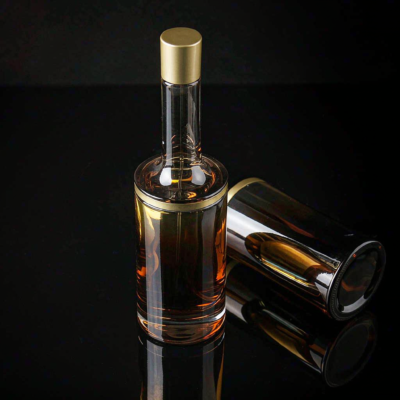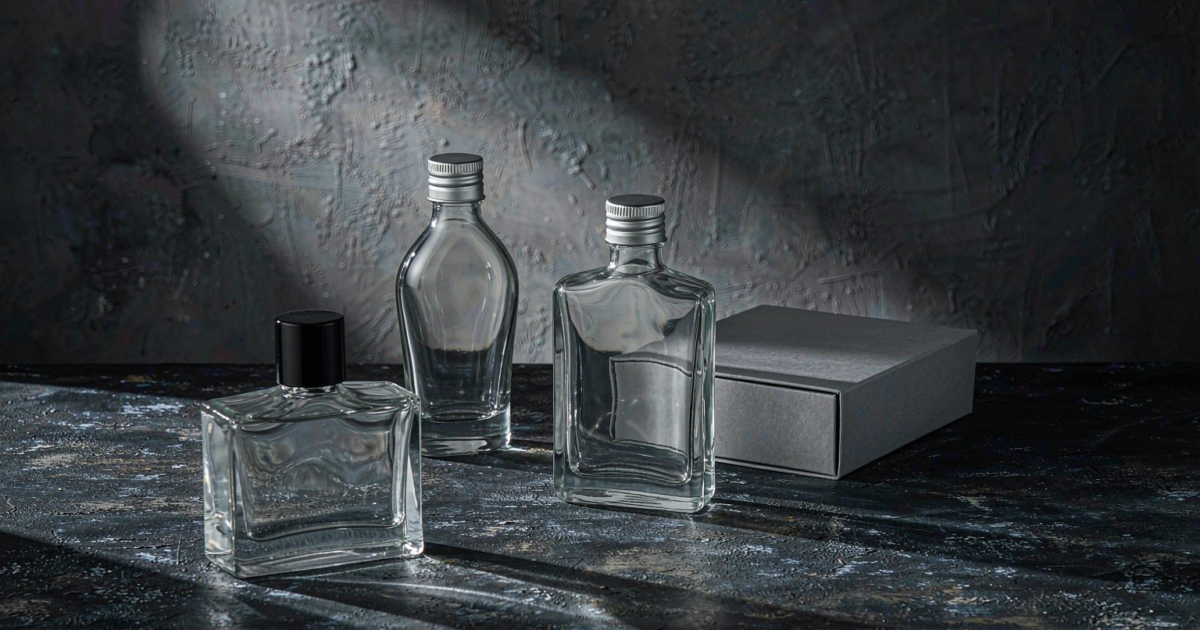
Cologne is the category where packaging decisions get made fastest and regretted longest. A men’s fragrance line typically runs three to five sizes, sells on a shelf where the bottle is the entire advertisement, and launches on volumes that are small enough to be refused by a glass factory and large enough to matter if the bottle is wrong. Buying empty cologne bottles wholesale sits at the intersection of all three pressures.
This guide covers the sizes that actually sell, what each configuration costs at wholesale volumes, the minimum order thresholds you will meet, the closure and neck decisions that determine whether the bottle leaks in a fulfilment centre, and the practical differences between buying cologne bottles and buying women’s fragrance bottles — because the category behaves differently in ways that affect both cost and design.
What Counts as a Cologne Bottle
The word cologne is used loosely in trade. In packaging terms a cologne bottle is generally:
- 75 ml to 200 ml in capacity, with 100 ml as the commercial centre of gravity
- A masculine or unisex design language — heavier glass, squarer or cylindrical forms, wider shoulders, darker and metallic closures
- A crimp or screw neck in 15 mm or 13 mm finish, usually 15 mm on larger sizes
- A fine mist sprayer, occasionally a splash neck for aftershave-style products
The distinction matters commercially because men’s fragrance volumes are typically concentrated in one or two sizes rather than spread across a ladder. Where a women’s line may run 30/50/100 ml with meaningful revenue in all three, a cologne line often runs 50/100/200 ml with 80% of volume in the 100 ml. That concentration is good news for minimum order quantities: fewer SKUs, more units each.
The Sizes That Sell, and What Each One Costs
Wholesale pricing for empty cologne bottles is driven by glass weight more than by nominal capacity. A 100 ml bottle that weighs 180 g and a 100 ml bottle that weighs 300 g are both “100 ml” and differ by 40–60% in price.
| Capacity | Typical bottle weight | Bottle cost (stock mould, 10k pcs) | Typical assembled cost with sprayer and cap | Best used for |
|---|---|---|---|---|
| 30 ml | 90–130 g | 0.28 – 0.45 | 0.55 – 0.95 | Travel, discovery, gift-with-purchase |
| 50 ml | 130–200 g | 0.32 – 0.55 | 0.60 – 1.10 | Entry retail size, sampling programmes |
| 75 ml | 180–260 g | 0.38 – 0.62 | 0.70 – 1.25 | Intermediate tier, gift sets |
| 100 ml | 180–300 g | 0.40 – 0.75 | 0.75 – 1.50 | The core size — most cologne volume ships here |
| 125 ml | 220–330 g | 0.48 – 0.85 | 0.85 – 1.70 | Value tier, refill positioning |
| 200 ml | 280–420 g | 0.65 – 1.20 | 1.10 – 2.30 | Aftershave, splash, large-format value |
Two structural observations. First, cost per millilitre falls steeply as size rises — the 200 ml is often half the cost per ml of the 30 ml — which is why large formats are used to deliver value positioning without discounting the core size. Second, the weight spread within a single capacity is enormous, and weight is what the customer feels. Going from a 180 g to a 260 g 100 ml bottle adds roughly 0.10–0.18 per unit at wholesale and completely changes the perceived price tier. It is the highest-leverage 12 cents in the entire bill of materials.
The 100 ml versus 125 ml decision in particular is worth modelling carefully rather than defaulting — the two sizes compete for the same shelf position and the same customer, and the choice affects carton count, freight and price architecture simultaneously. We covered that trade-off separately in 100 ml vs 125 ml perfume bottles.
Bottle Shapes That Read as Cologne
Shape carries category signalling more than any other packaging decision. Three families dominate men’s fragrance:
Wide square and rectangular flacons. Broad shoulders, flat front panels, heavy bases. The proportions read as architectural and masculine, and the flat panel is the best surface for a short, wide logo. This family also packs efficiently — square footprints waste almost no carton volume, which shows up directly in freight.
Straight cylinders with technical closures. Minimal body, ribbed or ridged caps, often in black or gunmetal. Cylinders are the cheapest glass form to make per unit and the most efficient for labelling and sleeve decoration, which is why so many value and tech-adjacent fragrance brands use them.
Flask and rounded-shoulder forms. Softer profile, usually with a wide body and a short neck, closer to a hip flask than a flacon. These sit between the masculine and unisex worlds and photograph unusually well in flat-lay.
What to avoid in this category: very tall, narrow necks with small caps. They read feminine immediately, and they also create a handling problem on high-speed filling lines because a narrow bottle is less stable in the starwheel. Our notes on men’s perfume bottle design language go deeper into the visual grammar; the commercial point is that shape decisions constrain decoration cost, carton efficiency and filling speed all at once.
Necks, Sprayers and Caps: Where Cologne Bottles Fail
The most common field failure in cologne packaging is not broken glass. It is leakage and sprayer failure, and it originates in decisions buyers treat as minor.
Neck finish. 15 mm crimp is the default on 75–200 ml cologne bottles; 13 mm appears on smaller and travel formats. Crimp necks are sealed by mechanically rolling a collar over the glass lip, which produces a more reliable seal than a screw thread at this scale and is what most filling lines are set up for. Screw necks are used where refilling is part of the proposition. Choosing the wrong one is not a quality issue you can inspect out — it is a line-compatibility issue. The dimensional difference between the two is explained in perfume bottle neck finish: 13/415 vs 15/415.
Sprayer dose. 0.10 ml per stroke suits a concentrated eau de parfum; 0.15 ml is standard for cologne and aftershave where the user expects a broader application. Dose affects perceived strength, number of uses per bottle, and customer satisfaction more than the fragrance concentration does. Our breakdown of spray pump output explains how to specify it.
Collar and ferrule material. Aluminium collars crimp more consistently than plastic and are the default for anything above entry price. Plastic collars are cheaper and adequate for value lines, but they are also the component most often substituted silently by suppliers — specify the material in writing.
Cap fit. A cap that fits too tightly is worse than one that fits loosely: customers cannot remove it, and it cracks. Ask for the cap-to-collar interference tolerance, and insist on an assembled sample from production tooling rather than from the sample room. The gap between sample-room assembly and production assembly is one of the most common reasons a launched bottle behaves differently from the approved sample.
Leak testing. Every cologne bottle programme should specify a leak test method and an acceptance level. Vacuum decay testing catches seal failures that a water bath misses, and the difference in cost is negligible. If your supplier’s quotation does not mention leak testing, it is not included.
MOQ: What to Expect and How to Structure It
Cologne bottle MOQs follow the same logic as any glass packaging: stock moulds are accessible, custom moulds are not.
| Configuration | Realistic MOQ | Notes |
|---|---|---|
| Stock mould, flint, undecorated | 2,000 – 5,000 | Often available from distributor stock at lower volumes |
| Stock mould, flint, sprayed or frosted | 3,000 – 5,000 | Decoration line set-up is the constraint, not the glass |
| Stock mould, printed | 3,000 – 5,000 | One set-up per colour; plates charged separately |
| Custom mould, flint | 20,000 – 30,000 | Tooling amortised in the unit price or invoiced separately |
| Custom mould, coloured glass | 30,000 – 50,000 | Furnace campaign length dominates |
| Custom cap (zamac or bespoke ABS) | 10,000+ | Cap tooling is a separate minimum from the bottle |
Three structures that make small cologne programmes viable:
- One body, three sizes. A single bottle family in 50/100/200 ml lets you commit 6,000 pieces across three SKUs where a single-SKU 2,000-piece order would be declined. Decoration set-ups multiply per SKU, so keep the decoration identical across sizes and vary only the print copy.
- Flint glass plus spray colour. Colour in decoration rather than in the furnace removes the largest MOQ constraint in the category. A sprayed black or gunmetal flint bottle is the standard solution for small men’s fragrance runs.
- Buy closures separately at lower volume. Component distributors stock pumps, collars and caps at 1,000–3,000 pieces. If your glass order is 5,000 but the pump MOQ is 10,000, sourcing the pump independently removes the binding constraint — at some cost in unit price and in the supplier’s willingness to warranty the assembly.
Pricing Reality at Different Volumes
Wholesale cologne bottle pricing has a predictable shape. The following reflects stock-mould 100 ml flint bottles with a 15 mm crimp neck, unbranded, ex-works Asia:
| Volume | Bottle only | With sprayer and collar | With sprayer, collar and stock cap |
|---|---|---|---|
| 2,000 | 0.72 – 0.95 | 0.88 – 1.15 | 1.05 – 1.40 |
| 5,000 | 0.58 – 0.78 | 0.72 – 0.95 | 0.88 – 1.18 |
| 10,000 | 0.48 – 0.68 | 0.62 – 0.85 | 0.75 – 1.05 |
| 25,000 | 0.42 – 0.60 | 0.55 – 0.76 | 0.68 – 0.95 |
| 50,000+ | 0.38 – 0.55 | 0.50 – 0.70 | 0.62 – 0.88 |
The pattern to notice: the assembled price is roughly 1.4× the bottle-only price, consistently, at every volume. Buyers who compare quotations on bottle price alone are comparing an incomplete number. Always ask for the assembled price with a named pump, collar and cap, because that is the number that hits your landed cost.
The second pattern: the curve flattens meaningfully after 25,000 pieces. Below that, you are paying for set-ups; above it, you are paying for glass, labour and energy. If your plan is 10,000 units, negotiating from 10,000 to 25,000 usually buys you 12–15% — worth having, but rarely worth carrying two years of inventory for.
Freight deserves a line of its own. Glass is heavy and volume-inefficient, and cologne bottles are among the heaviest common packaging formats. A 100 ml bottle at 300 g plus carton means roughly 3.5–4.5 kg per 12-unit shipper, and a 40ft container holds far fewer units than the carton count suggests once you account for pallet height limits. Read the carton and pallet specifications before you commit to a landed-cost model, and remember that a bottle that packs 88 units per carton instead of 70 saves more in freight than a 3% glass discount.
Buying Checklist Before You Place the Order
A short list that prevents the majority of first-order problems:
- Confirm the neck finish and thread standard in writing, with a drawing, not a description.
- Get an assembled production sample, not a sample-room assembly, and leak-test it yourself.
- Confirm cap material and finish — ABS, Surlyn, zamac, and plated versus painted are different products at different prices.
- Specify glass weight tolerance, typically ±5%, and ask what the factory measures it against.
- Confirm carton count, carton dimensions and gross weight; verify the container loading maths independently.
- Agree the decoration set-up charges and whether they are per order or per run.
- State the inspection standard — AQL level, critical defect definitions, and who pays for re-inspection.
- Agree the shipping terms and who arranges export documentation.
Each of these is cheap to clarify before production and expensive to resolve after.
FAQ
What is the most common cologne bottle size for wholesale?
100 ml dominates, typically carrying 60–80% of a men’s fragrance line’s volume. 50 ml is the usual entry size and 200 ml the value or aftershave format. If you are launching a single SKU, launch at 100 ml; if two, add 50 ml rather than 200 ml, because the entry size drives trial while the large format cannibalises the core.
How much do empty cologne bottles cost wholesale?
Stock-mould 100 ml flint bottles run roughly 0.48–0.68 per unit at 10,000 pieces, or 0.75–1.05 assembled with a fine mist sprayer, collar and cap. Custom moulds add tooling, not unit cost, but raise the MOQ to 20,000–50,000. Heavyweight bottles (280 g+) sit at the top of every range and are worth the premium if shelf presence is the objective.
What is the minimum order for empty cologne bottles?
For stock moulds, 2,000–5,000 pieces is realistic, and distributor stock can go lower. Custom moulds start at 20,000–30,000 in flint and 30,000–50,000 in coloured glass. The binding constraint is often the closure rather than the bottle — pumps and custom caps frequently carry higher minimums than the glass itself.
Should I choose crimp or screw neck for a cologne bottle?
Crimp is the default for 75–200 ml cologne and aftershave because it seals more reliably at this scale and suits standard filling lines. Choose screw only if refilling or decanting is part of the product proposition, and confirm your filler can handle the thread — switching later means new bottles, new collars and a re-validation.
Why is the assembled price so much higher than the bottle price?
Because a cologne bottle is not a bottle. The sprayer, collar and cap together add roughly 40% to the glass cost, and decoration adds more on top. A quotation for the bottle alone is an incomplete basis for comparison; always request pricing on the assembled pack with the components named, plus decoration and carton, so you are comparing complete landed costs rather than glass prices.
Get Assembled Cologne Bottle Pricing
Send us your target size, shape family and annual volume and we will return assembled wholesale pricing with the pump, collar and cap named — plus the carton and container loading figures you need to build a landed cost before you commit.