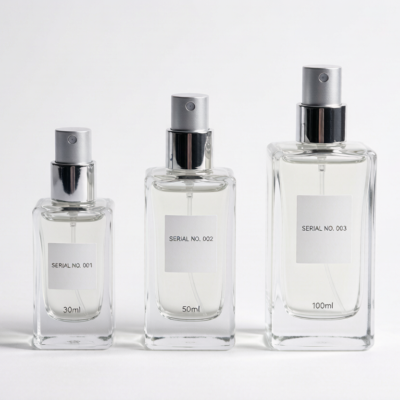
Buyers who treat a reed diffuser bottle as “just a glass jar” end up with slow wicking, top-heavy units that tip over on retail shelves, and re-orders that do not match the first shipment. Choosing a reed diffuser bottle correctly comes down to three technical decisions — neck finish, volume, and glass weight — plus the aesthetics that sit on top of them. This guide walks through each decision from a purchasing perspective, with the numbers you need before requesting quotes.
Why the Neck Finish Matters More Than the Shape
The neck finish determines how many reeds the bottle can hold, how tightly they pack, and how fast fragrance travels up the sticks. Get this wrong and the diffuser underperforms no matter how good the formula is.
Most reed diffuser bottles use one of three neck openings:
- Narrow neck, 18–22 mm opening — holds 5–8 reeds. Slows evaporation, extends product life to 10–16 weeks, and suits premium positioning where a slower scent throw reads as “refined.” Cap choices are typically a decorative collar or a shrink-banded collar.
- Medium neck, 25–28 mm opening — holds 8–12 reeds. The workhorse specification for mass retail; balances scent throw against longevity at 8–12 weeks.
- Wide mouth, 40 mm+ opening — holds 12–20 reeds for maximum throw in large rooms, but burns through 100–150 ml of fragrance oil in as little as 6 weeks. Common in hotel and commercial amenity programs where refill cycles are budgeted.
Match the opening to your client’s claim on the box. If the carton says “lasts up to 12 weeks,” a wide-mouth bottle with 16 reeds will not survive the promise — and returns follow. The neck also dictates collar (also called “international collar” or “gold collar”) sizing, so lock the finish before ordering collars or caps.
Volume: The 100 ml Standard and Its Neighbors
The market has consolidated around a few volumes, and deviating from them costs shelf compatibility and freight efficiency:
| Volume | Typical use | Fill + reed life | Notes |
|---|---|---|---|
| 50 ml | Gift sets, mini formats | 4–6 weeks | Popular for bathroom and car-adjacent positioning |
| 100 ml | Global standard | 8–12 weeks | Best SKU economics; most collar and reed SKUs are made for it |
| 150–200 ml | Large rooms, hospitality | 12–20 weeks | Heavier glass; check shelf load ratings |
| 250–500 ml | Refill bottles | Refill use | Usually no collar; simple screw or flip cap |
The 100 ml reed diffuser bottle is the safest first SKU: every major reed supplier stocks 3 mm rattan or fiber reeds cut to fit it, and filling lines are tooled for it. A 100 ml flint glass cylinder in a stock mold typically quotes $0.55–0.90 FOB China at 5,000–10,000 units; colored glass (amber, smoked, or painted) adds $0.10–0.25. If your client’s formula is a premium blend, note that oil viscosity affects both reed choice and fill-line setup — the same logic that applies to applicator selection in roll-on perfume bottles.
Glass Weight: The Shelf-Stability Variable
Weight is the spec buyers most often omit from RFQs, and it is the one that generates the most complaints. A reed diffuser is top-heavy by design — reeds extend 20–30 cm above the collar — so the base must carry a counterbalancing mass.
Practical guidance:
- 40–80 ml bottles: minimum 180–220 g glass weight.
- 100 ml bottles: 250–350 g is the sweet spot. Below 250 g, the unit tips at roughly 15–18 degrees of lean — enough for a customer brushing a shelf edge or a courier drop to cause an incident.
- 150–200 ml bottles: 400–550 g, often with a deliberately thick base (a “pressed bottom”) to lower the center of gravity.
Thicker glass also improves perceived value. In blind retail tests, consumers consistently rate heavier diffusers as more premium at the same price point — which is why luxury fragrance houses specify 350 g+ bases even for 50 ml minis. The trade-off is freight: a pallet of 100 ml diffusers at 300 g glass ships roughly 20% fewer units per container than the 220 g version. Quote both weights before deciding, and run the landed-cost math rather than the ex-works math. For comparison, weight-vs-appeal trade-offs on the perfume side are covered in heavy base perfume bottles.
Material and Finish Options
Flint (clear) glass is the default because it shows fill level and works with any décor. Beyond that:
- Amber and smoked glass suit woody, oud, and masculine fragrance positioning and protect light-sensitive oils — relevant for citrus-forward formulas with a 12-month shelf life.
- frosted glass diffuses the fill level, which helps when clients want to hide the oil line as it drops. Acid-etch frosting adds about $0.06–0.10 per unit.
- Spray painting and electroplating enable full-color matching to a brand palette, but painted exteriors scratch on shelf collisions; ask for a cross-hatch adhesion test report. Decoration process comparisons — including fired-on versus foil options — are covered in hot stamping vs cold foil for perfume bottles.
Note that a reed diffuser bottle is a cosmetic-adjacent glass container: for EU and US sales, buyers commonly verify that glass suppliers operate under a documented quality system such as ISO 9001 quality management 9001 (see the ISO 9001 standard overview) and that the finished fragrance product complies with the applicable cosmetic or home-fragrance regulatory framework, including FDA cosmetic packaging regulations.gov/cosmetics/cosmetics-guidance-regulation/cosmetics-guidance-regulation”>FDA rules for cosmetics in the US market.
Reed Compatibility: The Spec Nobody Puts in the RFQ
Reeds are consumables, but the bottle defines which reeds work:
- Rattan reeds (3 mm) are the classic: natural look, good capillary action, but each reed’s channels vary, so throw is inconsistent.
- Fiber reeds (3–4 mm) are synthetic with uniform pores — stronger, more consistent throw, 20–30% faster oil uptake. They clog faster with high-vanillin formulas.
- Reed length must be cut so that 4–6 cm sits below the oil line after fill, with the visible portion above the collar. A bottle filled to 80% with 24 cm reeds may expose only 10 cm of wick — fine for narrow necks, wrong for wide mouths.
Ask the factory for a fill-and-flip trial with your actual reed SKU and formula viscosity. Two bottles with the same neck opening can behave completely differently if one has a thicker wall that displaces oil volume — a 100 ml nominal bottle with 8 mm walls actually holds about 85 ml.
Packaging and Transit Considerations
Diffuser bottles ship with collars, caps, reed bundles, and sometimes boxed oil refills. Spec requirements worth writing into the PO:
- Individual poly bags or egg-crate dividers; direct glass-to-glass contact is the top cause of transit chips.
- Drop-test compliance for e-commerce SKUs — consult ISTA 3A procedure guidance for parcel-network testing if units ship DTC.
- Collars packed separately with gasket orientation noted; mixed orientations cause leaks that show up as oil-stained cartons at the customer’s warehouse.
Our leak-testing checklist for perfume bottle packaging applies almost one-to-one to diffusers, since both combine glass, a friction-fit closure, and a low-viscosity oil.
A Practical Selection Checklist
Before issuing an RFQ, fix these seven parameters:
- Neck opening diameter (18–22 / 25–28 / 40+ mm) matched to the reed count on the pack claim.
- Nominal volume and real fill volume after wall thickness.
- Glass weight target for shelf stability.
- Finish (flint / amber / frosted / painted) with adhesion test requirement.
- Collar or cap type and gasket material.
- Reed type, diameter, and cut length.
- Carton configuration and ISTA drop-test level.
Answering these seven questions in the RFQ itself typically cuts two rounds of sampling out of the process — and with 30–40 day production lead times, that is six weeks saved on a launch calendar.
FAQ
What is the best neck size for a reed diffuser bottle?
For retail SKUs, a 25–28 mm medium neck holding 8–12 reeds is the most versatile. Narrow 18–22 mm necks slow evaporation for premium positioning, while 40 mm+ wide mouths maximize throw for large rooms and hospitality use but consume oil 40–50% faster.
How much fragrance oil does a 100 ml diffuser bottle actually hold?
Less than the nominal volume — typically 85–90 ml after wall displacement, filled to about 80%. Plan your formula supply around the real fill volume, not the nominal one, and confirm it with a water-fill trial before mass production.
Why is glass weight important for reed diffusers?
Reeds extend far above the bottle, making the unit top-heavy. A 100 ml bottle needs 250–350 g of glass so the center of gravity stays low enough to resist tipping on shelves and during transit. Heavier glass also reads as more premium to consumers.
What is the typical MOQ for custom reed diffuser bottles?
Stock-mold 100 ml bottles start at 3,000–5,000 units. Fully custom shapes require 10,000–20,000 units plus a mold fee of roughly $2,000–5,000, with 35–45 day lead times from mold approval. Decoration and collars usually share the same MOQ as the glass.
Are fiber reeds better than rattan reeds?
Fiber reeds deliver 20–30% more consistent throw because their synthetic pores are uniform, and they suit commercial settings. Rattan reeds offer a natural look and gentler throw for premium home positioning. Fiber reeds clog faster with high-vanillin oils, so match the reed to the formula.