Walk into any fragrance counter and pick up two bottles. One feels solid, grounded, expensive. The other feels light — and even if the liquid inside is identical, your brain has already priced the light one lower. That first impression is driven largely by one spec most buyers underestimate: perfume bottle base thickness. For B2B buyers sourcing from China, base thickness is one of the most consequential decisions on the spec sheet. It affects unit cost, shipping weight, mold design, filling-line compatibility, drop performance, and ultimately how premium your brand feels in hand. Get it right and the bottle sells the juice. Get it wrong and you either pay for glass weight you don’t need or ship a bottle that cracks in transit.
This guide breaks down how base thickness is specified, what ranges are typical at different price points, and — the question every purchasing manager eventually asks — how heavy is too heavy.
Why Base Thickness Matters More Than You Think
In a glass perfume bottle, the base does more structural work than any other part of the container. It absorbs the impact when the bottle is set down, it carries the entire column load when bottles are palletized, and it concentrates stress during thermal swings on the filling line.
Three practical consequences follow directly from base thickness:
Cost per unit. Glass is priced largely by weight. A 100ml bottle with a 12mm base weighs noticeably more than the same geometry with a 6mm base — often 15–25% more total glass. At container-load volumes, that difference shows up directly in your landed cost.
Shipping economics. Freight is paid on gross weight. Heavier bases mean fewer bottles per container before you hit weight limits, and higher per-unit logistics cost. For air-freighted launch batches, the penalty is severe.
Perceived quality. This cuts both ways. A heavier bottle reads as premium — up to a point. Past that point it reads as clumsy, and the extra glass becomes dead cost that the consumer never rewards.
If you are still comparing bottle geometries, our guide to square shoulder vs round shoulder perfume bottles covers how shape choices interact with wall and base distribution.
Typical Base Thickness Ranges by Market Segment
There is no single standard, but across the fragrance packaging industry the ranges are remarkably consistent:
| Segment | Typical base thickness | Notes |
|---|---|---|
| Economy / travel sizes (5–15ml) | 3–5mm | Light handling, cost-driven |
| Mass market (30–100ml) | 5–8mm | Balanced weight and cost |
| Premium / designer (50–100ml) | 8–12mm | “Weight = quality” positioning |
| Niche / luxury (50–100ml) | 12–20mm+ | Sometimes with thick glass base discs or bottom-poured effect |
| Display / shaped objects | 20mm+ | Often decorative, rarely filled to full capacity |
Two things stand out from this table. First, the jump from mass market to premium is mostly base thickness — the sidewalls barely change, because thick sidewalls cause visible distortion of what’s inside. Second, luxury houses exploit the base deliberately: a heavy glass base creates that “sinking anchor” feel when the bottle is picked up.
How Thickness Is Specified and Measured
When you receive a spec sheet or a mold drawing from a factory, base thickness appears in one of three ways:
- Nominal minimum wall — the thinnest point the factory commits to, e.g. “min. 6mm base.” This is the number that matters for strength.
- Average section — useful for weight estimation but tells you nothing about the worst case.
- Weighted glass distribution — premium factories provide a section-weight drawing showing where glass accumulates, which is essential for complex sculpted bottles.
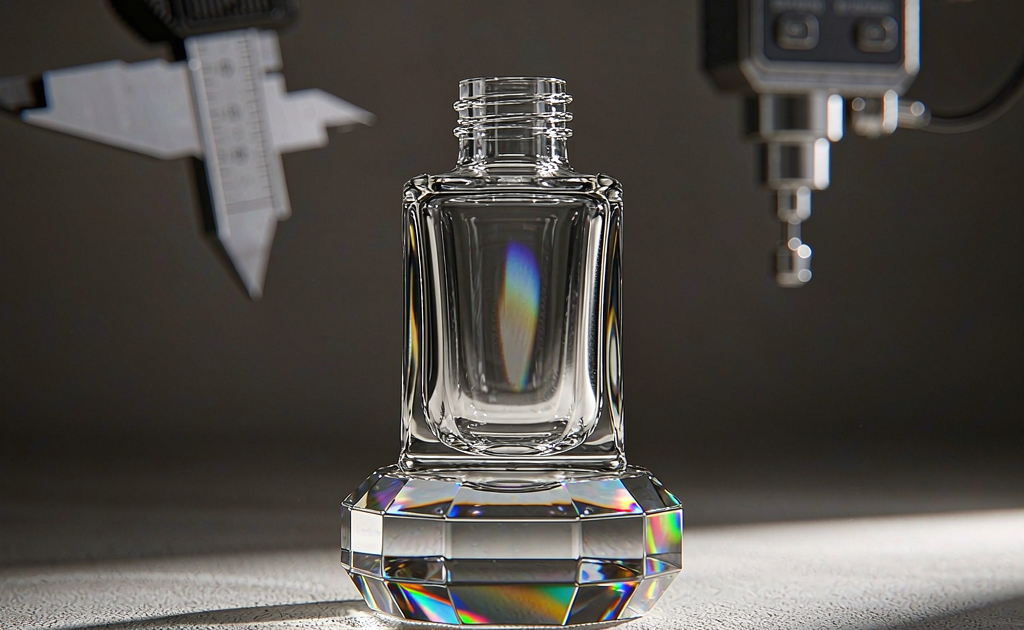
Measurement is done with ultrasonic wall-thickness gauges on sampled production, and destructively by saw-cutting a bottle in half during first-article inspection. A capable supplier will happily saw a sample bottle for you during the approval stage. If a supplier refuses to show a cross-section, treat it as a red flag — it usually means the base is thinner than quoted.
For buyers evaluating multiple factories, our perfume bottle quality control checklist includes base thickness checkpoints alongside seam, verticality, and capacity tolerances.
The Weight-Feel Sweet Spot: 8–12mm for a 100ml Bottle
Ask ten brand owners what their bottle should weigh and you’ll get ten vague answers. Here’s the practical heuristic we use with clients:
For a standard 100ml cylindrical or square shoulder bottle:
- Under 250g empty — feels light, appropriate for mass-market and e-commerce value lines
- 250–350g empty — the sweet spot for most premium positioning; substantial in hand without becoming a liability
- 350–500g empty — distinctly luxury; expect higher freight and be sure your outer packaging and displays are rated for it
- Over 500g empty — only justified for niche statements, gift sets, or sculptural objects
Base thickness is the main lever for moving between these bands. Moving a 100ml bottle from a 6mm to a 10mm base typically adds 60–90g of glass — enough to jump a full weight band.
One caution: thick bases must be designed, not just made thicker. A base that transitions abruptly to thin sidewalls creates a stress riser at the junction, which is exactly where bottles crack on impact. Good mold design uses gradual fillets and controlled distribution.
Too Heavy: When Extra Glass Starts Working Against You
The “too heavy” threshold is not a single number — it’s where four separate costs start stacking faster than the perceived-quality benefit:
- Freight crossover. Once container weight limits bind before volume limits, every extra gram is pure freight. Heavy-base bottles commonly lose 10–15% units per 40HQ container.
- Breakage pattern shift. Counterintuitively, heavier bottles can suffer more damage in transit and retail handling, because impact energy scales with mass. ISTA 3A testing on a heavy bottle requires stronger inner packaging, which adds cost again. Our ISTA 3A packaging guide explains how this plays out in real test reports.
- Consumer handling. A 500g+ bottle of 100ml becomes awkward for smaller hands and risky on bathroom shelves. Returns and negative reviews on “clumsy” bottles exist, and no brand wants them.
- Cost without reward. Glass price scales with weight. Past roughly 15mm of base on a standard 100ml geometry, blind testing shows diminishing perception gains — most consumers cannot reliably distinguish a 15mm from a 20mm base.
The pattern we see in successful launches: premium brands converge on 8–12mm bases plus a separate visual trick — a thick, deeply faceted, or darkened base disc that looks heavier than it is.
Glass Type and Thickness Interaction
Base thickness decisions also depend on the glass composition. Standard soda-lime glass, which covers the vast majority of fragrance bottles and complies with packaging requirements in major markets (see the Glass Packaging Institute for composition and recycling standards), performs well at the ranges above.
Where thickness matters differently:
- Flint (clear) glass shows internal stress and cord lines more readily when sections are thick, so thick-base flint bottles demand better furnace control.
- Colored glass (amber, cobalt, black) absorbs stress visually but follows the same mechanical rules.
- Crystal-look high-density formulations achieve heavy feel with slightly thinner sections — a useful option when freight is the binding constraint.
Practical Spec Checklist for Your Next RFQ
When you request a quotation for a custom perfume bottle or a fragrance bottle program, include these base-related items on the spec sheet:
- Minimum base thickness (not average): state 6mm, 8mm, 10mm etc.
- Total empty weight tolerance: ±5g is standard for machine-made; ±3g achievable on good lines
- Cross-section approval: require a saw-cut sample photo at first article
- Drop test height commitment: typically 1.0–1.2m onto hard surface for filled bottles in sales packaging
- Pallet load assumption: bottle-on-bottle stacking height and carton compression rating
Factories that answer these five points precisely are the ones that measure; factories that answer vaguely are the ones that guess.
FAQ
How thick should the base of a 50ml perfume bottle be?
For a 50ml bottle, 6–10mm is the practical range. Mass-market 50ml bottles typically use 5–7mm, while premium positioning starts around 8mm. Because a 50ml bottle is smaller and lighter overall, the base proportionally dominates the feel — going from 6mm to 9mm produces a noticeably more substantial bottle for only 20–40g of extra glass.
Does a thicker base prevent perfume bottles from breaking?
It helps but doesn’t guarantee anything. A thicker base resists point impact better and lowers the center of gravity, but the failure location usually moves to the base-to-sidewall junction if the transition is abrupt. Well-designed gradual fillets matter as much as raw thickness. Always validate with drop testing at your actual filling weight, in your actual sales packaging.
How much does base thickness add to bottle cost?
Glass cost is roughly proportional to weight. Adding 4mm to the base of a 100ml bottle adds roughly 60–90g of glass, which typically raises the ex-factory bottle price by 10–20%, depending on geometry and decoration. Freight adds a second, often larger, increment at container scale — which is why the base spec belongs in your landed-cost model, not just the unit-price model.
What is the heaviest base a filling line can handle?
Most standard rotary and inline filling systems handle bottles up to about 800–900g total filled weight without modification. Beyond that, starwheel grip width, vacuum chucking, and capper downforce may need adjustment. Always send your factory’s spec sheet — including empty weight — to your filling-line supplier before finalizing the mold. A bottle that the line cannot grip stably is an expensive discovery on installation day.
Can I make a bottle feel heavier without a thicker base?
Yes, and this is exactly what experienced brand designers do. Options include: a dark or smoked base that visually suggests mass, deep faceting or knurling around the base edge, a separate heavy Zamak or Surlyn cap that adds top-weight balance (see our cap material comparison), and widening the base footprint while keeping thickness moderate. Blind tests show perceived weight is heavily influenced by cap weight and surface texture — you can often buy the same premium feel for half the glass cost.