Every fragrance brand eventually faces the same fork in the road: do you extend your line with travel-size perfume bottles in the form of refillable atomizers, or with miniature replica bottles that mirror your hero flacon? Both formats chase the same shopper — the one who wants fragrance in a handbag, a carry-on, or a first-time trial purchase — but they are manufactured, priced, and merchandised in completely different ways.
For procurement and brand teams, the decision is not cosmetic. It determines your closure supplier base, your decoration spend per unit, your margin structure, and even how the SKU performs in travel retail. Here is a working comparison built from the factory floor’s point of view.
First, Define the Two Formats
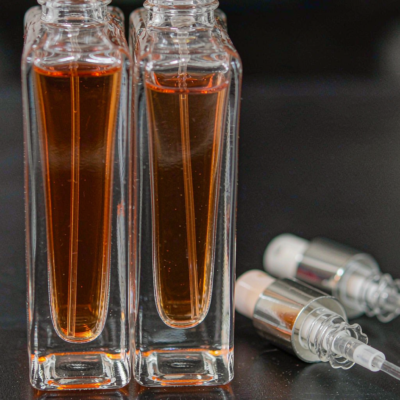
Travel atomizers are refillable spray containers, typically 5–12 ml, built around a removable fill chamber or a bottom-valve refill system. The classic construction is an aluminum or ABS outer shell with an inner glass or plastic reservoir and a standard spray pump. Newer “twist and fill” designs draw liquid directly from your full-size bottle through the actuator.
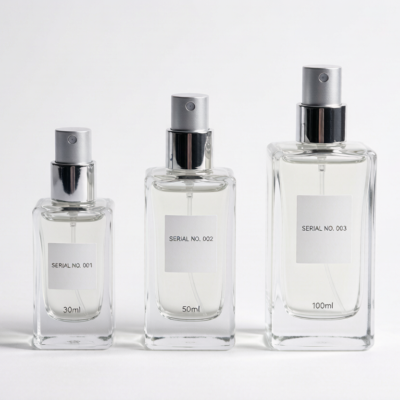
Miniature bottles (often called minis or coffret sizes) are small glass replicas — usually 4–10 ml — of your main bottle, produced with the same mold family or a scaled-down dedicated mold, fitted with a matching mini crimp pump and miniature cap. They are filled once, sold, and emptied. No refill functionality.
Both are legitimate. They just solve different problems.
Manufacturing and Cost Structure
This is where the two formats diverge sharply.
Travel atomizers:
- The bottle is essentially a stock component. Aluminum shells, glass inserts, and pumps are catalog items at most closure makers, which means no mold investment and low MOQs (often 3,000–5,000 units).
- Your differentiation comes from the shell finish — anodized colors, soft-touch coating, laser engraving — not from glass shaping.
- Unit cost typically lands between $0.45 and $1.20 depending on shell material and actuator, at moderate volumes.
- Decoration is cheap to change: a new anodized color is a new PO, not a new mold.
Miniatures:
- If your hero bottle has a custom silhouette, the mini needs its own mold — even a scaled version. Expect $6,000–15,000 in mold cost depending on complexity, or a shared-cavity arrangement if your supplier already runs a similar shape.
- Glass forming, annealing, and QC add real cost per unit; minis are disproportionately labor-intensive because all the handling steps happen at small scale.
- Unit cost for a decorated glass mini typically runs $0.60–1.50 — comparable to or above an atomizer, despite containing far less glass.
- The payoff is brand equity: the mini is your bottle. No atomizer can replicate that shelf recognition.
A useful lens: atomizers are a functional product; miniatures are a brand artifact. Price and produce accordingly.
Consumer Use Case and Channel Fit
Where does each format actually sell?
Travel atomizers shine in:
- Travel retail and duty-free, where refillability is the whole point and TSA liquid rules (containers ≤100 ml, so both formats qualify) make 8–10 ml atomizers a convenient purchase.
- Gifting add-ons and e-commerce bundle inserts — low unit cost makes them viable as a “free gift” lever that still carries your engraving.
- Corporate and promotional orders, where a custom-engraved atomizer at 5,000 units is far more economical than a custom glass mini.
Miniatures win in:
- Discovery sets and coffrets, where five 4 ml minis introduce a full line and drive conversion to full-size purchase. This is the classic fragrance sampling funnel.
- Premium gift-with-purchase programs at department store counters, where the mini’s fidelity to the hero bottle is the entire value.
- Subscription and sampling boxes, where the perceived “real product” quality of glass matters more than refill function.
If your distribution leans e-commerce and travel retail, atomizers usually deliver faster sell-through. If your strategy is counter-led and discovery-set driven, minis justify their mold spend. For a deeper dive on how the sampling funnel works at small volumes, our comparison of 5 ml vs 10 ml sample bottles covers the conversion data.
Compliance and Shipping Notes
Both formats avoid most regulatory friction because they fall under standard cosmetic packaging rules — glass is inert, and fragrance formulas are the licensee’s responsibility. But three practical points matter:
- Air transport. Both formats travel fine by air at ≤100 ml per container, but finished-fragrance shipments are classed as limited-quantity dangerous goods (alcohol-based, UN1266). Inner packaging performance is validated under ISTA-style drop and vibration protocols — ask your supplier for transit test reports on the actual SKU configuration, since 10 ml minis in coffret inserts behave differently than full-size bottles.
- Food-contact-adjacent expectations. Fragrance packaging isn’t food-contact, but buyers increasingly ask for compliance declarations referencing FDA cosmetic packaging regulations cosmetic guidance or EU cosmetics regulation frameworks for the pump’s plastic components. Stock atomizer pumps usually carry existing declarations; custom minis need their pump spec’d the same way you would for a full-size SKU.
- Labeling real estate. A 13 mm-diameter mini cannot carry your full regulatory back label. Plan for a fold-out leaflet or carton-based labeling strategy — this is a recurring surprise for first-time mini buyers.
The Hybrid Play: Doing Both
Many mid-size brands run both formats with clean role separation:
- Miniature for the hero SKU only (one mold, amortized over 2–3 years of coffret and GWP volumes).
- Atomizers in 8–10 ml for the broader line, with shell colors mapped to each fragrance family.
This contains mold investment to a single SKU while still covering travel retail and promo channels. The atomizer side can be re-skinned seasonally — a new anodized colorway for holiday sets — without touching tooling.
If you are planning a gift box that mixes sizes, our guide to perfume gift set bottle configuration walks through how to combine a 100 ml hero, 30 ml companions, and a 10 ml travel size inside one rigid box — including insert design and weight limits.
Sourcing Checklist Before You Commit
Whichever way you lean, put these five items in your RFQ:
- Refill mechanism specification (atomizer path): twist-and-fill, funnel-fill, or removable chamber — each has different leak profiles in transit.
- Mold ownership and exclusivity (mini path): confirm the mini mold is yours, and whether scaled geometry is technically feasible or needs redesign.
- Pump output volume: minis and atomizers typically use 0.05–0.08 ml/stroke pumps, roughly half of a full-size bottle’s output — confirm so the spray experience doesn’t feel weak.
- MOQ and reorder lead time: stock atomizers reorder in 25–35 days; glass minis after the initial run reorder in 45–60 days.
- Leak and drop test reports for your exact configuration, not a “similar SKU.”
FAQ
What sizes do travel atomizers and miniatures typically come in?
Travel atomizers usually range from 5–12 ml, with 8 ml and 10 ml the most common. Glass miniatures typically run 4–10 ml, with 5 ml and 7.5 ml standard for coffret sets. Both formats comply with the 100 ml limit for cabin baggage, so no special travel documentation is needed.
Which format is cheaper for a first-time order?
Travel atomizers are almost always cheaper to start: no mold investment, MOQs from around 3,000 units, and stock components. A custom glass miniature requires mold tooling (typically $6,000–15,000) and higher effective MOQs to amortize it.
Can a miniature bottle be refilled?
Not by design. Minis are fitted with permanent crimp pumps intended for single-fill, and attempting to refill them usually damages the neck or pump. If refillability matters to your customer, that is precisely the case for a travel atomizer instead.
Do atomizers and minis use the same pumps as full-size bottles?
No. Both use smaller-output pumps, typically 0.05–0.08 ml per stroke versus 0.10–0.15 ml on full-size bottles. Atomizer pumps are integrated with the shell; mini pumps are scaled crimp units matched to the mini’s neck finish. Always confirm spray output in the spec sheet so the hand feel matches brand expectations.
Which format converts better in discovery sets?
Glass miniatures generally convert better in coffret and discovery-set contexts because they replicate the hero bottle and feel like “real product.” Atomizers perform better as standalone travel-retail SKUs and promotional gifts. Many brands use minis for sampling programs and atomizers for travel and corporate channels.