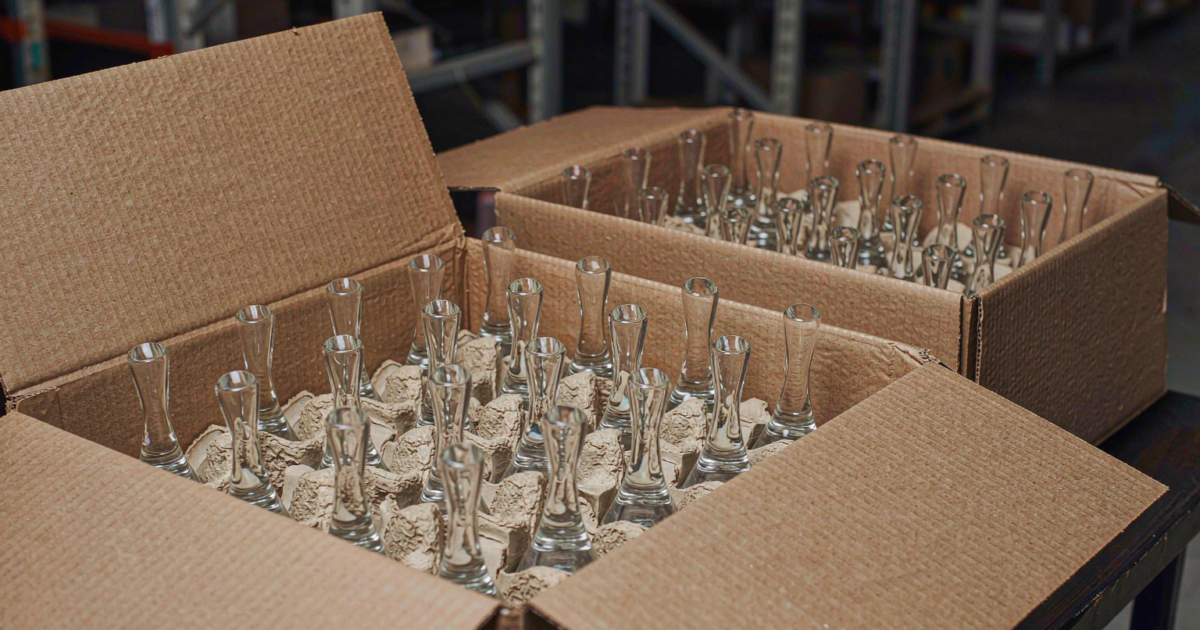
A 1% breakage rate on a 100,000-piece order sounds negligible until you see it as 1,000 unusable bottles, a filling line stoppage in your customer’s plant, and a claim argument that lasts longer than the shipment took to arrive. Glass perfume bottles break in transit at rates that range from 0.2% on a well-engineered pack to over 6% on a pack designed by nobody in particular — and the difference is rarely the bottle’s fault. It is the carton, the divider, the pallet pattern, and the last 40 centimetres of the container.
This article covers where breakage actually comes from, what packaging configurations do and do not work, how to test a pack before you ship 100,000 units in it, and how to structure the commercial side so a damage event does not become a two-month negotiation.
Where Breakage Actually Happens
Damage in glass shipments clusters in four places, and only one of them is visible when you open the container.
Carton compression. Corrugated board loses strength with humidity. A board rated at 8 kN compression at 50% relative humidity can lose 40–50% of that strength in a humid container over a four-week sea voyage. Stacked six high in a container, the bottom cartons carry the weight of everything above them and slowly crush, transferring load onto the bottles. Failure looks like hairline cracks along the shoulder that only appear when the bottle is filled and pressurised.
Impact at the ends of the carton. Bottles break most often at the two ends of the carton, not the middle, because that is where the divider weakens and where handling impacts concentrate. If your damage pattern shows end-position failures, the problem is the divider-to-wall interface, not the glass.
Pallet overhang and strapping. A carton that overhangs the pallet edge by 10 mm loses a large fraction of its compression strength. Over-tight plastic strapping does the opposite damage: it deforms the carton walls inward against the bottles. Both mistakes are common and both are invisible in a photo of a nicely wrapped pallet.
Vibration and resonance. Vibration in a container is not violent, but it is relentless. Over 30 days, bottles that can move a few millimetres inside their cavity will abrade against each other and against the divider, creating surface damage that fails incoming AQL even when nothing is visibly cracked.
The pattern to remember: breakage is usually a load-path problem, not an impact problem. Fix the load path and the numbers drop.
The Packaging Configurations, Ranked
| Configuration | Typical breakage | Incremental cost | Best for | Main weakness |
|---|---|---|---|---|
| Bottles in poly bag, loose in carton | 3–8% | Baseline | Nothing. Do not ship this way | No load path, bottles contact each other |
| Corrugated partition grid | 1.0–2.5% | +3–6% of pack cost | Standard 30–100 ml flacons, high volume | Grid collapses if board gets damp |
| Molded pulp (recycled fibre) inserts | 0.5–1.5% | +8–14% | Premium gift sets, heavy-base bottles | Tooling cost per SKU; moisture sensitive |
| EPE foam inserts | 0.4–1.2% | +12–20% | Heavy bottles, decorated surfaces that must not abrade | Volume penalty in the container; not widely recyclable |
| PET / rPET blister tray | 0.3–1.0% | +15–25% | Retail-ready packaging, pharmacy channel | Tooling cost; recyclability questions in EU |
| Individual foam sleeve + grid | 0.3–0.8% | +20–30% | High-value flacons, electroplated caps | Manual packing labour, slow line speed |
Three things stand out. First, the cheapest option that works at all — a corrugated partition — is good enough for most volume programmes, and the gap between it and the best option is under 2 percentage points. Second, the biggest single improvement is not the insert material but whether the insert actually touches the bottle on four sides. Third, everything beyond molded pulp buys you protection for the decoration, not the glass: once breakage is below 1%, what remains is usually surface abrasion on sprayed or plated parts, and that is solved by a sleeve, not a stronger box.
If your bottle carries a heavy base or a large flat panel, the risk profile shifts. Our article on heavy-base perfume bottles explains why the mass distribution changes where the load lands during a drop.
Carton Specification: The Numbers That Matter
Buyers habitually specify “5-ply export carton” and consider the question closed. It is not, because ply count says nothing about strength. The specification that matters is the compression value, stated under a defined humidity condition.
| Parameter | What to specify | Why |
|---|---|---|
| Board grade | ECT (edge crush test) value, e.g. ECT 44 | Directly predicts stacking strength; ply count does not |
| Box compression (BCT) | Minimum kN, calculated for your stack height and voyage duration | The load the box must survive wet, not dry |
| Humidity conditioning | Test at 90% RH for 48 h for sea freight | Dry-condition values overstate real performance by 40%+ |
| Flute direction | Vertical flutes on all four walls | Horizontal flutes lose most of their compression strength |
| Board moisture at packing | 8–10% | Board packed damp starts weak and gets weaker |
| Print coverage | Under 40% of surface | Heavy ink coverage reduces board strength |
The arithmetic for stack height is worth doing once. Six pallets high in a container, each pallet holding five layers of cartons, means the bottom carton carries the weight of 35 cartons above it. At 16 kg per carton that is 560 kg of static load, before any dynamic amplification from sea motion. A BCT of 8 kN gives you a safety factor above 1.4; a BCT of 4 kN does not.
Testing the Pack Before You Ship 100,000 Units
Three tests, in increasing order of cost, tell you whether a pack will survive:
- Carton drop test — ISTA 1A style, ten drops from 760 mm on corners, edges and faces, on a carton that has been humidity conditioned. Cheap, fast, and it finds the obvious failures.
- Vibration test — ISTA 3A or ASTM International standards D999, random vibration at 0.5 g for one to three hours with the carton on a pallet. This is the test that catches abrasion and divider collapse, which drop tests miss entirely.
- Full ISTA 3A or 3E distribution simulation — drop, vibration, compression and atmospheric conditioning in sequence. Around two weeks and a few thousand dollars at an accredited lab, and it is the only test that predicts sea freight performance with any confidence.
For European retail channels, ISTA 3A is often a contractual requirement rather than a choice. Our guide to ISTA 3A testing for perfume packaging covers the protocol in detail. If you ship e-commerce parcels, ISTA 6-AMAZON.COM over-box testing applies instead, and it is materially harsher.
A practical compromise for medium-volume buyers: run the drop test on every new pack, run the vibration test whenever the divider material or board grade changes, and run full ISTA once per packaging design. Test the pack with bottles filled to nominal weight — an empty bottle behaves differently, and the difference matters on corner drops.
Pallet Pattern and Container Loading
The pallet is where most of the preventable damage is created, and it is the cheapest thing to fix.
- No overhang, ever. Cartons must sit inside the pallet footprint. A 10 mm overhang can cost 20% of carton compression strength.
- Interlocked stacking rather than column stacking, unless the cartons are rated for column load and the pallet is stretch-wrapped tightly. Column stacking gives better compression performance; interlocking gives better stability. Choose based on the board grade you actually bought.
- Corner protectors and top caps. Cheap, and they recover most of the compression lost to handling.
- Stretch wrap with a top sheet. The top sheet matters more than the wrap: it stops moisture migrating down through the stack.
- Desiccant in the container, not in the cartons. 1–2 kg of container desiccant per 20 ft reduces the humidity swing that weakens board.
- No mixed-SKU pallets for fragile shapes. A pallet of one SKU with one divider height loads predictably; a mixed pallet does not.
One more: check the container floor. Broken glass on the floor of a container from a previous shipment is not your problem until your cartons slide on it.
The Commercial Side: Claims and Risk Transfer
Packaging protects the goods; the sales contract determines who pays when it fails. Three clauses do most of the work.
Risk transfer point. Under FOB or CIF, risk passes at the port of loading, which means transit damage is the buyer’s risk unless the contract says otherwise. Many buyers accept this without realising it, then discover their marine insurance excludes insufficient packaging — a standard exclusion. If you are buying FOB, buy insurance that explicitly covers packaging insufficiency, or negotiate a delivered term.
Damage notification window. Require written notification within a defined period of container devanning, with photos of the container, the pallet, the carton and the damaged bottle in situ. A claim filed 45 days after arrival with no in-situ photos is unpayable, and suppliers know it.
Replacement mechanism. Agree in advance how breakage above an agreed threshold is settled: credit note, replacement units in the next production run, or a price rebate. A threshold of 0.5% with replacement at the supplier’s cost on the next order is a normal commercial position on a well-tested pack.
Also agree the counting method. Breakage measured as “bottles that will not pass your filling line” is a different number from “bottles with any chip,” sometimes by a factor of three. Define the failure criterion — a chip larger than 1 mm in the visible zone, a crack visible under backlight, a neck finish that fails the go/no-go gauge — before the first shipment, not after.
A Breakage Reduction Plan in Order of Payback
If you are starting from a 4% breakage rate and want to get under 1%, this sequence gives the most improvement per dollar:
- Fix the divider. Ensure the partition grid contacts the bottle on all four sides with 1–2 mm compression. Cost: near zero, if the die is right. Typical improvement: 1.5–2 points.
- Upgrade the board grade to a specified ECT, tested wet. Cost: 5–10% of carton price. Typical improvement: 0.8–1.2 points.
- Eliminate pallet overhang and add corner protectors. Cost: negligible. Typical improvement: 0.3–0.6 points.
- Add a foam or pulp sleeve for decorated surfaces. Cost: 10–20% of pack cost. Typical improvement: 0.3–0.5 points, plus a large reduction in cosmetic rejects.
- Run ISTA 3A once and fix what it finds. Cost: a few thousand dollars. Typical improvement: variable, but it converts guesswork into a design.
Steps 1 to 3 are usually enough to move a pack from unacceptable to acceptable. Steps 4 and 5 are what separate an acceptable pack from one that arrives with the decoration intact.
FAQ
What is a normal breakage rate for glass perfume bottles shipped by sea?
Between 0.5% and 1.5% on a properly engineered pack with a corrugated partition or pulp insert, humidity-conditioned board, and no pallet overhang. Rates above 2.5% almost always indicate a load-path failure — divider clearance, board grade, or stacking — rather than a glass quality problem.
Is a thicker carton the best way to reduce breakage?
Usually not the first fix. Divider fit and pallet pattern give more improvement per dollar than board thickness. Once those are right, upgrading the board to a specified wet ECT value is worthwhile, but buying a thicker board while leaving a 3 mm gap between bottle and divider changes very little.
Should I test with empty bottles or filled bottles?
Filled, at nominal weight, whenever possible. An empty bottle has a different centre of gravity and a different response to corner drops, and empty-bottle testing tends to understate damage on heavy-base shapes. If filling is not practical at the sampling stage, add water to nominal weight in a sealed sample.
Who pays for breakage that happens during sea freight?
Under FOB and CIF terms, risk transfers at the port of loading, so transit damage is contractually the buyer’s risk. Marine insurance frequently excludes losses caused by insufficient packaging, so the practical protection is either a tested pack plus insurance that covers packaging insufficiency, or a negotiated delivered term that keeps risk with the seller until arrival.
How do I prove breakage came from packaging rather than the bottles?
Photograph the container and pallet condition on devanning, record which carton positions failed (end versus middle, bottom tier versus top), and inspect the failed bottles for the fracture origin. Damage that starts at the body wall with no impact mark on the divider points to compression; damage clustered at carton ends with crushed divider walls points to handling. That positional evidence is what makes a claim arguable.