Leak testing is the step where a perfume bottle program is either proven or exposed, and there are two methods that account for almost every bottle you have ever bought: the water bath test and the vacuum decay test. They are not interchangeable. One finds leaks that exist right now, under a small positive pressure of air. The other finds leaks that will exist after a pump is crimped on, after a bottle has sat in a warm warehouse for six months, and after the alcohol has had time to attack a marginal seal.
For a buyer specifying a perfume bottle leak test method, the practical question is not which test is “better” — it is which failure mode you are trying to catch, at which point in the process, and at what cost per bottle. This article sets out both methods, the parameters that matter, the acceptance criteria that hold up in real programs, and how to combine them.
What Each Test Actually Measures
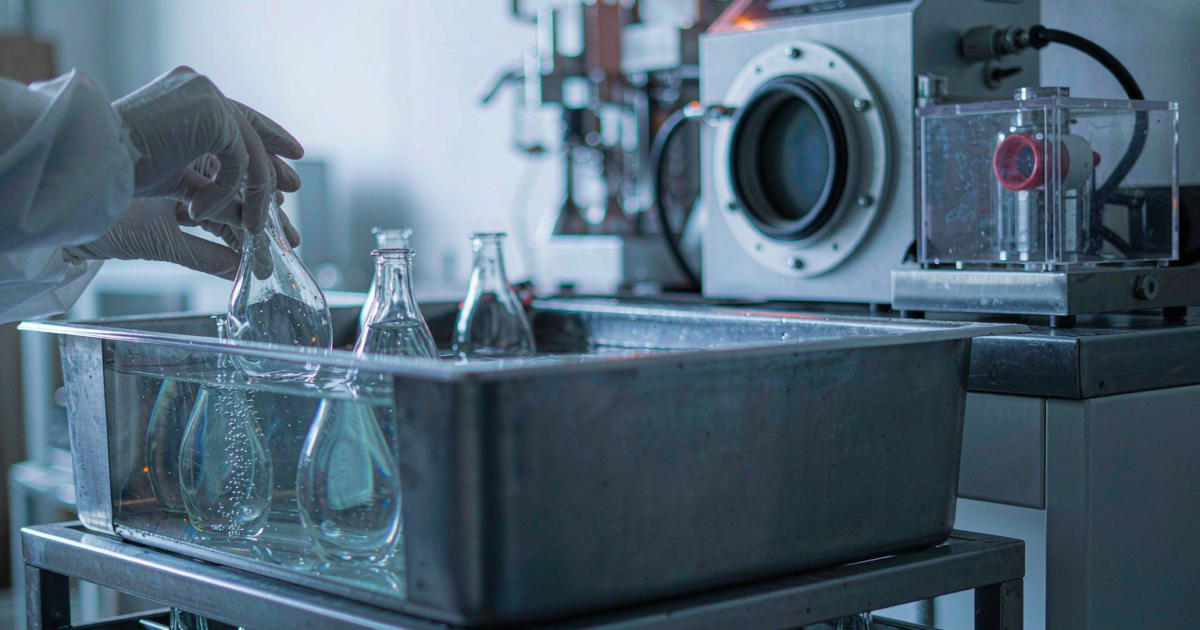
Water bath testing (positive pressure immersion). Bottles are filled with water or a water/surfactant solution, sealed with the intended closure or a test closure, and submerged in a water bath. Air is introduced — either by pre-pressurising the bottle or by the natural headspace pressure of a squeeze — and any leak shows as a stream of bubbles at the leak path. It is a direct, visual, binary test. It is also the classic method for glass containers in the container industry, and its logic is the same one behind the well-established pressure and leak standards maintained by bodies such as ASTM International standards International for packaging and closures.
Vacuum decay testing (pressure change method). The sealed bottle is placed in a test chamber, the chamber is evacuated, and a pressure transducer monitors the pressure rise over a defined dwell time. A leaking bottle lets air (or headspace vapour) escape into the chamber, and the pressure rise is larger than for a sound bottle. The result is a number, traced to a calibrated transducer, and the test does not require the bottle to be wetted.
There is a third method worth knowing — dye penetration, where a coloured dye solution is drawn into a leak path under vacuum — but it is a laboratory diagnostic rather than a production test, useful for finding where a leak is, not for screening.
Where Perfume Bottles Actually Leak
Knowing the failure locations tells you which test will catch them, because the two methods have very different sensitivities to the same defect.
- Neck finish / land sealing area. Chips, mould lines, or out-of-tolerance land flatness on the sealing surface. This is the highest-frequency leak in perfume bottles, because the crimp or screw cap relies on a narrow annular seal.
- Shoulder and body cracks. Impact damage, thermal shock, or a stone inclusion. A through-crack leaks immediately and obviously.
- Base and heel. Thin or uneven base, or a crack at the heel from a drop.
- Mouth and thread region. On screw-neck flacons, thread finish defects that let the cap back off.
- The pump/crimp interface. Not a glass leak at all, but the cause of the majority of what customers report as “the bottle leaks.”
Note that items 1 and 5 are seal-interface problems, not holes in glass. That distinction matters enormously, because a bottle with a marginal neck finish will pass a water bath test at ambient pressure and fail after 8 weeks in a warm warehouse — alcohol vapour finds its way through a seal that water did not.
Water Bath: Parameters That Matter
If a supplier says “we do a water bath test,” the next four questions determine whether that means anything.
| Parameter | Typical industrial setting | Why it matters |
|---|---|---|
| Test pressure | 0.3–1.0 bar positive, or vacuum −0.3 to −0.6 bar | Below 0.3 bar you miss pinhole-scale leaks |
| Immersion time | 30–60 seconds minimum | Short dips miss slow leaks |
| Water temperature | 20–30°C | Cold water raises viscosity and hides small leaks |
| Surfactant added | 0.1–0.3% wetting agent | Without it, small leaks form clinging bubbles instead of visible streams |
| Closure used | Production closure, same torque/crimp | Testing with a test cap proves nothing about the real seal |
| Sampling | 100% for premium lines, AQL for volume lines | Full inspection is slow but eliminates escapes |
The critical weakness of water bath testing is not sensitivity — a properly run bath with surfactant at 0.5 bar will find a 0.1 mm hole reliably. It is that water bath tests the bottle, not the pack. If the test closure is not the production pump crimped at the production setting, the test is a glass integrity test and says nothing about whether your finished product will leak on the shelf.
For premium fragrance lines this is why the meaningful test is a filled-pack water bath: the actual bottle, filled with the actual juice (or a close surrogate), closed with the actual pump at the actual crimp dimension, immersed. That test catches neck finish problems, crimp problems, and seal compatibility problems at once. It is slower and messier, and it is what a serious supplier does for first-article approval.
Vacuum Decay: Where It Wins
Vacuum decay testing has three genuine advantages in a perfume program.
It is quantitative and traceable. You get a pressure rise in pascals over a fixed dwell, not a technician’s opinion about bubbles. That number can be trended across a production run, so you detect drift before you get failures. This is the same principle behind the non-destructive package integrity methods now widely used in pharmaceutical and food packaging, where container closure integrity testing has been formalised into standards and guidance.
It is non-destructive and dry. No water enters the bottle, so the tested units can be returned to the line. For an expensive flacon with a decorated cap, being able to test and keep the unit matters.
It is fast and automatable. Modern inline vacuum decay leak testers run 100–300 bottles per minute with no operator judgement. That makes 100% inspection economically viable in a way the water bath never is.
Where vacuum decay loses: it is less good at finding blockages (a blocked leak path does not show), it needs a well-characterised chamber volume for each bottle size, and it is much less effective on a seal problem where the leak is driven by the fragrance’s solvent power rather than by pressure differential. Vacuum decay will happily pass a bottle whose seal will fail in six months because the gasket swells in alcohol.
The Test That Tests Nothing: Ambient Bottle-Only Screening
A pattern worth flagging because it is common and expensive. Buyer asks for a leak test. Supplier runs bare bottles (no pump) through a water bath at low pressure. All bottles pass. Buyer approves. Three months later, filled goods leak from the neck.
Nothing was wrong with the supplier’s water bath. What was tested was glass integrity only — that the bottle has no hole. That is a useful and necessary test, but it is not a leak test for the pack, and it should not be presented as one. In a purchase specification, name the test honestly: “glass integrity — water bath, 0.5 bar, 60 s, 100% or AQL 0.65” if that is what is being run, and require a separate filled-pack verification for the seal.
Leak Testing for Different Bottle Types
The right method shifts with bottle type and value.
Standard spray flacons (50–100 ml, crimp neck). Glass integrity by inline vacuum decay at 100%, plus filled-pack vacuum decay or water bath on an AQL sample per batch. Rationale: high volume, low unit value, seal problems dominated by the crimp which is controlled separately.
Heavy-base premium flacons (100 ml+, decorated). Filled-pack water bath on first article plus per-batch AQL sample; inline vacuum decay would require a chamber matched to a large, heavy, decorated bottle and is often not economical. Accept the slower method because the unit cost justifies it.
Roll-on and reducer-fit bottles. Seal is at the fitment, so test the assembled pack. Vacuum decay works well here because the fitment is a tight interference fit and the method detects fit variation.
Miniatures and samples (2–10 ml). Highest leak rate per unit in the industry, because the neck finish is tiny and the crimp tolerance is proportionally larger. Vacuum decay with a small chamber is the practical production method; 100% inspection is affordable at this size.
Refillable and thick-wall decorative bottles. Test the pack assembled, and add a cycle test — open and reclose 20 times, then leak test — because the seal on a refillable bottle degrades with use in a way a single-shot test will never reveal.
Our article on perfume bottle leak testing methods covers the underlying test logic in more depth, and the neck dimension tolerances that drive most seal failures are set out in perfume bottle neck finish: 13/415 vs 15/415.
Acceptance Criteria That Survive Scrutiny
Vague criteria generate arguments. These are specific enough to contract:
- Glass integrity: zero leaks permitted. A leak is a critical defect, not a major one. 100% inspection for glass integrity on any bottle above 50 ml, or AQL 0.1 with a documented sampling plan.
- Filled pack, ambient: zero leaks at 24 hours after filling, 100% visual for neck wicking.
- Filled pack, accelerated: 4 weeks at 40°C / 75% RH, stored inverted for half the period, then inspected for leakage, weight loss and seal swelling. Weight loss is the quantitative measure — for a 50 ml flacon, more than 0.15 g/year loss is a red flag on a crimp seal.
- Vacuum decay: reject if pressure rise exceeds the calibrated threshold for that chamber and bottle size, with the threshold established during first-article validation using deliberately leaking reference samples.
That last point is the one buyers most often skip. A vacuum decay tester is only meaningful if the reject threshold was set by testing bottles with known leaks of known size. Without that validation, the instrument produces numbers, not quality.
Practical Procurement Notes
Timing. Leak testing happens at two points: inline on the glass line (glass integrity) and after assembly (pack integrity). They are different tests, run by different people, and the purchase order should name both if both are required.
Cost. Inline vacuum decay adds a small per-unit cost — in the range of a fraction of a cent to about €0.01 per bottle depending on volume and line speed. Filled-pack water bath on an AQL sample adds labour and a small amount of product waste but almost no equipment cost.
Documentation. Ask for the leak test report per batch: method, pressure, dwell, sample size, failures found, and the serial number of the instrument. This is standard practice and unremarkable for a factory operating under ISO 9001 quality management 9001; if a supplier cannot produce it, that alone is diagnostic.
Where the test belongs in your sampling flow. Leak testing is one of several gates in the approval sequence we describe in the perfume bottle sampling process and in the broader quality control checkpoints for perfume bottle production. It should also be repeated on the production tooling, not just the prototype, because tool wear changes the neck finish — the subject of our mold lifespan and maintenance guide.
FAQ
Is vacuum leak testing better than a water bath test for perfume bottles?
They catch different things. Vacuum decay is quantitative, fast, non-destructive and ideal for 100% inline glass integrity screening. Water bath immersion is better for detecting seal failures on an assembled, filled pack because it tests the actual closure at the actual crimp. Most well-run programs use vacuum decay inline and water bath on assembled AQL samples.
At what pressure should a water bath leak test be run?
0.3–1.0 bar positive pressure or −0.3 to −0.6 bar vacuum, with 0.5 bar being the common working point for glass containers. Immersion time should be at least 30–60 seconds, water at 20–30°C, and 0.1–0.3% surfactant added so small leaks form visible streams instead of clinging bubbles.
Why did my bottles pass the factory leak test but leak in the market?
Almost always because the factory tested bare glass, not the assembled pack. A bare bottle water bath proves the glass has no hole; it says nothing about the neck finish to gasket interface or the crimp dimension. Seal failures commonly appear only after weeks at elevated temperature, when alcohol vapour attacks the gasket.
How much weight loss indicates a leak on a perfume bottle?
For a 50 ml flacon stored inverted at 40°C, more than 0.15 g per year of weight loss is a warning sign on a crimped seal. Measure by weighing the filled unit on a calibrated balance at t=0 and at the end of the accelerated period, and treat rising weight loss across a batch as a tool-wear signal on the neck finish.
Can leak testing be done on 100% of production?
Yes, with vacuum decay. Inline vacuum decay testers handle 100–300 bottles per minute and add roughly €0.005–0.01 per bottle, so 100% screening is standard on premium lines. Water bath immersion cannot realistically run at 100% on volume because it is slower and wet, so it is normally an AQL sample or a first-article validation.