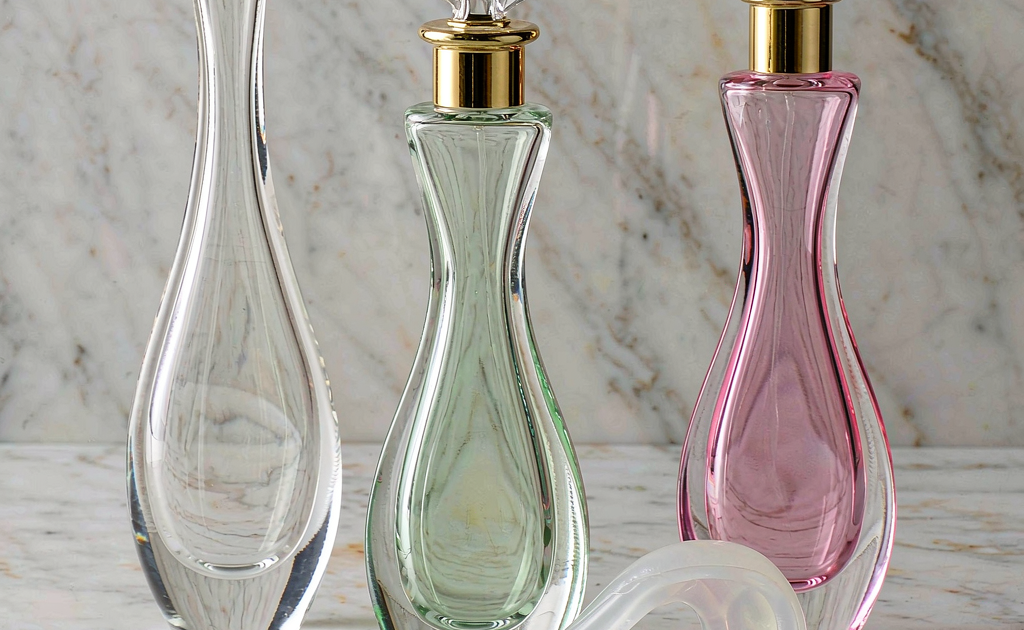
When buyers source custom perfume bottles for a women’s fragrance line, the silhouette is often the first decision that shapes everything else: label placement, cap proportion, decoration budget, and shelf presence. Women’s perfume bottle design favors curves because curves communicate softness, movement, and luxury in a way that rigid geometry rarely matches. But not every curve works. The same recurring patterns appear across best-selling launches because they solve practical manufacturing problems while creating emotional impact at the point of sale.
At Huanshi, we produce custom perfume glass bottles for independent fragrance brands, contract manufacturers, and cosmetic packaging distributors. Over the last five years, the requests that convert into repeat orders tend to cluster around five proven silhouette families. This guide breaks down those recurring design patterns, explains why they perform, and shows how to specify them without blowing the mold budget.
Why Curves Dominate Women’s Perfume Bottle Design
Perfume is sold as fantasy before it is sold as scent. The bottle is the physical proof of that fantasy. For women’s lines, curves read as approachable, sensual, and premium. Neuroscience-backed retail studies consistently show that rounded forms increase perceived value and approachability compared to sharp angles. That does not mean every bottle should look like a teardrop. It means the curve must be intentional.
A well-placed curve does three things at once:
- It guides the eye toward the brand name or front label.
- It creates a comfortable grip for spray application.
- It reflects light in a way that catches smartphone cameras and social feeds.
Because of that last point, many 2026 launches are being designed with shareability in mind. A bottle that photographs well in natural light often outperforms a technically superior competitor on social platforms.
The Five Recurring Silhouette Patterns
1. The Hourglass Waist
The hourglass silhouette is the most requested shape in women’s perfume bottle design. It narrows at the center to emphasize the spray pump and shoulders, creating natural symmetry. From a manufacturing standpoint, this shape requires a two-part mold with careful wall-thickness control. If the waist is too narrow, the glass can cool unevenly and create stress points.
Recommended parameters for a 50 ml hourglass bottle:
| Specification | Typical Value |
|---|---|
| Total height | 85–95 mm |
| Waist diameter | 28–32 mm |
| Shoulder diameter | 38–42 mm |
| Base thickness | 5.5–6.5 mm |
| Wall thickness at waist | 3.5–4.0 mm |
| Neck finish | 15/415 |
Hourglass bottles photograph well because the label sits on a relatively flat front panel while the sides curve away. The result is strong shelf presence without excessive glass weight.
2. The Soft Shoulder Flask
A rounded shoulder that flows directly into the body is the second most common request. It feels classic and works especially well for floral or oriental fragrance positioning. Unlike the hourglass, the soft shoulder flask does not narrow in the middle, so it offers more printable real estate for front and back labels.
This pattern is forgiving in production because the mold draft angle is gentle. It is also a strong candidate for decoration techniques such as gradient spraying and metallization, since the curved surface catches coatings evenly.
3. The Pear or Teardrop
The pear shape is playful and premium at the same time. It is common in travel-size and rollerball formats because the narrow neck and wider base feel secure in the hand. Buyers choosing a pear silhouette should pay attention to stability. A base that is too round will rock on a vanity shelf; a flat bottom insert or weighted base solves the problem without changing the outer profile.
Pear molds are more complex than they look. The body usually requires a blow-and-blow process with precise parison control to maintain even wall thickness. If your target volume is below 30 ml, expect slightly higher per-unit cost because the mold utilization rate drops.
4. The Vertical Oval Column
A vertical oval column is the minimalist answer to curves. The front and back are flat; the sides are elliptical. This pattern is increasingly popular for clean beauty and niche fragrance brands that want a modern, quiet luxury look. It stacks and ships efficiently, which reduces packaging cost and breakage.
The key design rule is the ratio of width to depth. A ratio of 1.6:1 feels elegant; anything beyond 2:1 starts to look like a flat disc and can become unstable. The oval column is also ideal for direct print because the front panel is flat, allowing crisp logos without distortion.
5. The Asymmetric Flow
Asymmetric curved bottles generate the strongest social media response but carry the highest engineering risk. One shoulder higher than the other, a body that twists slightly, or a heel that extends beyond the base all fall into this category. They signal artistic intent and justify premium pricing.
From a sourcing perspective, asymmetric designs require mold cost planning early. Because the center of gravity is off-axis, filling lines and carton inserts must be tested with real samples. We recommend producing a 3D-printed prototype before committing to the glass mold.
How to Match Curve Style to Fragrance Positioning
The silhouette should reinforce the fragrance story. Here is a quick mapping we use with clients:
| Fragrance Positioning | Recommended Silhouette | Surface Finish |
|---|---|---|
| Classic floral | Soft shoulder flask | Frosted or clear with gold accents |
| Modern clean beauty | Vertical oval column | Matte pastel coating |
| Sensual evening | Hourglass waist | Deep gradient or metallization |
| Playful daytime | Pear or teardrop | Transparent bright color |
| Niche avant-garde | Asymmetric flow | Raw glass with embossed detail |
Decoration and Curve Interaction
Curved surfaces change how decoration behaves. On a convex surface, logos and text can appear to stretch. On a concave waist, labels may not adhere evenly. For women’s perfume bottle design, the decoration stage must be considered at the same time as the silhouette.
The most stable surfaces for direct print are the vertical oval column and the soft shoulder flask. Hourglass waists work best with partial labels or shrink sleeves. Pear shapes suit small-format hot stamping on the shoulder rather than full-body print.
We recommend ordering pre-production samples with at least two decoration placements. The cost of a sample run is almost always lower than the cost of correcting a full order.
Practical Spec Checklist for Buyers
Before sending a curved bottle design to a supplier, confirm these points:
- Wall thickness minimum at the narrowest point
- Flat base diameter or weighted base requirement
- Neck finish compatibility with the chosen pump or cap
- Label panel dimensions and curvature compensation
- Carton insert cavity to prevent rocking in transit
- Decoration adhesion test on the most curved area
Our factory follows an ISO 9001 quality management 9001 quality management system, and every new mold is checked against these points before sampling. We also reference guidance from the Glass Packaging Institute on sustainable design to keep wall thickness and material use efficient.
What MOQ and Lead Time Look Like
For a custom curved perfume bottle with a new mold, standard MOQ is 5,000 units per shape. If you adapt an existing Huanshi mold, MOQ drops to 3,000 units. Tooling lead time for a new mold is 18–22 days; first article samples follow 7–10 days after mold approval. Mass production lead time is typically 30–35 days for orders up to 50,000 units.
Fragrance brands planning a holiday launch should lock the bottle silhouette 16 weeks before the desired delivery date. That leaves time for sampling, decoration matching, and stability testing without last-minute air freight.
FAQ
What is the most cost-effective curved silhouette for a new fragrance brand?
The soft shoulder flask is usually the most cost-effective curved option. It uses a simple mold, offers generous decoration space, and ships well. It also adapts easily to different volumes, so a 30 ml, 50 ml, and 100 ml family can share design DNA.
Can a curved perfume bottle use a standard pump and cap?
Yes, as long as the neck finish matches. The body curve does not affect the neck. We typically recommend a 15/415 neck finish for curved 50 ml bottles because it balances proportion and pump availability. Custom caps like zamac or magnetic styles can be added without changing the glass shape.
Does an hourglass waist increase the risk of breakage?
If the wall thickness is controlled, the risk is low. The danger point is the waist transition. We use annealing lehrs with a controlled cooling curve to remove internal stress. Every production lot also passes a drop test from 1.2 meters onto a hard surface.
How do I avoid label lifting on curved surfaces?
Use a label material with some conformability, or switch to direct screen printing. For high-curvature areas, shrink sleeves are often more reliable than pressure-sensitive labels. Always run a 72-hour adhesion test at 45°C and 85% humidity before full production.
Can Huanshi modify an existing curved mold for my brand?
Yes. We maintain a catalog of existing mold bases that can be adapted with embossing, base shape changes, or neck height adjustments. This reduces tooling cost by 40–60% and shortens lead time by about two weeks. Contact our team with your reference shape and we will match it to the closest existing option.