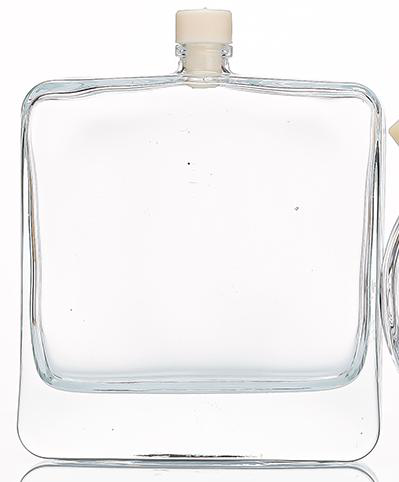
At 289 g empty for a 100 ml fill, the wx-26 is one of the four heaviest 100 ml bodies in our current stock batch — behind only the wx-80 at 315 g, the WX-4 at 300 g and the wx-77 at 290 g. For a fragrance brand, that number is a design decision with a freight invoice attached: heavy glass is the fastest way to make a 100 ml read as a premium 100 ml on a retail shelf, and the most expensive way to ship one across an ocean.
This page gives you the measured specification for the wx-26, the real loading arithmetic for a 20 GP and a 40 HQ, and an honest read on when the extra 90 g over a standard 100 ml body pays for itself — and when it does not.
wx-26 Specifications
| Item | Specification |
|---|---|
| Model | wx-26 |
| Fill capacity | 100 ml |
| Neck finish | 15 mm crimp neck |
| Bottle weight | 289 g |
| Glass | Clear flint soda-lime glass |
| Body shape | Wide flat flask, rounded corners, flat front and back panels |
| Units per carton | 50 pcs |
| Net glass weight per carton | ≈ 14.45 kg |
| Gross weight per carton | 15.5 kg |
| Carton dimensions | 49 × 34 × 12.5 cm |
| Carton cube | 0.0208 CBM |
| Cap and pump | Quoted separately — 15 mm crimp pump, collar and overcap |
| Height / diameter | Formal drawing issued with the quotation |
Every figure in this table is measured stock data from the current batch. The only field we do not publish on a web page is the height-and-diameter pair, because tooling is re-measured between batches and a callout that drifts by a millimetre breaks a gift-box or a shrink-wrap drawing downstream. Ask for the drawing pack and you get the numbers that match the glass you will actually receive.
The Profile: A Flask, Not a Cylinder
The stock photo shows the geometry clearly. The front elevation is close to square, the front and back are flat panels rather than curves, and the four corners carry a generous radius — roughly a fifth of the body width, which is what keeps the shape from looking like a laboratory reagent bottle. Because the panels are flat, the glass reads thick and even across the face rather than pooling into a lens at the centre the way a round body does. The base is flat with a small chamfer at the perimeter, and the neck sits centred, short, at 15 mm.
The proportions are what make the shape work. A wide flat flask at 100 ml holds the same volume as a cylinder but presents a much larger front face — width and height both grow while depth shrinks to a third of the width. On a crowded shelf that means more label area and a silhouette that stands out among round bottles, and in the hand it sits flatter and feels denser.
Suits: men’s EDT and eau de toilette lines, unisex and gender-neutral ranges, woody and amber fragrances where a flask reads as heritage rather than novelty, gift sets that need a 100 ml anchor, and travel-retail or duty-free packs where the bottle is handled constantly. For a wider read on the design language this profile belongs to, see men’s perfume bottle design language and gender-neutral fragrance packaging.
Two things to check before you commit to the shape. First, a flat flask has a large flat base, which is stable on a shelf but unforgiving on a conveyor: any warp in the base shows immediately, because the bottle cannot rock. Our base flatness is held within the tolerance covered in perfume bottle tolerance. Second, the flat panel is an asset for printing but the corner radius is not — artwork that runs off the face onto the radius will distort, so keep the print field inside the flat.
Loading Arithmetic: Weight-Limited, and That Matters
| Metric | 20 GP | 40 HQ |
|---|---|---|
| Carton cube | 0.0208 CBM | 0.0208 CBM |
| Cartons by cube (28 / 68 CBM usable) | 1,344 | 3,265 |
| Cartons by payload (25 t / 26 t) | 1,612 | 1,677 |
| Practical cartons | 1,344 | 1,677 |
| Bottles | 67,200 pcs | 83,850 pcs |
| Gross weight shipped | 20.8 t | 26.0 t |
| Cube actually used | 28.0 CBM | 34.9 CBM |
Read the last row carefully. A 40 HQ of wx-26 is weight-limited at 1,677 cartons, which occupies only 34.9 CBM of a 68 CBM container — the box sails half empty. That is the direct cost of 289 g of glass per unit, and it is why we quote this SKU differently from a standard 100 ml body.
It is also an opportunity. The 33 CBM of unused cube is free freight for anything light: caps, collars, overcaps, pumps, rigid gift boxes, pouches, outer cartons. Buyers who pair a heavy bottle with light accessories in the same container cut their effective landed cost per set noticeably, and the arithmetic is on the page — the bottle is the constraint, so fill the rest. Our carton and pallet specification guide covers how to plan a mixed load without breaking the weight distribution.
A 20 GP is cube-limited at 1,344 cartons and sails at 20.8 t, which leaves payload on the table but keeps you inside road limits in the EU and UK, where a 20 GP on a standard chassis is the friendlier configuration. Full-container buyers who care about freight per unit generally do better on a 40 HQ with the cube filled; part-load buyers are better served by the 50-piece carton.
Why 50 Pieces per Carton
Most 100 ml bodies in our range pack 42 to 70 pieces per carton. The wx-26 sits at 50, in a carton that is 49 × 34 cm in footprint and only 12.5 cm deep. The low count is deliberate: 50 pieces of a 289 g bottle is already 14.45 kg of glass, and pushing to 70 would take the carton past 20 kg, which is above the manual-handling threshold most warehouses and 3PLs apply.
In practice a 50-piece carton buys you three things. It stays under 16 kg, so it can be lifted by one person without a team-lift rule. It is shallow, so the bottles sit in fewer layers and the top layer carries less load — breakage in transit on a heavy flat body usually starts with a corner chip on a bottle that has been loaded under three neighbours. And it is easy to count and reconcile on receipt, which matters when you are sampling from the first carton of a production run. Breakage control in transit is covered in reducing perfume bottle breakage.
Decoration on a Flat Flask
The wx-26 is one of the easier bodies in the range to decorate, because you are printing on flat glass rather than wrapping a curve:
- silk screen printing — one to three colours on the flat face, with excellent registration and no distortion. This is the default decoration for this shape; the process and ink options are set out in our silk screen guide.
- Hot foil stamping — the flat panel takes gold or silver foil cleanly, and because the surface is planar the foil does not wrinkle at the edges. See gold foil stamping.
- Spray coating — solid colours cover evenly; if you want a clear window for the liquid, mask the flat face and coat the sides and the perimeter radius, which produces a framed effect that suits the flask.
- Frosted / acid-etched — a full etch on a flat flask reads as stone rather than as glass, which is a strong look for a men’s line; partial etching works but needs a mask that respects the corner radius.
- Vacuum metallization — full plating on a flask is bold and expensive; more common is a plated band or a plated cap and collar with a clear body. Parameters are in vacuum metallization.
- Laser engraving — cleanest on the flat base and on the perimeter chamfer, useful for batch codes and small brand marks.
Two-tone work on this body is worth a conversation, because the flat face and the radius give you a natural break line for masking — the technique and its cost drivers are in two-tone spray coating.
Closures: 15 mm Crimp Only
The wx-26 is a crimp-neck body, which fixes the closure strategy: the pump is sealed onto the neck and cannot be removed without destroying the seal. For retail that is the right answer — it is the standard for fragrance, it eliminates leakage complaints from customers who unscrew a pump, and it protects the fill from oxidation and evaporation.
What it rules out is a refill programme on this body. If you sell refill pouches or plan a refillable bottle system, take a screw-neck body from the same programme instead; the crimp versus screw comparison sets out the trade in full.
Matching accessories ship from the same stock batch: 15 mm crimp pumps in gold, silver and black electroplated aluminium and in plastic-collared versions, plated and ABS collars, and cylindrical or square overcaps in aluminium, ABS and zamac. Pump output — 0.1 ml versus 0.15 ml per stroke — changes the spray character more than most buyers expect, and is compared in spray pump output.
Compare Within the 100 ml Slot
The wx-26 is the flask. If the brief calls for something else at the same fill volume, the closest alternatives in current stock are the wx-3 100 ml for a smoother-sided barrel, the xy-3 100 ml for a wider round footprint, the xf-19 100 ml for a tall rounded rectangle, and the wx-57 100 ml for a domed barrel at 200 g — 89 g lighter, and the better choice if freight per unit is the deciding factor. The pricing relationship between 30, 50 and 100 ml on the same programme is covered in the size guide.
If weight is the point of the design, heavy base perfume bottles explains where the grams actually go and which ones a customer can feel, and glass thickness covers the strength-versus-aesthetics trade.
MOQ, Samples and Lead Time
There is no tooling charge — the wx-26 mould exists and is in production. Clear samples ship from stock, usually within a few days. A decorated sample in your colour and print typically runs 7–15 days from artwork approval, with frosting adding an etch cycle and metallization adding a plating cycle.
Glass production is 15–25 days after golden-sample sign-off, plus decoration time. MOQ is set by the decoration line rather than by the glass: a clear, undecorated order can start at trial-carton quantities, while spray coating and printing have practical minimums at which the setup is economic. Tell us the quantity you have in mind and we will confirm the threshold for that finish — the logic is explained in low MOQ perfume bottles and perfume bottle pricing explained.
Request a quote for the wx-26 with your quantity, decoration, pump output and destination port. We will return the unit price, matched 15 mm crimp accessory pricing, and freight calculated on the carton data on this page — including a mixed-load option that uses the 33 CBM of unused cube.
FAQ
What is the MOQ for the wx-26 100 ml bottle?
The mould exists, so there is no tooling MOQ. Clear bottles can be ordered at trial-carton quantities. Spray-coated or printed orders start where the decoration run is economic, which depends on the number of colours and the finish — confirm with your quantity.
Why is the wx-26 heavier than other 100 ml bottles?
It is a thick-walled flat flask at 289 g, which is intentional: the mass is what gives the bottle its hand-weight and shelf presence. Only the wx-80, the WX-4 and the wx-77 are heavier in the current 100 ml stock range.
How many wx-26 bottles fit in a 40 HQ?
About 1,677 cartons, or 83,850 pieces, weight-limited at 26 t. That fills only about 35 CBM of the container, so there is roughly 33 CBM of free space for light accessories or packaging.
Is the neck crimp or screw?
Crimp. The wx-26 is a 15 mm crimp-neck body, so the pump is sealed on and the unit is not refillable. Choose a screw-neck body if you plan a refill programme.
Is the cap included in the bottle price?
No. The glass, the pump, the collar and the overcap are quoted separately, which lets you mix finishes — for example a clear bottle with a gold electroplated pump and a black ABS overcap.