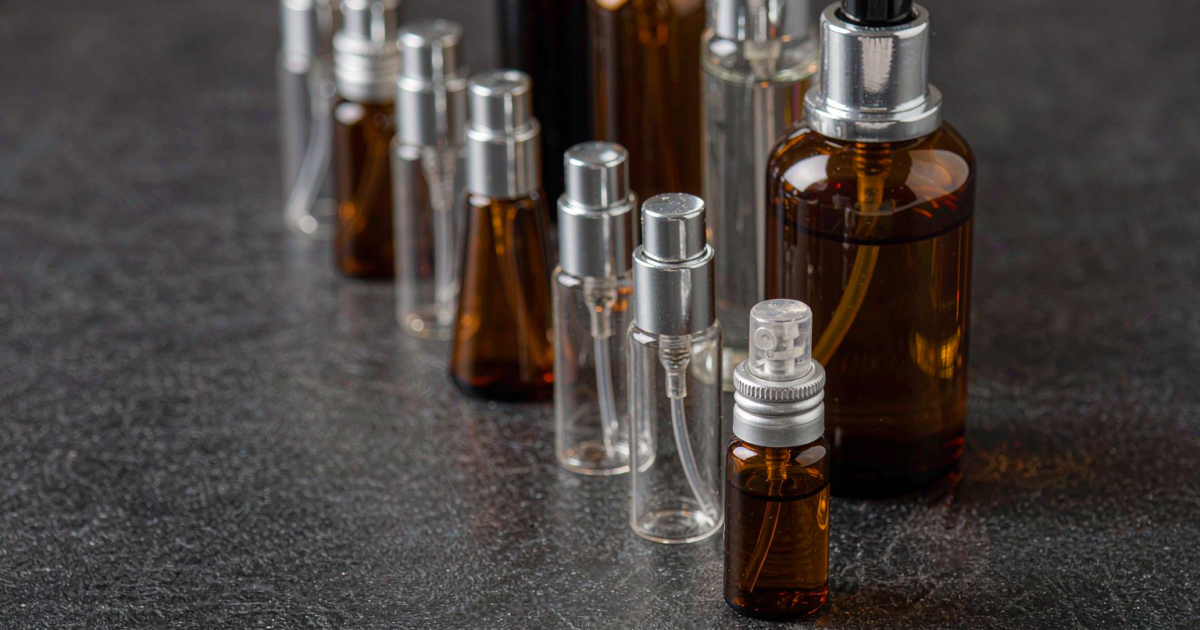
The smallest bottles in the fragrance industry have quietly become its fastest-moving segment. Between discovery sets, travel retail, subscription boxes, and the social media habit of showing off a shelf of miniatures, the 5–15ml range has grown from an afterthought on the price list into a standalone sourcing category with its own economics, its own component chain, and its own failure modes. Buyers who treat a 10ml bottle as “just a smaller 50ml” routinely run into problems the 50ml never presents: pump compatibility, filling losses, decoration limits, and transit breakage rates that look nothing like the big bottles.
This guide covers the wholesale side of mini and travel perfume bottles: what each size in the 5–15ml range is actually used for, how spray and roll-on formats differ at small volumes, what MOQ and pricing look like when the bottle holds less than a shot glass, which decoration techniques still work on small glass, and the packing rules that keep a carton of miniatures from arriving as a carton of shards. The goal is that by the end, you can brief a supplier on a mini format line as precisely as you would on a flagship 100ml flacon.
The 5–15ml Range at a Glance
Each size in the mini range has settled into a distinct commercial role. The boundaries are not regulation — they are the accumulated logic of filling costs, consumer behavior, and courier rules.
| Size | Primary use | Typical format | Business role |
|---|---|---|---|
| 3–5ml | Discovery/sample vials, gift-with-purchase | Splash, roll-on, mini spray | Customer acquisition, sampling programs |
| 8–10ml | Travel/ purse spray, subscription boxes | Pocket spray with atomizer | Repeat-purchase and add-on SKU |
| 12–15ml | Travel retail, boutique minis, layering sets | Mini spray, sometimes roll-on | Margin-rich companion product |
Two structural points jump out of that table. First, the smaller the bottle, the more it behaves like a marketing item and the less like a product — a 5ml vial’s job is to convert a customer, not to earn shelf margin. Second, the 10ml pocket spray is the workhorse of the range: small enough for airline rules and a handbag, large enough for dozens of uses, and cheap enough to price as an impulse buy. Much of what applies to 5ml sampling scales up to 10ml, and the trade-offs between the two sample sizes are compared in detail in our 5ml vs 10ml sample bottles guide.
5ml and Below: Sampling Economics
At 5ml and below, the bottle’s cost is dominated not by the glass but by the closure and the filling process. A 5ml glass vial is cheap; a 5ml vial with a functional crimp atomizer is several times the cost of the vial alone, because the pump is the same precision component that goes on a 50ml bottle. This is why many sampling programs use splash or roll-on formats at 3–5ml and reserve sprays for 8ml and up.
Filling economics matter more than buyers expect. On a 5ml fill, every fraction of a milliliter lost to the filler’s dead space or to foaming is a real percentage of the product. Filling accuracy of ±0.1ml, negligible on a 100ml line, is ±2% on a 5ml vial — and cosmetic overfill or underfill becomes visible through the glass. Sampling programs therefore specify fill volume, tolerance, and visual fill line expectations in writing, and trial the fill on the actual vial before committing to tens of thousands of units.
There is also a regulatory nuance: in several markets, tiny formats ride under labeling thresholds that larger formats cannot, but “sample” status does not exempt a sold product from ingredient labeling. Sampling SKUs sold for money need the same compliant labeling as the flagship, just smaller — and miniature labels are a design discipline of their own.
The 10ml Pocket Spray: Component Chain in Miniature
A 10ml travel spray is, mechanically, a full-size atomizer compressed into a small body. The pump, collar, dip tube, and actuator are essentially the same hardware as a 50ml bottle’s; only the glass shrinks. That asymmetry drives the two defining constraints of the format.
The first constraint is glass-to-pump geometry. Mini bottles leave very little room above the shoulder, so the pump’s dip tube length, the collar height, and the inner neck dimensions must match to fractions of a millimeter. A dip tube cut for a deep 50ml base will bottom out or hover uselessly in a 10ml body. This is why serious suppliers match minis to pumps they have validated together, and why mixing components across suppliers at mini scale fails far more often than at 50ml scale. The vocabulary here — crimp sizes, finish dimensions — is the same one covered in our crimp vs screw-on pump guide.
The second constraint is fill headspace. A 10ml bottle filled with 10ml of liquid has no expansion room and no priming space for the pump. Practical fills run 8–9.5ml depending on the pump’s priming volume, and buyers should confirm the rated capacity versus the usable fill in the spec sheet, not on the label. The mismatch between nominal and usable volume is the single most common complaint in travel-spray sourcing.
Roll-On vs Spray at Mini Scale
Below roughly 10ml, the roll-on format becomes genuinely competitive with the spray rather than a budget alternative. A roll-on consists of a glass body, a glass or steel ball, and a screw cap — no pump, no dip tube, no priming losses. That simplicity shows up in three ways.
Cost: without the atomizer, a roll-on’s component cost is a fraction of a spray’s, which matters most exactly where unit budgets are smallest. Product loss: a spray’s priming charge (the liquid that stays in the pump and is lost when the consumer discards the bottle) is proportionally punishing at 5ml, while a roll-on delivers nearly everything. Application: oils and lighter body fragrances suit ball application, and many sampling programs prefer it for control.
The flip side: roll-ons read as body-product rather than fragrance-product in many consumers’ minds, and the spray gesture is part of what sells a perfume. The format trade-offs are unpacked in our article on when roll-on bottles beat sprays. Many brands solve this by running both: a roll-on for oils and sampling, a spray for the travel line.
MOQ and Pricing Realities at Mini Scale
The intuitive assumption — small bottle, small price, small MOQ — is half wrong. Small bottles are cheaper per unit, but the MOQ logic does not shrink with the glass, because the MOQ is set by the decoration run and the component order, not the glass volume.
A stock 10ml cylinder in clear glass with a stock spray can be sourced in the low thousands and sometimes below, which is why mini formats have become the entry point for indie brands testing a fragrance — a dynamic covered in our low MOQ sourcing guide. But add a custom color spray, a printed logo, and a colored cap, and the MOQ rises to cover the spray booth setup and the cap supplier’s minimum, often matching or exceeding the MOQ of a larger bottle with the same decoration stack. The decoration cost per unit also inflates at small sizes: a one-color print occupies the same screen and the same setup whether it goes on 5ml or 50ml of glass, so its per-unit share of cost is far higher on the mini.
Pricing follows a simple rule of thumb worth internalizing: below 10ml, the closure and decoration dominate the quote; the glass is nearly free. Buyers optimizing hard on bottle price at mini scale are optimizing the wrong 20% of the cost. The productive negotiation is on the combined glass-plus-closure-plus-decoration package, and on honest volume breaks — the techniques covered in negotiating MOQ with suppliers.
Decoration on Small Glass: What Still Works
Small glass is less forgiving canvas. Three techniques survive the scale change well; several popular ones do not.
silk screen printing works down to vial size and remains the default for minis — a single small logo prints cheaply and durably. Hot foil stamping also scales down cleanly and is the workhorse for premium minis. Frosting and spraying work, with the caveat that on a 10ml body a full-surface color changes the perceived volume and can make fill levels hard to read. What struggles: multi-color prints (registration tolerances do not shrink with the bottle), fine typography (anything below roughly 6pt becomes illegible after curing), and complex gradient effects, whose technique and costs are covered in our gradient color guide. The practical design brief for a mini is one strong graphic element, not a scaled-down version of the flagship’s artwork — minis read at arm’s length and at gift-shop lighting, not at vanity-table distance.
One more decoration decision specific to minis: where to put the mandatory information. Compliant ingredient and safety labeling often cannot fit on a 5ml bottle at legal legibility, so brands either use an accordion booklet label or put compliance on the outer carton. Decide this before tooling and sampling, not after — it affects carton design and sometimes the bottle’s printable area.
Packing and Transit: The Breakage Problem
Miniatures break at higher rates than large bottles in transit, and the reasons are mechanical. Small bottles have thinner absolute glass walls, they rattle in cartons sized for larger voids, and their low individual value tempts everyone in the chain toward under-spec packaging. A carton of 10ml sprays is also, per shipped liter, mostly air and dividers — which makes carton count and freight class surprising.
The countermeasures are unglamorous and effective: cell dividers or molded pulp trays rather than loose packing, fill voids so bottles cannot shift, and a transit test before the first big shipment — the same ISTA-style logic applied to full-size packaging in our ISTA 3A testing guide. One added wrinkle at mini scale: pressurized pump bottles are subject to air-freight restrictions on filled aerosol-adjacent goods, so most travel sprays ship empty and are filled at destination. Confirm with your forwarder which configurations they accept; the rules on filled small sprays are stricter than on the same volume in a splash vial.
Compliance Notes Buyers Miss
Three regulatory points apply with unusual force to the mini segment. First, child-resistance and safety closures: several markets apply CR requirements to certain product categories regardless of size, and a pretty screw cap on a 5ml vial may need to be more than pretty depending on destination and product type. Second, labeling: as noted above, sold minis need full compliance labeling, and the carton often becomes the label carrier. Third, the EU’s packaging rules are tightening on all formats, and while miniatures are exempted from some requirements, the direction of travel is clear — the framework is summarized in our EU packaging regulations overview. None of these points is exotic, but all of them are cheaper to design in than to retrofit after a customs hold.
FAQ
What MOQ should I expect for 10ml travel spray bottles wholesale?
For a stock 10ml cylinder in clear glass with a stock pump and no custom decoration, MOQs in the 1,000–3,000 unit range are realistic, and some suppliers go lower on mixed-carton sampling orders. Custom decoration — a printed logo, colored spray, or custom cap color — typically raises the MOQ to 5,000+ because screen setup and cap minimums do not scale down with bottle size. The decoration stack, not the glass, sets the MOQ floor.
Can I put the same pump on a 10ml bottle as on my 50ml bottle?
Usually no. Even when the neck finish matches (both crimp 13/415, for example), the dip tube length and the pump’s priming volume must suit the mini’s shallow body. Pumps designed for deep 50ml bottles draw poorly or bottom out in 10ml bodies. Source the mini and its pump as a validated pair from one supplier, and test fill, prime, and spray behavior on real assembled units before mass production.
Are roll-on bottles cheaper than mini sprays?
Yes, significantly at small sizes. A roll-on replaces the pump, collar, and dip tube with a ball and screw cap, cutting the closure cost by half or more — and at 5ml the closure is the majority of unit cost. The trade-off is consumer perception: sprays read as “perfume,” roll-ons read as “body product or oil.” Many brands run roll-ons for oil-based and sampling SKUs and sprays for the alcohol-based travel line.
How much liquid does a “10ml” travel spray actually hold?
Less than 10ml in practice. The rated capacity is the total vessel volume; the usable fill leaves headspace for pump priming and thermal expansion, typically 8–9.5ml depending on the pump design. Confirm both the rated capacity and the recommended fill volume in the supplier’s spec sheet, and set consumer-facing claims against the fill volume, not the vessel volume — regulators and reviewers check the former against the latter.
What is the best size to start a discovery set with?
Most successful discovery sets use 3x2ml, 5x2ml, or 4x5ml splash or mini-spray vials — enough for several wears of each scent, cheap enough that the set prices as an acquisition tool rather than a product, and small enough that shipping weight stays trivial. The strategic role of the set is to convert buyers to a full bottle, so the vials should showcase the fragrances honestly and carry a redemption mechanic toward the full size. The commercial logic of the small-format segment is covered further in our travel size opportunity analysis.

