Most bottle pages tell you the capacity, the weight and the carton count. This one will not, and the reason is worth explaining, because it says something about how stock catalogues actually work.
The wx-12 is a measured mould — we hold it, we can shoot it, we can sample from it, and it is in the current stock batch — but it is one of a group of SKUs where the packing sheet was never completed for the fields a buyer needs: fill volume, empty weight, pieces per carton, carton dimensions. The neck is recorded as 15 mm crimp or screw, confirmed at quotation. Everything else in that block is blank on the sheet.
We could invent plausible numbers. A rectangular flask of this proportion is usually 50 or 100 ml, weighs something in the 180–280 g range and packs 50–70 to a carton, and a marketing page written on those assumptions would read perfectly. It would also be wrong for at least some buyers, and you would discover it after paying for a sample. So this page gives you the shape, the tooling status, the decoration options and the closure decision, and flags every unmeasured field as confirm on quote, with the exact measurement we will take.
wx-12 Specifications
| Item | Specification |
|---|---|
| Model | wx-12 |
| Fill capacity | Confirm on quote — measured per mould |
| Neck finish | 15 mm crimp or screw — variant confirmed on quote |
| Bottle weight | Confirm on quote |
| Glass | Clear flint soda-lime glass |
| Body shape | Rectangular flask, thick walls, heavy base, rounded vertical edges |
| Units per carton | Confirm on quote |
| Gross weight per carton | Confirm on quote |
| Carton dimensions | Confirm on quote |
| Cap and pump | Quoted separately — 15 mm crimp or screw pump, plated collar, overcap |
| Height / diameter / drawing | Issued with the quotation |
That is an honest table rather than a thin one: four of the eight fields are real, one is a binary choice we can supply either way, and three are measurements we will take off the mould when you ask.
The Profile: A Rectangular Flask With a Heavy Base
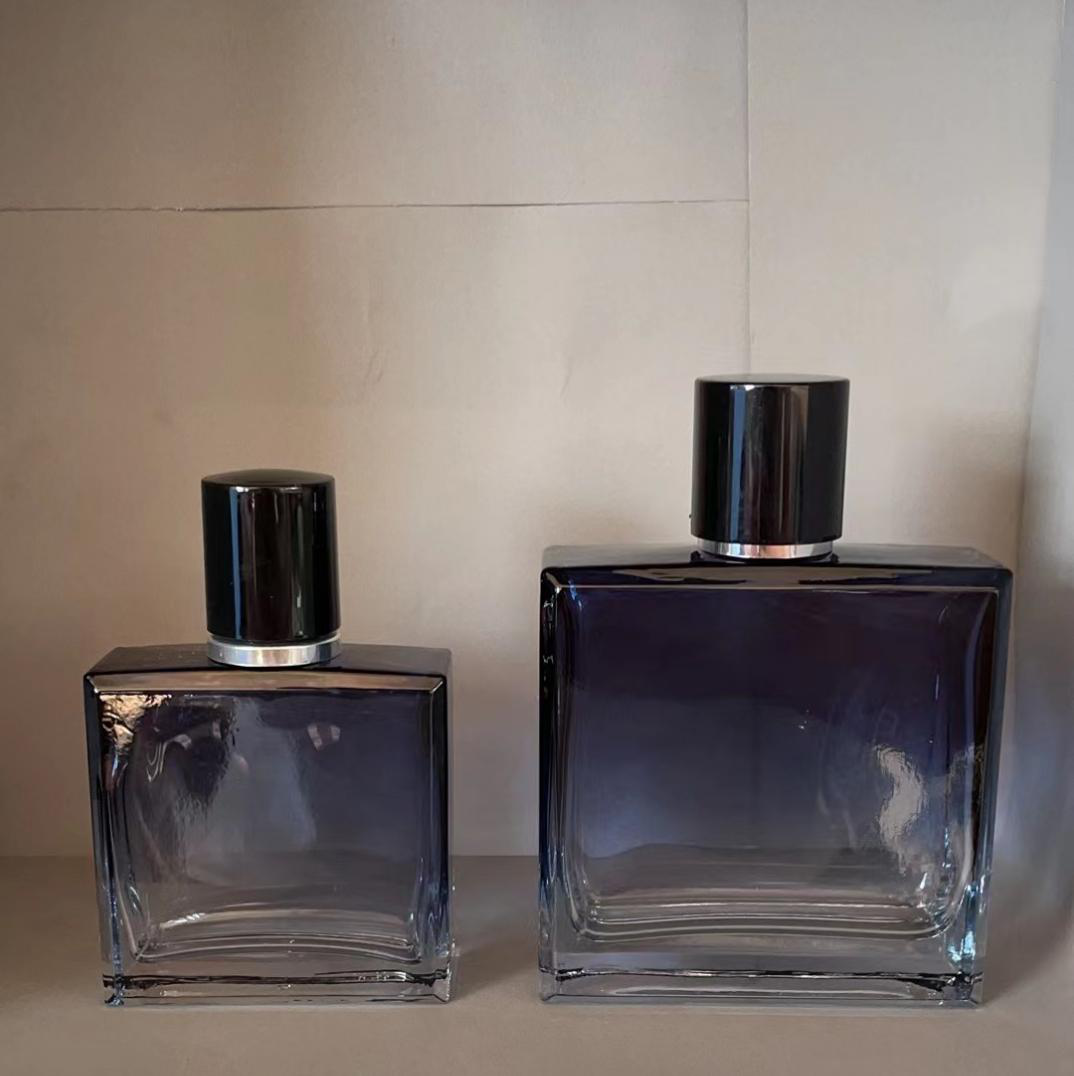
The stock photo is clear enough to design from. The body is a rectangular flask — flat front and back panels, a near-square elevation, vertical edges rounded on a moderate radius so the corners catch a highlight rather than reading sharp. The shoulder is close to horizontal with a small step into a wide, short neck. At the bottom, the glass thickens into a substantial slab: in the photo the base band is visibly two to three times the wall thickness, and the liquid sits above it.
The closure in the photo is a glossy black cylinder seated on a bright plated collar, which is the arrangement most buyers use on this shape — the collar does the luxury signal, the cap does the colour. The photo shows two sizes of the family side by side, both on the same geometry with the same collar and cap treatment; the fill volume of each is confirmed at quotation.
That heavy base is the design asset. On a rectangular body it does two things: it puts a dark, dense line of glass at the foot of the bottle, which is what the eye reads as quality, and it lowers the centre of gravity so a tall flat bottle does not tip when it is picked up by the cap. The principle and its limits are covered in perfume bottle base thickness and heavy base perfume bottles.
Suits: unisex and gender-neutral ranges, woody and amber fragrances, men’s EDT where a rectangular flask is the default language, private label and white label programmes, and brands that want a classic rectangular silhouette with the option of a screw neck for refill. Design references in men’s perfume bottle design language and gender-neutral fragrance packaging.
What We Confirm at Quotation
This is the list we send back with your quote, and it is worth knowing what we will ask you, because two of the answers are yours to give:
We measure and confirm:
- Fill capacity, measured to the intended fill line rather than brim-full, since the two differ by 5–10% depending on the neck.
- Empty bottle weight, weighed on a calibrated scale from the current batch.
- Pieces per carton, gross weight and carton dimensions from the actual packing used on the line.
- Which neck variant is available in current stock — crimp, screw, or both — and the mould number for each.
- Height, body width, depth and neck bore, as a dimensioned drawing.
You decide:
- The volume you intend to fill, which drives the capacity confirmation. If you need 50 ml and the mould lands at 55 ml to the fill line, that is fine — the label governs, not the glass.
- Whether the closure is crimp (sealed, single-use, tamper-evident) or screw (refillable, openable, needs a liner and a torque spec).
- The decoration, because the finish can affect the carton count if it changes handling between the decoration line and packing.
Turnaround on that confirmation is one to two working days for measurements we can take in the warehouse, longer if you need a fresh drawing from the tooling file. A physical sample of the current batch ships faster than the drawing, in most cases.
Why Blank Fields Happen, and Why It Matters to You
Stock catalogues are built for production, not for marketing. The fields that matter on the factory floor are the mould number, the neck, and whether the body runs on a given line — capacity and carton data get filled in when a customer asks, because they are only needed at quotation. On a catalogue of 117 bottle bodies, the blanks accumulate: about 51 SKUs in our current sheet are missing at least one field, most commonly the neck finish or the packing data.
The practical consequence for a buyer is that a page like this is not a red flag, it is a signal about which numbers you can trust. Where we publish a figure, it is measured and we stand behind it — the wx-26 at 289 g, the wx-67’s 84-piece carton, the wx-27’s 108 g. Where we publish “confirm on quote”, we are telling you that the sheet is incomplete and that we would rather take the measurement than repeat the gap. If you are comparing suppliers and one of them has a complete spec table for a mould they have never run, ask them for a photo of the actual bottle on a scale. That question separates a stock list from a wish list.
Decoration on a Rectangular Flask
Flat panels are the friendliest print surface in glass packaging, and this body has two of them:
- silk screen printing — distortion-free registration on a flat face, up to three or four colours. This is the default and the cheapest per unit at volume. See the silk screen guide.
- Hot foil stamping — flat glass takes foil cleanly with no wrinkling at the edges, so a gold or silver mark on this body reads sharp. See gold foil stamping.
- Frosted / acid etched — a satin etch on a rectangular body reads as stone and suits the heavy base particularly well. See frosted glass perfume bottles.
- Spray coating — solid colour, or a two-tone with a clear window masked over the front panel; the vertical corner radius gives you a natural mask line. See two-tone spray coating.
- Vacuum metallization — flat faces plate evenly; expensive on a small unit, used for a premium tier or a limited edition. See vacuum metallization.
- Laser engraving — the flat face and the base take engraving well; useful for batch codes and personalisation. Compare in laser engraving versus screen printing.
- Labels — a practical first step before print tooling, with the cost and durability trade in label versus direct print.
On a body where the capacity is still to be confirmed, one process point matters: decoration samples are made from production glass, so we will not quote a decoration price until we have confirmed the body weight and carton. Coating is priced per square metre of surface and printing per impression, and both depend on the final dimensions.
Closures: Crimp or Screw, Both Listed
The sheet records this SKU as available with a 15 mm crimp or a 15 mm screw neck, with the stock variant confirmed at quotation. That is a useful position to be in, because it lets the closure decision follow the business model rather than the mould:
- Crimp — the pump is sealed onto the neck. Tamper-evident, leak-tight in transit, standard for retail, and the bottle cannot be refilled or opened by the customer.
- Screw — the pump can be removed. Required for refill programmes, decant-at-counter service, and travel formats where the customer tops up from a larger bottle. Needs a liner and a defined torque value on the filling line, and it is not tamper-evident unless you add a band.
The mechanics and the failure modes of each are set out in crimp versus screw pumps and refillable bottle systems. Neck standards and what 15 mm actually means in practice are covered in 13/415 versus 15/415 and perfume bottle neck sizes.
Accessories from the same stock batch: 15 mm crimp and screw pumps in gold, silver and black electroplated aluminium, plated and ABS collars, and cylindrical or square overcaps in aluminium, ABS and zamac. The black glossy cylinder in the photo is a stock overcap style; cap materials are compared in zamac vs surlyn vs ABS and cap types in perfume bottle cap types. Pump output, 0.1 or 0.15 ml per stroke, is compared in spray pump output.
Compare by Shape, Not by Volume
Because the capacity is unconfirmed, the honest way to shortlist against this body is by silhouette. If you want a rectangular flask at a known volume, start from a measured SKU and use the wx-12 as the alternate: the wx-3 100 ml and xf-19 100 ml are both rectangular bodies with published weight and packing data, and the wx-2 50 ml covers the smaller format. If the heavy-base look is what you are buying rather than the rectangle, the wx-26 100 ml carries 289 g of glass in a flat flask and is fully measured.
The pricing relationship across sizes is covered in 30ml vs 50ml vs 100ml, and the commercial case for a stock mould over a bespoke one is in mold cost and OEM versus ODM.
MOQ, Samples and Lead Time
No tooling charge — the mould exists. Clear samples ship from the current batch within days of the capacity being confirmed, because we send the sample and the measurement together. A decorated sample takes 7–15 days from artwork approval; glass production is 15–25 days after golden-sample sign-off, plus decoration.
MOQ depends on the finish rather than the glass: clear, undecorated orders can start at trial-carton quantities; coating and printing carry setup minimums. See low MOQ perfume bottles and perfume bottle pricing explained.
Request a quote for the wx-12 with the volume you intend to fill, your decoration, crimp or screw, and destination port. We will return the measured capacity and weight, the carton data, the drawing, and a unit price built on those numbers — not on an assumption.
FAQ
What is the capacity of the wx-12?
Not confirmed on our current sheet, so we will not quote a figure. Ask for it with your enquiry and we measure it to the intended fill line, then send the number with the sample. Treat any published capacity you find elsewhere for this mould with suspicion until it is measured.
Is the neck crimp or screw?
Both are listed for this model, with the stock variant confirmed at quotation. Choose crimp for a sealed retail unit, screw for a refillable or decant format.
Why does this page have so many “confirm on quote” fields?
Because the packing sheet for this SKU is incomplete — roughly 51 of the 117 bodies in our catalogue are missing at least one field. We publish only measured data and flag the rest rather than filling a table with plausible guesses.
Can I get a sample before committing?
Yes. A clear sample from the current batch ships quickly, and we send the measured capacity and weight with it so you can validate the fill and the label fit at the same time.
How fast can this be produced?
Glass production runs 15–25 days after golden-sample sign-off, plus decoration time. The quotation itself, including measurements and drawing, takes one to two working days for data we can take in the warehouse.
Product pages are being published - check back shortly.